
Triangle Congruence
Loading the math board and drawing, please wait…
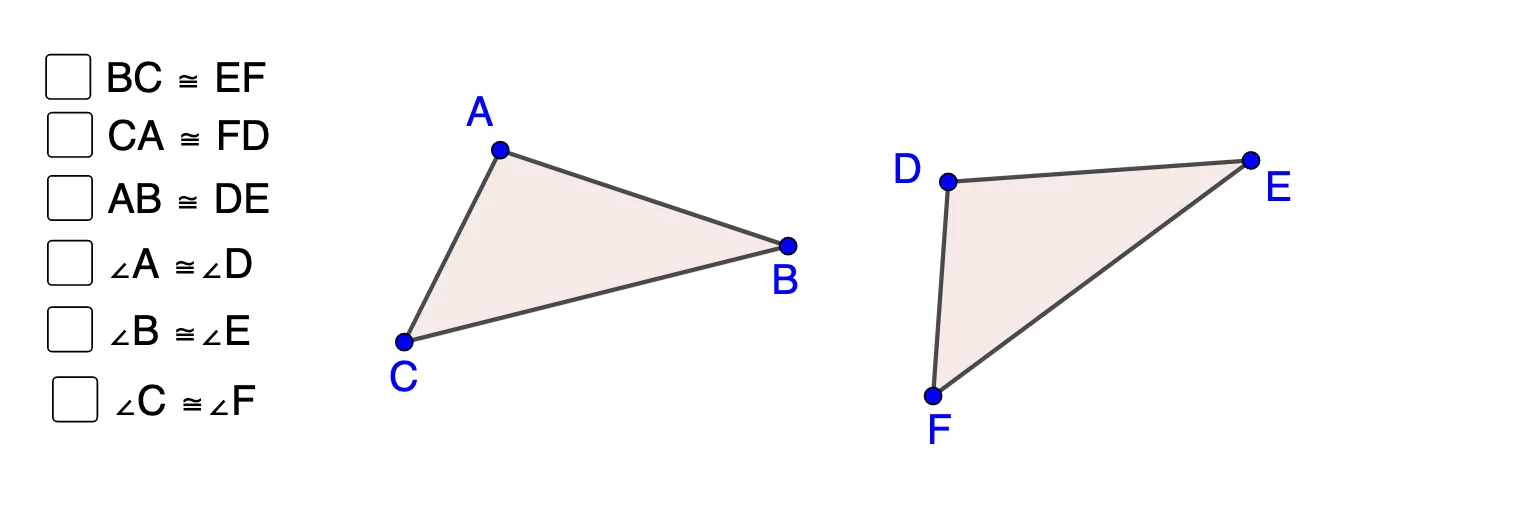
This example demonstrates the criteria for concluding triangles are congruent. Using GeoGebra commands such as Polygon, Rotate, and Dilate, it visually illustrates the geometric transformations and proof methods for congruent triangles. Suitable for middle and high school students learning about geometric transformations and congruence of triangles.
GeoGebra Commands & Parameters
Polygon(A, B, C) → t1, c, a, bCentroid(t1) → DRotate(A, (π * p), D) → A'Rotate(B, (π * p), D) → B'Rotate(C, (π * p), D) → C'Dilate(Translate[A', (d, 0)], e, D) → A''Polygon(A', B', C') → t1', c', a', b'Dilate(Translate[B', (d, 0)], e, D) → B''Dilate(Translate[C', (d, 0)], e, D) → C''Polygon(A'', B'', C'') → t1'', c'', a'', b''Segment(A, B) → lSegment(B, C) → mSegment(C, A) → nSegment(A'', B'') → p_1Segment(B'', C'') → qSegment(C'', A'') → rAngle(C, A, B) → αAngle(A, B, C) → βAngle(B, C, A) → γAngle(C'', A'', B'') → δAngle(A'', B'', C'') → εAngle(B'', C'', A'') → ζ
AI Drawing Prompt Reference
Draw a triangle, then rotate it 180 degrees about its centroid to form a second triangle. Translate the second triangle horizontally and dilate it about the centroid to create a third triangle. Label the sides and angles of the first and third triangles to show corresponding congruent parts, illustrating triangle congruence criteria.
The prompt above was compiled from the original drawing commands and is for reference only.