
Triangle Classification and Interior/Exterior Angle Sum Proof
Loading the math board and drawing, please wait…
In collections
Properties of Polygons
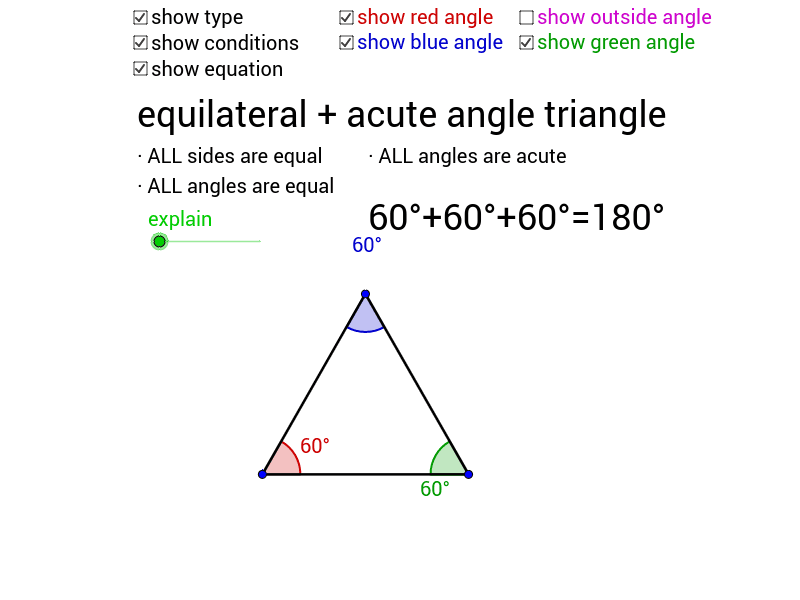
This GeoGebra example demonstrates how to name and classify triangles—equilateral, isosceles, right, and scalene—while dynamically proving that the interior angle sum is 180° and the exterior angle sum is 360°. Core mathematical concepts include triangle taxonomy, planar angle relationships, and the interior and exterior angle-sum theorems. The construction uses GeoGebra commands such as If, Vector, Line, Angle, Rotate, Polygon, and Segment, along with objects including points A, B, C, P, Q, R, S, T, angles α, β, γ, polygon poly1, and text labels text4 and text14. Through vector translation and rotation, angles are assembled to visually verify their sums. Suitable for middle school geometry instruction, high school review, and interactive self-study in Euclidean plane geometry.
GeoGebra Commands & Parameters
If((0 ≤ n) ∧ (n < 1), n, 1) → PIf((1 ≤ n) ∧ (n ≤ 2), n - 1, 1) → QIf(P < 1, 0, Q) → RIf((2 ≤ n) ∧ (n ≤ 3), n - 2, 1) → SIf(R < 1, 0, S) → TVector(D, A) → uLine(C, D) → bLine(A, C) → cAngle(C, A, D) → αLine(D, A) → fAngle(F, E, G) → βVector(C, A) → vRotate(A, (P * 180)°, C) → JRotate(D, (P * 180)°, C) → IAngle(J, L, M) → γPolygon(C, A, D) → poly1, d_1, c_1, a_1Segment(G, A) → eAngle(C, A, G) → δ