
Tree Growth Iteration
Loading the math board and drawing, please wait…
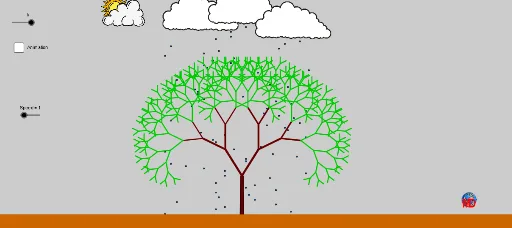
This example demonstrates the growth of a tree through iteration, showcasing the branching structure. Key mathematical concepts include sequences and iteration. Using commands like Branche_2, Segment, Branche3, Polygon, Line, etc., the branching structure of a tree can be constructed. Suitable for middle school and above students to learn geometric construction and the concept of iteration.
GeoGebra Commands & Parameters
Branche_2(A, B, k, t) → C, D, e, f, E, F, G, H, a, b, c, dSegment(B, A) → gBranche_2(C, E, k, t) → I, J, m, n, K, L, M, N, h, i, j, lBranche_2(C, F, k, t) → O, P, a1, b1, Q, R, S, T, p, q, r, sBranche_2(D, G, k, t) → U, V, g1, h1, W, Z, A1, B1, c1, d1, e1, f1Branche_2(D, H, k, t) → C1, D1, m1, n1, E1, F1, G1, H1, i1, j1, k1, l1Branche3(k, t, P, S) → p1, q1, f2, g2, h2, i2, j2, k2, l2, m2, n2, p2, r1, q2, r2, s2, t2, a3, b3, c3, d3, e3, f3, s1, t1, a2, b2, c2, d2, e2Branche3(k, t, O, R) → g3, h3, r3, s3, t3, a4, b4, c4, d4, e4, f4, g4, i3, h4, i4, j4, k4, l4, m4, n4, p4, q4, r4, j3, k3, l3, m3, n3, p3, q3Branche3(k, t, O, Q) → s4, t4, i5, j5, k5, l5, m5, n5, p5, q5, r5, s5, a5, t5, a6, b6, c6, d6, e6, f6, g6, h6, i6, b5, c5, d5, e5, f5, g5, h5Branche3(k, t, J, N) → j6, k6, a7, b7, c7, d7, e7, f7, g7, h7, i7, j7, l6, k7, l7, m7, n7, p7, q7, r7, s7, t7, a8, m6, n6, p6, q6, r6, s6, t6Branche3(k, t, J, M) → b8, c8, l8, m8, n8, p8, q8, r8, s8, t8, a9, b9, d8, c9, d9, e9, f9, g9, h9, i9, j9, k9, l9, e8, f8, g8, h8, i8, j8, k8Branche3(k, t, I, L) → m9, n9, d10, e10, f10, g10, h10, i10, j10, k10, l10, m10, p9, n10, p10, q10, r10, s10, t10, a11, b11, c11, d11, q9, r9, s9, t9, a10, b10, c10Branche3(k, t, I, K) → e11, f11, p11, q11, r11, s11, t11, a12, b12, c12, d12, e12, g11, f12, g12, h12, i12, j12, k12, l12, m12, n12, p12, h11, i11, j11, k11, l11, m11, n11Branche3(k, t, P, T) → q12, r12, g13, h13, i13, j13, k13, l13, m13, n13, p13, q13, s12, r13, s13, t13, a14, b14, c14, d14, e14, f14, g14, t12, a13, b13, c13, d13, e13, f13Branche3(k, t, U, W) → h14, i14, s14, t14, a15, b15, c15, d15, e15, f15, g15, h15, j14, i15, j15, k15, l15, m15, n15, p15, q15, r15, s15, k14, l14, m14, n14, p14, q14, r14Branche3(k, t, V, A1) → t15, a16, j16, k16, l16, m16, n16, p16, q16, r16, s16, t16, b16, a17, b17, c17, d17, e17, f17, g17, h17, i17, j17, c16, d16, e16, f16, g16, h16, i16Branche3(k, t, V, B1) → k17, l17, b18, c18, d18, e18, f18, g18, h18, i18, j18, k18, m17, l18, m18, n18, p18, q18, r18, s18, t18, a19, b19, n17, p17, q17, r17, s17, t17, a18Branche3(k, t, C1, E1) → c19, d19, m19, n19, p19, q19, r19, s19, t19, a20, b20, c20, e19, d20, e20, f20, g20, h20, i20, j20, k20, l20, m20, f19, g19, h19, i19, j19, k19, l19Branche3(k, t, C1, F1) → n20, p20, e21, f21, g21, h21, i21, j21, k21, l21, m21, n21, q20, p21, q21, r21, s21, t21, a22, b22, c22, d22, e22, r20, s20, t20, a21, b21, c21, d21Branche3(k, t, D1, G1) → f22, g22, q22, r22, s22, t22, a23, b23, c23, d23, e23, f23, h22, g23, h23, i23, j23, k23, l23, m23, n23, p23, q23, i22, j22, k22, l22, m22, n22, p22Branche3(k, t, D1, H1) → r23, s23, h24, i24, j24, k24, l24, m24, n24, p24, q24, r24, t23, s24, t24, a25, b25, c25, d25, e25, f25, g25, h25, a24, b24, c24, d24, e24, f24, g24Branche3(k, t, U, Z) → i25, j25, t25, a26, b26, c26, d26, e26, f26, g26, h26, i26, k25, j26, k26, l26, m26, n26, p26, q26, r26, s26, t26, l25, m25, n25, p25, q25, r25, s25Polygon(E_1, D_1, B_1, C_1) → poly1, e_1, d_1, b_1, c_1Line(A, B_1) → a_1Point(a_1) → F_1Point(a_1) → G_1Polygon(G_1, F_1, 4) → poly2, g_1, f_1, h_1, i_1, H_1, I_1Sequence(((Random[-38, 10] * 0.6) + (0 * o), 32 - (i * o)), i, 0, 13, 0.1) → liste1
AI Drawing Prompt Reference
Draw a tree structure that grows through iteration, showcasing branching patterns. Start with a trunk and extend two main branches upward, each main branch further splits into two secondary branches, repeating this process recursively. Use lines of varying thickness and color to represent different levels of branches, connecting the base to a square and terminal ends of branches to circular nodes, creating a dynamic upward growth effect.
The prompt above was compiled from the original drawing commands and is for reference only.