
Trapezoid Rule: Dynamic Numerical Integration Demo
Loading the math board and drawing, please wait…
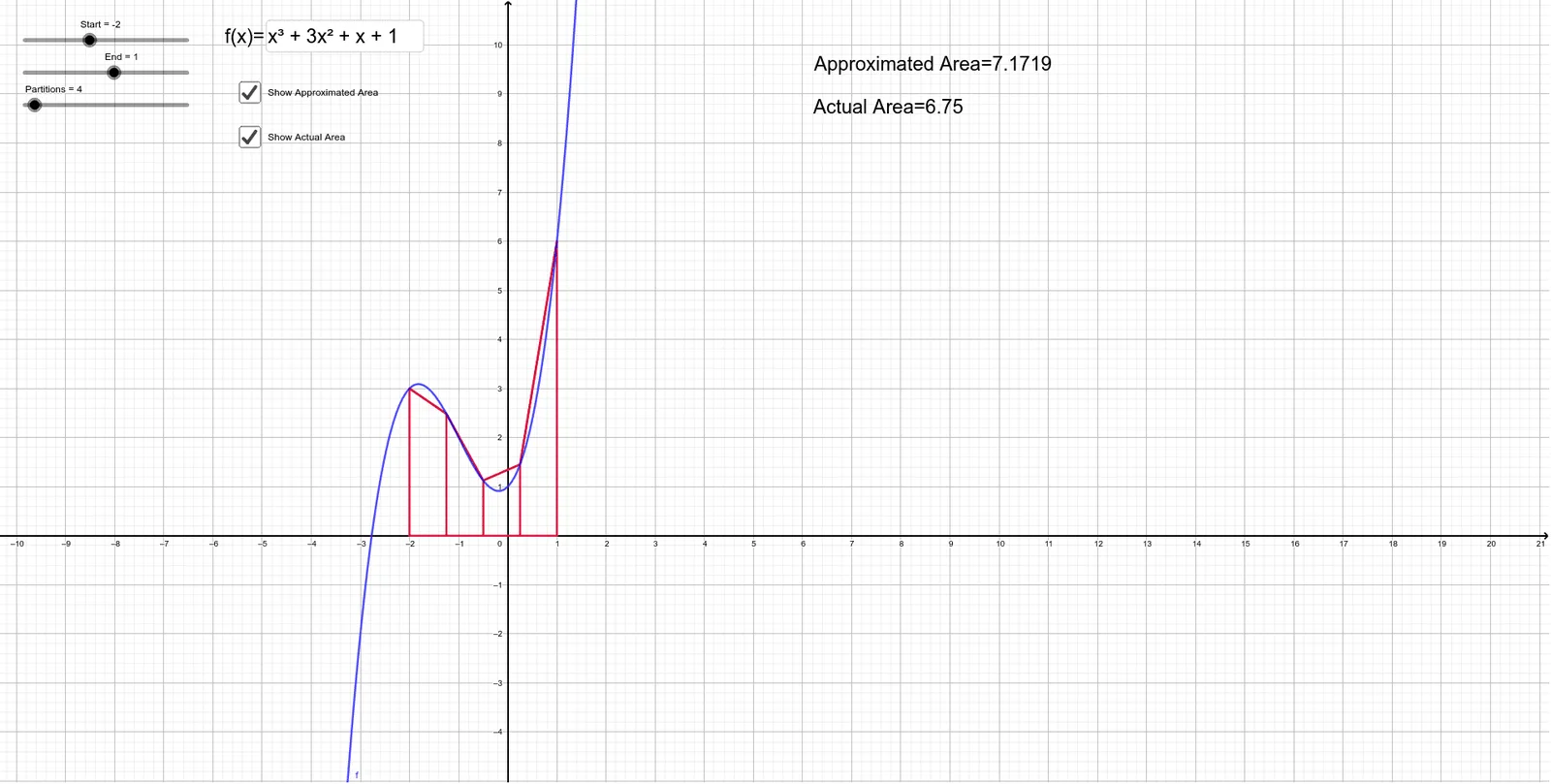
This GeoGebra example dynamically demonstrates how the Trapezoid Rule approximates a definite integral by summing areas of trapezoids under a continuous function. Core mathematical concepts include numerical integration, Riemann sums, linear approximation, interval partitioning, and the geometric mean. The construction uses commands such as Sequence to generate partition points, Sum to accumulate trapezoid areas, Integral to compute the exact value, and Textfield/InputBox for interactive inputs. Users can adjust endpoints a, b and the number of partitions via sliders or input boxes, observing how the approximation converges to the exact integral. Suitable for high school advanced calculus or introductory university calculus courses, this tool helps visualize the error behavior and the effect of increasing partition count.
GeoGebra Commands & Parameters
Sequence((i, 0), i, Start, End, (End - Start) / Partitions) → l1Sequence((i, 0), i, Start, End, (End - Start) / Partitions) → l2Sequence((i, f(i)), i, Start, End, (End - Start) / Partitions) → l3Sequence(Segment[(i, 0), (i, f(i))], i, Start, End, (End - Start) / Partitions) → l4Sequence(Segment[(i, f(i)), (i + (End - Start) / Partitions, f(i + (End - Start) / Partitions))], i, Start, End - (End - Start) / Partitions, (End - Start) / Partitions) → l5Sequence(Segment[(i, f(i)), (i + (End - Start) / Partitions, f(i + (End - Start) / Partitions))], i, Start, End - (End - Start) / Partitions, (End - Start) / Partitions) → l6Sequence(Segment[(i, 0), (i + (End - Start) / Partitions, 0)], i, Start, End - (End - Start) / Partitions, (End - Start) / Partitions) → l7Sum(f(Start + (D * i)), i, Partitions - (Partitions - 1), Partitions - 1) → BIntegral(f, Start, End) → IntegralTextfield(f) → InputBox1