
Trapezoid Midsegment Dynamic Demonstration
Loading the math board and drawing, please wait…
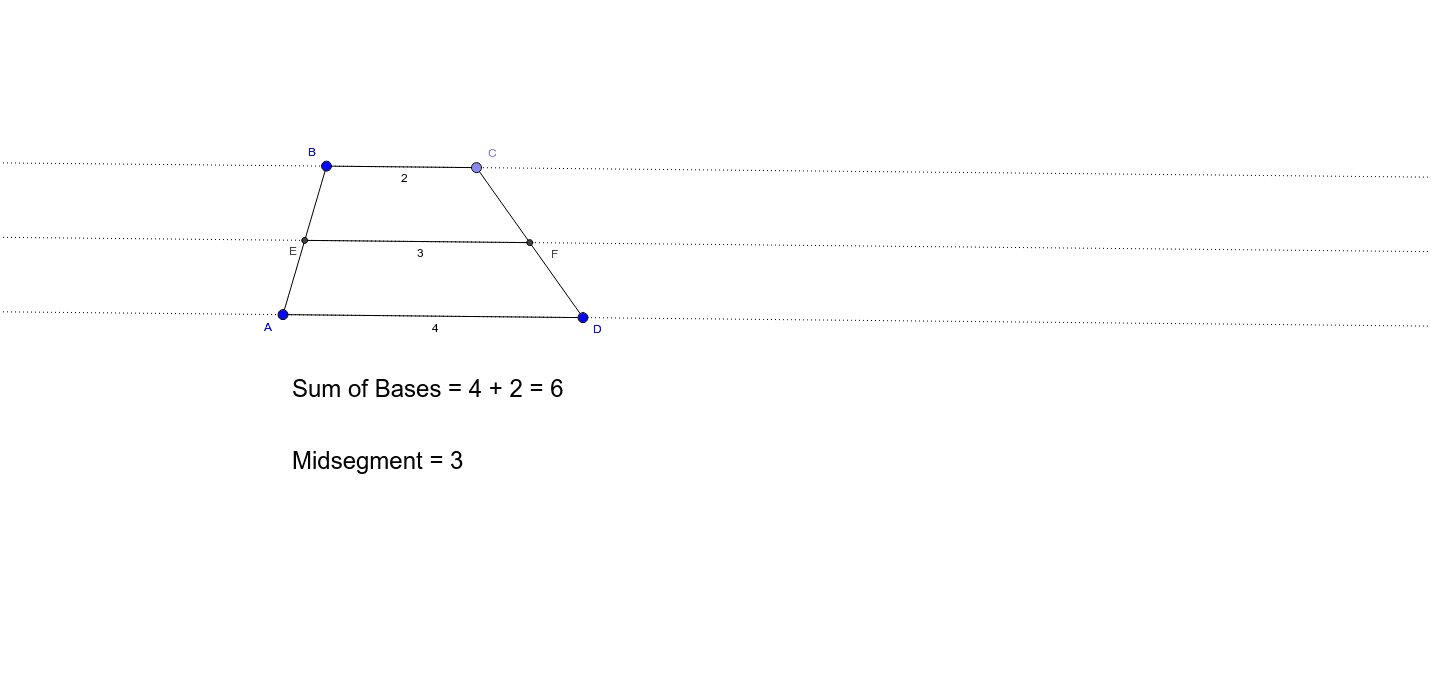
① This GeoGebra example dynamically demonstrates the trapezoid midsegment (the segment connecting the midpoints of the two legs), showing that it is parallel to both bases and its length equals half the sum of the base lengths. ② Core mathematical concepts include trapezoids, midsegments, parallel lines, midpoints of segments, and length relationships, involving polygon geometry and basic measurement. ③ Construction details: Using GeoGebra commands such as Segment, Line, Point, Angle, and Midpoint, the trapezoid vertices A, B, C, D, the midpoints E and F on the legs, and the midsegment EF are constructed; multiple angles (α, β, γ, δ, ε, ζ) and segments (a, b, c, d, e, f, g, h, i, j) are labeled, along with a text object text1 for displaying measurements or explanations. ④ Suitable for middle school geometry teaching or self-study, to understand the trapezoid midsegment theorem, and as an interactive exploration tool to drag vertices and observe how the midsegment length changes relative to the bases.
GeoGebra Commands & Parameters
Segment(A, D) → aSegment(A, B) → bLine(B, a) → cPoint(c) → CSegment(D, C) → dSegment(B, C) → eAngle(D, A, B) → αAngle(A, B, C) → βAngle(B, C, D) → γAngle(C, D, A) → δMidpoint(A, B) → EMidpoint(D, C) → FSegment(E, F) → fLine(B, C) → hLine(E, F) → iLine(A, D) → j
AI Drawing Prompt Reference
Draw a dynamic trapezoid to demonstrate its midsegment (the segment connecting the midpoints of the legs), showing it is parallel to both bases and its length equals half the sum of the base lengths. Label the vertices, midpoints of the legs, and the midsegment, along with multiple angles and segments to illustrate the midsegment theorem and length relationships, suitable for teaching and interactive exploration.
The prompt above was compiled from the original drawing commands and is for reference only.