
Trapezoid Median: 2 'Proofs' Without Words
Loading the math board and drawing, please wait…
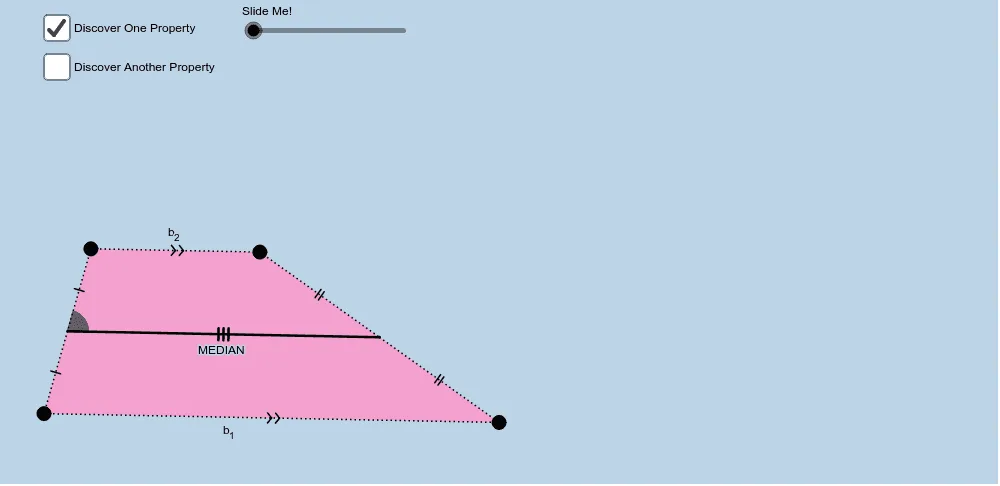
This example demonstrates the properties and proofs of a trapezoid's median through dynamic geometry, visually showing the median's parallelism to the bases and its length being half that of the bases. Core mathematical concepts include parallel lines, congruent triangles, trapezoid properties, and geometric transformations. Construction involves commands like Ray, Segment, Line, Point, Polygon, Midpoint, Rotate, Circle, Intersect, CircleSector, Dilate, Vector, Translate to build the trapezoid and median, with rotations and dilations verifying the properties. Suitable for high school mathematics education to understand geometric proofs and transformation concepts.
GeoGebra Commands & Parameters
Ray(A, B) → aSegment(A, B) → bLine(C, b) → cPoint(c) → DRay(C, D) → dPoint(d) → ESegment(C, A) → eSegment(C, E) → fSegment(E, B) → gPolygon(A, B, E, C) → poly1, a_1, b_1, e_1, c_1Midpoint(e) → FMidpoint(g) → GSegment(F, G) → hRotate(A, (-α), G) → A'Rotate(B, (-α), G) → B'Rotate(E, (-α), G) → E'Rotate(C, (-α), G) → C'Polygon(A', B', E', C') → poly1', a', b', e', c'Rotate(F, (-α), G) → F'Rotate(G, (-α), G) → G'Segment(F', G') → h'Segment(B', A') → iSegment(A', C') → jSegment(C', E') → kSegment(E', B') → lSegment(C, F) → mSegment(F, A) → nSegment(E, G) → pSegment(G, B) → qSegment(C', F') → rSegment(F', A') → sLine(C, A) → tCircle(F, 1) → f_1Intersect(f_1, h, 1) → JIntersect(t, m) → KIntersect(t, m) → LIntersect(f_1, t) → M, NCircleSector(F, J, M) → h_1Dilate(F, 1 - o, A) → F'_1Dilate(F, 1 - o, C) → F'_2Vector(F, F'_2) → uVector(F, F'_1) → vTranslate(h_1, v) → k_1Translate(h_1, u) → p_1Dilate(F, If[0 < w ≤ 1, 1 - w, 0], C) → F'_3Vector(F, F'_3) → u_1Translate(G, u_1) → G'_1Segment(F'_3, G'_1) → d_1Dilate(F, If[1 < w ≤ 2, 2 - w, 0], C) → F'_4Vector(F, F'_4) → v_1Translate(F', v_1) → F''Translate(G, v_1) → G'_2Segment(G'_2, F'') → g_1
AI Drawing Prompt Reference
Draw a trapezoid and illustrate the properties of its median. Start by sketching the two parallel bases and the non-parallel sides. Identify the midpoints of the bases to locate the endpoints of the median, then connect them. Use rotations and dilations on parts of the median to demonstrate that it is parallel to the bases and half their length. The final image should clearly show these properties and geometric transformations.
The prompt above was compiled from the original drawing commands and is for reference only.