
Trapezoid and Its Properties
Loading the math board and drawing, please wait…
In collections
geometriadinamica.es
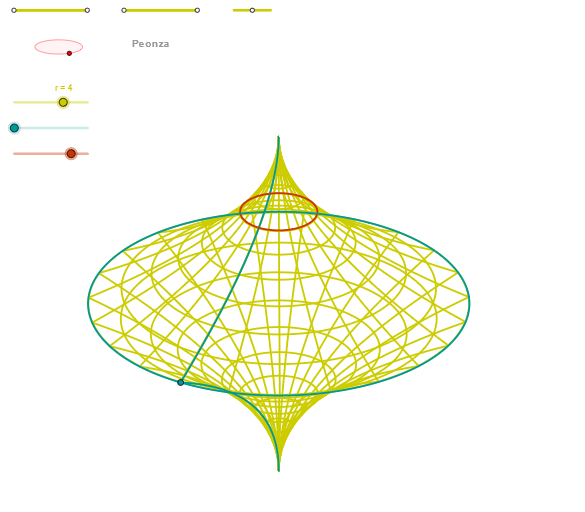
This example demonstrates a trapezoid and its statistical characteristics. It shows the geometric properties and statistical features of a trapezoid using commands such as line segment, point, orthogonal line, circle, intersection, ellipse, angle, etc. Suitable for students at middle school level and above to learn geometry and statistics.
GeoGebra Commands & Parameters
Segment(Q5, Q6) → p5Point(p5) → P5Segment(Q3, Q4) → p2Point(p2) → P3Segment(P3, Q4) → p4Point(p4) → P4Segment(Q1, Q2) → p1Point(p1) → P1Segment(P1, Q2) → p3Point(p3) → P2OrthogonalLine(C, xAxis) → zz2Circle(C, 0.62) → zz0Intersect(zz0, zz2, 1) → ZZ4Intersect(zz0, zz2, 2) → ZZ3Ellipse(ZZ3, ZZ4, 0.65) → zElipse2Point(zElipse2) → ZIntersect(zElipse2, zz2) → ZZ7, ZZ8Angle(ZZ8, C, Z) → zAngIncOrthogonalLine(C, yAxis) → zz1Intersect(zz0, zz1, 2) → ZZ2Intersect(zz0, zz1, 1) → ZZ1Ellipse(ZZ1, ZZ2, 0.65) → zElipse1Point(zElipse1) → XYIntersect(zElipse1, zz1) → ZZ5, ZZ6Angle(ZZ6, C, XY) → zAngRotSegment(ZZ5, ZZ6) → zz4Segment(ZZ7, ZZ8) → zz3Intersect(zElipse2, zElipse1, 1) → zPunto1Intersect(zElipse2, zElipse1, 4) → zPunto2Segment(zPunto1, zPunto2) → zSeg2CurveCartesian(((r * 1.3) * ((((abs(u) - 1)^(2) * cos(α)) * sin(zAngRot)) + (((abs(u) - 1)^(2) * sin(α)) * cos(zAngRot)))), ((1.3 * r) * (((((-(abs(u) - 1)^(2)) * cos(α)) * cos(zAngRot)) * sin(zAngInc)) + ((((abs(u) - 1)^(2) * sin(α)) * sin(zAngRot)) * sin(zAngInc)) + (u * cos(zAngInc)))), u, u1, u2) → curva2CurveCartesian(((r * 1.3) * ((((abs(β) - 1)^(2) * cos(v)) * sin(zAngRot)) + (((abs(β) - 1)^(2) * sin(v)) * cos(zAngRot)))), ((1.3 * r) * (((((-(abs(β) - 1)^(2)) * cos(v)) * cos(zAngRot)) * sin(zAngInc)) + ((((abs(β) - 1)^(2) * sin(v)) * sin(zAngRot)) * sin(zAngInc)) + (β * cos(zAngInc)))), v, v1, v2) → a1CurveCartesian(((r * 1.3) * ((cos(v) * sin(zAngRot)) + (sin(v) * cos(zAngRot)))), ((1.3 * r) * ((((-cos(v)) * cos(zAngRot)) * sin(zAngInc)) + ((sin(v) * sin(zAngRot)) * sin(zAngInc)))), v, v1, v2) → curva1Sequence(CurveCartesian[((r * 1.3) * ((((abs(u) - 1)^(2) * cos(v)) * sin(zAngRot)) + (((abs(u) - 1)^(2) * sin(v)) * cos(zAngRot)))), ((1.3 * r) * (((((-(abs(u) - 1)^(2)) * cos(v)) * cos(zAngRot)) * sin(zAngInc)) + ((((abs(u) - 1)^(2) * sin(v)) * sin(zAngRot)) * sin(zAngInc)) + (u * cos(zAngInc)))), v, v1, v2], u, u1, u2, paso) → list2Sequence(CurveCartesian[((r * 1.3) * ((((abs(u) - 1)^(2) * cos(v)) * sin(zAngRot)) + (((abs(u) - 1)^(2) * sin(v)) * cos(zAngRot)))), ((1.3 * r) * (((((-(abs(u) - 1)^(2)) * cos(v)) * cos(zAngRot)) * sin(zAngInc)) + ((((abs(u) - 1)^(2) * sin(v)) * sin(zAngRot)) * sin(zAngInc)) + (u * cos(zAngInc)))), u, u1, u2], v, v1, v2, (3 * paso)) → list1
AI Drawing Prompt Reference
Draw a trapezoid and label its sides and diagonals. Then, draw two orthogonal lines parallel to the x-axis and y-axis, centered at the trapezoid's center. Create two ellipses with this center, mark their intersections with the orthogonal lines, and connect these intersection points. Finally, draw two complex curves based on the intersection points and the center, forming intricate patterns.
The prompt above was compiled from the original drawing commands and is for reference only.