
Trapezoid and Isosceles Trapezoid Construction and Properties
Loading the math board and drawing, please wait…
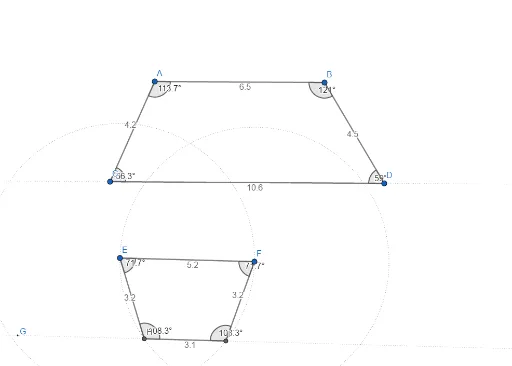
This GeoGebra example demonstrates the dynamic construction of a trapezoid and an isosceles trapezoid, highlighting their definitions and key properties. Core mathematical concepts include quadrilateral classification, parallel line properties, symmetry of isosceles trapezoids, equal base angles, and equal diagonals. Construction details: using commands such as Segment, Line, Point, Circle, Intersect, and Angle, points A and B and segment f are created first; then parallel lines g and h determine points C and D, forming sides i and j; circles and intersections enforce the isosceles condition, and angles α, β, γ, δ etc. are labeled for clarity. This resource is suitable for middle school geometry lessons, helping students intuitively grasp the criteria and properties of trapezoids and isosceles trapezoids, and can be used for exploratory learning or teacher demonstrations.
GeoGebra Commands & Parameters
Segment(A, B) → fLine(C, f) → gSegment(A, C) → hPoint(g) → DSegment(B, D) → iSegment(C, D) → jSegment(E, F) → kLine(G, k) → lCircle(E, F) → cCircle(F, E) → dIntersect(d, l, 1) → HIntersect(c, l, 2) → ISegment(E, H) → mSegment(F, I) → nSegment(H, I) → pAngle(F, E, H) → αAngle(H, I, F) → βAngle(I, F, E) → γAngle(E, H, I) → δAngle(A, C, D) → εAngle(D, B, A) → ζAngle(C, D, B) → ηAngle(B, A, C) → θ