
Trapezium Dimensions
Loading the math board and drawing, please wait…
In collections
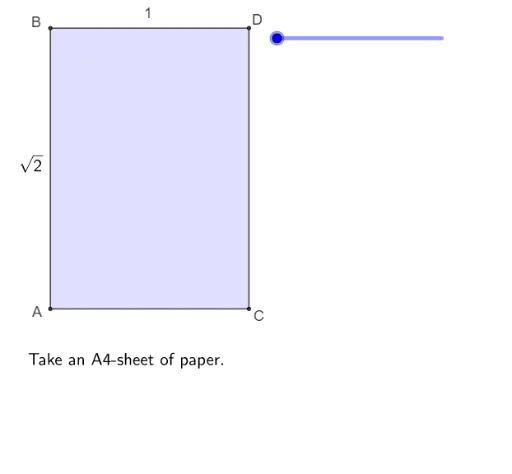
Folding paper, doing geometry figures
This example demonstrates the dimensions of a trapezium. Key mathematical concepts include the properties of trapeziums and geometric construction. Using GeoGebra commands such as Polygon, Midpoint, CircleArc, etc., the trapezium is constructed and the relationships between its sides and height are explored. Suitable for middle and high school students learning geometric construction and trapezium properties.
GeoGebra Commands & Parameters
Polygon(A, C, D, B) → vierhoek1, a, c, d, bMidpoint(B, D) → BDMidpoint(A, C) → FMidpoint(B, E) → GCircleArc(B, DD, D) → eSegment(B, E) → fPolygon(B, A, C, E) → vierhoek2, b_1, a_1, c_1, e_1Polygon(B, E, D) → driehoek1, d_1, b_2, e_2Rotate(B, (((-(s - 1)) * 180))°, e_1) → B'Rotate(E, (((-(s - 1)) * 180))°, e_1) → E'Rotate(D, (((-(s - 1)) * 180))°, e_1) → D'Polygon(B', E', D') → driehoek1', d', b', e'Polygon(DD, E, B) → driehoek2, b_3, dd, e_3Segment(G, F) → gPolygon(G, F, C, E) → vierhoek3, g_1, f_1, c_2, e_4Polygon(B, A, F, G) → vierhoek4, b_4, a_2, f_2, g_2Rotate(G, (((-(s - 3)) * 180))°, f_2) → G'Rotate(F, (((-(s - 3)) * 180))°, f_2) → F'Rotate(C, (((-(s - 3)) * 180))°, f_2) → C'Rotate(E, (((-(s - 3)) * 180))°, f_2) → E'_1Polygon(G', F', C', E'_1) → vierhoek3', g', f', c', e'_1Polygon(A, F, G, DD) → vierhoek5, a_3, f_3, g_3, dd_1Polygon(FE, A, F) → driehoek3, f_4, fe, a_4Segment(A, FA) → iRotate(FE, (((-(s - 5)) * 180))°, i) → FE'Rotate(A, (((-(s - 5)) * 180))°, i) → A'Rotate(F, (((-(s - 5)) * 180))°, i) → F'_1Polygon(B, A, FA, G) → vierhoek6, r, t, i_1, j_1Intersect(g_3, i) → HOrthogonalLine(H, g', xOyPlane) → jLine(BD, F) → nPoint(n) → KCircleArc(K, C, A) → pPolygon(G, H, F) → driehoek4, f_6, g_5, h_1Intersect(f_6, Line[FE, GG]) → JOrthogonalLine(H, b) → kCircleArc(A, F, FB) → hPolygon(A, F, FA) → driehoek5, fa, a_5, f_5Rotate(A, (((-(s - 5)) * 180))°, t) → A'_1Rotate(F, (((-(s - 5)) * 180))°, t) → F'_2Rotate(FA, (((-(s - 5)) * 180))°, t) → FA'Polygon(A'_1, F'_2, FA') → driehoek5', fa', a'_1, f'_2Line(DD, GG) → lIntersect(l, i) → IPolygon(G, DD, I, FA) → vierhoek7, g_4, dd_2, i_2, fa_1Line(FB, FA) → mIntersect(m, g_4) → MSegment(M, G) → qSegment(DD, I) → k_1Segment(DD, M) → l_1Segment(B, D) → m_1Segment(D, C) → n_1Segment(G, E) → p_1Segment(A, C) → q_1Segment(G, BD) → r_1Segment(F, FA) → s_1