
Translational Symmetry: Periodic Patterns via Vectors and Sequences
Loading the math board and drawing, please wait…
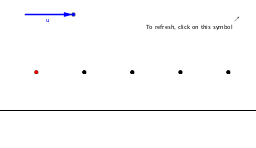
① This GeoGebra example demonstrates translational symmetry by repeating a base figure along a fixed vector, creating a periodic pattern. ② The core mathematical concepts include translation transformations, symmetry groups, and the use of modular arithmetic and sequences to generate repeated structures. ③ Construction highlights: Points (A, B, C, D, E, F) define the base shape, a vector u specifies the translation direction and magnitude, and commands like Mod and Sequence generate lists (list1, list2) of translated objects, with text1 providing annotations. ④ Suitable for middle school geometry or introductory abstract algebra, this example helps visualize translational symmetry groups and periodic tiling, and can be used in math art or pattern design lessons.
GeoGebra Commands & Parameters
Point(g) → FVector(A, F) → uMod(x(Corner[1]) - x(D), x(u)) → aMod(x(Corner[2]) - x(D), x(u)) → bSequence(D + (n * u), n, 1, d) → list1Sequence(D + (n * u), n, c, -1) → list2
AI Drawing Prompt Reference
Create a periodic pattern by repeating a base shape along a fixed direction. Start with a base figure defined by several key points, then set a translation vector indicating the direction and distance of each move. Copy the base shape multiple times along both the positive and negative directions of this vector, arranging them in a row to form a continuous, repeating strip or grid. The pattern should show clear translational symmetry, where each unit is obtained by the same shift. Include a slider to control the number of repetitions and display an annotation for the translation vector to help observe the generation rule.
The prompt above was compiled from the original drawing commands and is for reference only.