
Zig Zag: Vector-Based Polyline with Geometric Transformations
Loading the math board and drawing, please wait…
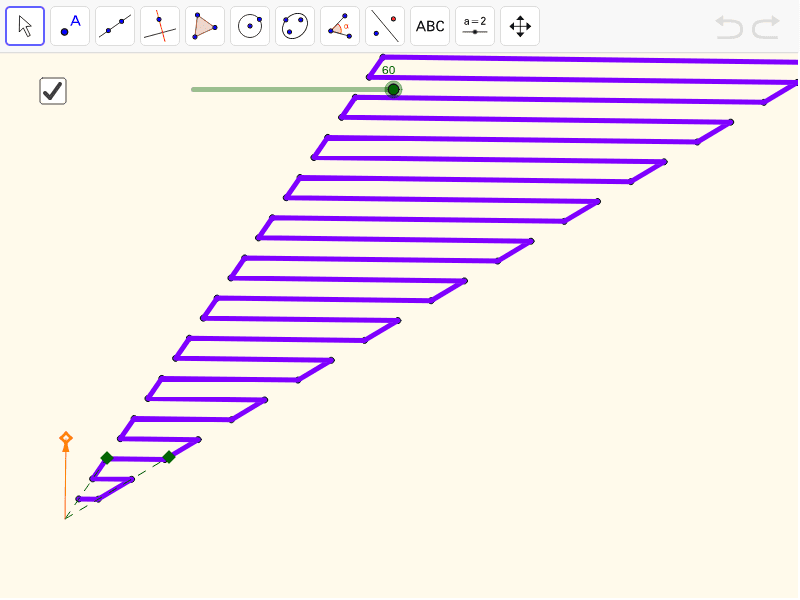
This example demonstrates a dynamic 'Zig Zag' pattern that starts from the origin and is constructed using vectors, orthogonal lines, and sequences, resulting in a polyline with adjustable parameters for intuitive control. The core mathematical concepts include 2D vectors, straight lines and perpendicularity, geometric transformations (such as translation and rotation), piecewise functions, and congruence. Construction highlights: using GeoGebra commands such as Vector, OrthogonalLine, Sequence, PolyLine, and Segment, with objects including points A, B, C, vector u, parameters m and n, and lists list1, bpts, apts, list4. The pattern is built by generating a sequence of points and connecting them with polylines, while orthogonal lines enforce right-angle relationships. Suitable for high school or early college students learning vectors, transformations, and dynamic geometry, and for exploring how parameter changes affect the shape, fostering visual intuition.
GeoGebra Commands & Parameters
Vector((0, 0), C) → uOrthogonalLine((0.25 * C), u) → cSequence(Translate[c, Vector[((0.25 * i) * u)]], i, 0, n) → list1Sequence(Intersect[b, Element[list1, i]], i, 1, n + 1) → bptsSequence(Intersect[a, Element[list1, i]], i, 1, n + 1) → aptsSequence(If[Mod[i, 4] ≟ 1, Element[apts, ceil(i / 2)], If[Mod[i, 4] ≟ 2, Element[bpts, ceil(i / 2)], If[Mod[i, 4] ≟ 3, Element[bpts, ceil(i / 2)], Element[apts, ceil(i / 2)]]]], i, 1, (2 * n)) → list4PolyLine(list4) → dSegment((0, 0), B) → eSegment((0, 0), A) → f
AI Drawing Prompt Reference
Create a Zig Zag pattern starting from the origin, controlled by vector u and parameter n. First, generate a vector u from point C, then create a series of orthogonal lines using u, and translate these lines along u to form a series of points. Use these points to construct the Zig Zag pattern. Finally, draw line segments from the origin to points A and B.
The prompt above was compiled from the original drawing commands and is for reference only.