
Translation Tessellation
Loading the math board and drawing, please wait…
In collections
Translation Tessellation
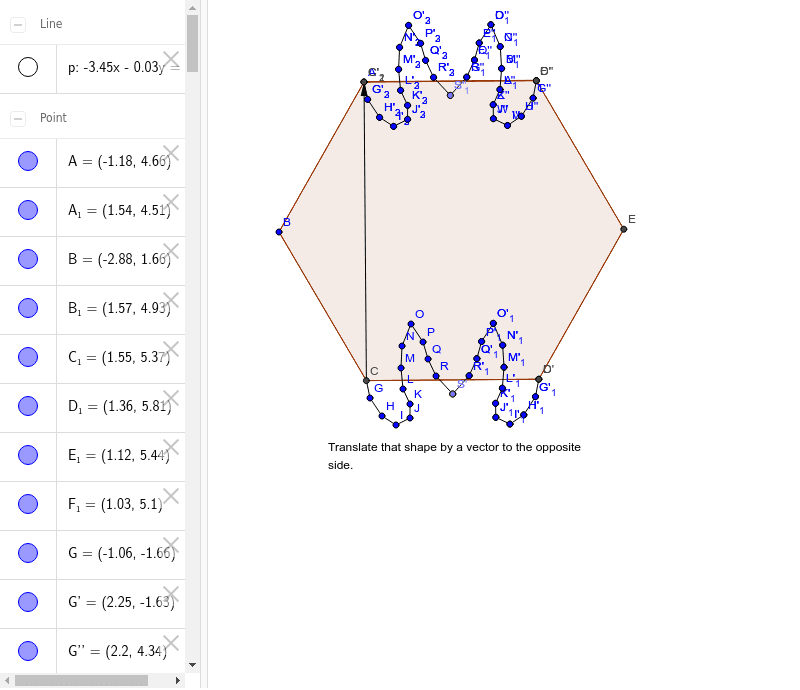
This example demonstrates the creation of a tessellation pattern using translation transformations. It involves core mathematical concepts such as translation, congruence, vector operations, and polygon construction. The construction utilizes commands like Polygon, Segment, LineBisector, Point, Mirror, Vector, and Translate. It is suitable for high school mathematics education to understand the principles of transformation geometry and the formation of tessellations.
GeoGebra Commands & Parameters
Polygon(A, B, 6) → poly1, a, F, b, c, d, e, f, C, D, ESegment(C, G) → gSegment(G, H) → hSegment(H, I) → iSegment(I, J) → jSegment(J, K) → kSegment(K, L) → lSegment(L, M) → mSegment(M, N) → nLineBisector(c) → pSegment(N, O) → qSegment(O, P) → rSegment(P, Q) → sSegment(Q, R) → tPoint(p) → SSegment(R, S) → a_1Mirror(C, p) → C'Mirror(G, p) → G'Segment(C', G') → g'Mirror(G, p) → G'_1Mirror(H, p) → H'Segment(G'_1, H') → h'Mirror(H, p) → H'_1Mirror(I, p) → I'Segment(H'_1, I') → i'Mirror(I, p) → I'_1Mirror(J, p) → J'Segment(I'_1, J') → j'Mirror(J, p) → J'_1Mirror(K, p) → K'Segment(J'_1, K') → k'Mirror(K, p) → K'_1Mirror(L, p) → L'Segment(K'_1, L') → l'Mirror(L, p) → L'_1Mirror(M, p) → M'Segment(L'_1, M') → m'Mirror(M, p) → M'_1Mirror(N, p) → N'Segment(M'_1, N') → n'Mirror(N, p) → N'_1Mirror(O, p) → O'Segment(N'_1, O') → q'Mirror(O, p) → O'_1Mirror(P, p) → P'Segment(O'_1, P') → r'Mirror(P, p) → P'_1Mirror(Q, p) → Q'Segment(P'_1, Q') → s'Mirror(Q, p) → Q'_1Mirror(R, p) → R'Segment(Q'_1, R') → t'Mirror(R, p) → R'_1Mirror(S, p) → S'Segment(R'_1, S') → b_1Vector(C, A) → uTranslate(C, u) → C'_1Translate(D, u) → D'Segment(C'_1, D') → c'Translate(C, u) → C'_2Translate(G, u) → G'_2Segment(C'_2, G'_2) → g'_1Translate(G, u) → G'_3Translate(H, u) → H'_2Segment(G'_3, H'_2) → h'_1Translate(H, u) → H'_3Translate(I, u) → I'_2Segment(H'_3, I'_2) → i'_1Translate(I, u) → I'_3Translate(J, u) → J'_2Segment(I'_3, J'_2) → j'_1Translate(J, u) → J'_3Translate(K, u) → K'_2Segment(J'_3, K'_2) → k'_1Translate(K, u) → K'_3Translate(L, u) → L'_2Segment(K'_3, L'_2) → l'_1Translate(L, u) → L'_3Translate(M, u) → M'_2Segment(L'_3, M'_2) → m'_1Translate(M, u) → M'_3Translate(N, u) → N'_2Segment(M'_3, N'_2) → n'_1Translate(N, u) → N'_3Translate(O, u) → O'_2Segment(N'_3, O'_2) → q'_1Translate(O, u) → O'_3Translate(P, u) → P'_2Segment(O'_3, P'_2) → r'_1Translate(P, u) → P'_3Translate(Q, u) → Q'_2Segment(P'_3, Q'_2) → s'_1Translate(Q, u) → Q'_3Translate(R, u) → R'_2Segment(Q'_3, R'_2) → t'_1Translate(R, u) → R'_3Translate(S, u) → S'_1Segment(R'_3, S'_1) → c_1Translate(C', u) → C''Translate(G', u) → G''Segment(C'', G'') → g''Translate(G'_1, u) → TTranslate(H', u) → H''Segment(T, H'') → h''Translate(H'_1, u) → UTranslate(I', u) → I''Segment(U, I'') → i''Translate(I'_1, u) → VTranslate(J', u) → J''Segment(V, J'') → j''Translate(J'_1, u) → WTranslate(K', u) → K''Segment(W, K'') → k''Translate(K'_1, u) → ZTranslate(L', u) → L''Segment(Z, L'') → l''Translate(L'_1, u) → A_1Translate(M', u) → M''Segment(A_1, M'') → m''Translate(M'_1, u) → B_1Translate(N', u) → N''Segment(B_1, N'') → n''Translate(N'_1, u) → C_1Translate(O', u) → O''Segment(C_1, O'') → q''Translate(O'_1, u) → D_1Translate(P', u) → P''Segment(D_1, P'') → r''Translate(P'_1, u) → E_1Translate(Q', u) → Q''Segment(E_1, Q'') → s''Translate(Q'_1, u) → F_1Translate(R', u) → R''Segment(F_1, R'') → t''Translate(R'_1, u) → G_1Translate(S', u) → S''Segment(G_1, S'') → d_1
AI Drawing Prompt Reference
Draw a hexagon and then construct its side bisectors, use these bisectors as mirrors to reflect the hexagon repeatedly, creating a translation tessellation pattern that demonstrates translation, congruence, vector operations, and polygon construction.
The prompt above was compiled from the original drawing commands and is for reference only.