
Translation Polygon
Loading the math board and drawing, please wait…
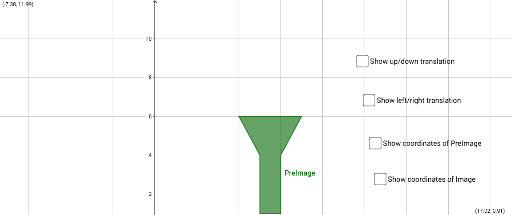
This example demonstrates the process and result of translating a polygon in a plane, involving core concepts like translation, vectors, polygon construction, and linear equations. It uses commands such as Polygon, Point, Line, Vector, and Translate in GeoGebra. Suitable for high school students learning geometric transformations, vectors, and coordinate geometry.
GeoGebra Commands & Parameters
Polygon(A, B, C, D, E, F) → PreImage, a, b, c, d, e, fPoint(yAxis) → GLine(G, H) → gPoint(yAxis) → JVector(J, I) → uTranslate(A, u) → A'Translate(B, u) → B'Translate(C, u) → C'Translate(D, u) → D'Translate(E, u) → E'Translate(F, u) → F'Polygon(A', B', C', D', E', F') → Image2, a', b', c', d', e', f'Vector(K, L) → vTranslate(A, v) → A'_1Translate(B, v) → B'_1Translate(C, v) → C'_1Translate(D, v) → D'_1Translate(E, v) → E'_1Translate(F, v) → F'_1Polygon(A'_1, B'_1, C'_1, D'_1, E'_1, F'_1) → Image1, a'_1, b'_1, c'_1, d'_1, e'_1, f'_1
AI Drawing Prompt Reference
Draw a hexagon and then translate it using two parallel vectors to demonstrate the process and result of translation, highlighting core concepts like vectors, polygon construction, and linear equations. First, draw the original hexagon, then show two translated hexagons using the same vectors, connecting corresponding points with lines to clearly illustrate the translation relationships.
The prompt above was compiled from the original drawing commands and is for reference only.