
Three Numbers Board
Loading the math board and drawing, please wait…
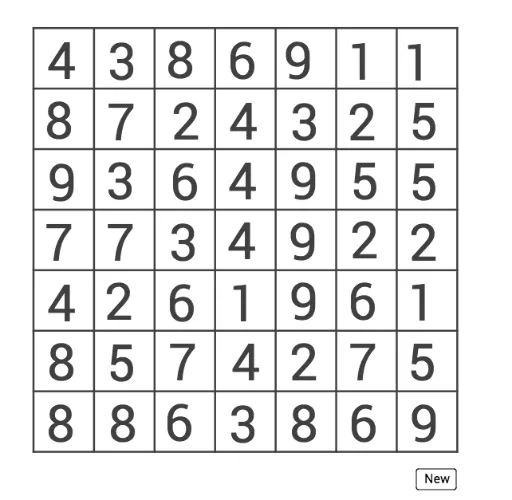
This example demonstrates a 3x3 matrix containing 36 numbers, which can be randomly shuffled to show number distribution. Core math concepts include Probability & Statistics, Sequence, and Combinatorics. GeoGebra commands used are Shuffle, Element, and Sequence, with objects A1 to A36. Suitable for high school mathematics teaching, particularly for demonstrating probability distributions and random events.
GeoGebra Commands & Parameters
Shuffle(L) → list2Element(list2, 1) → aElement(list2, 2) → bElement(list2, 3) → cElement(list2, 4) → dElement(list2, 5) → eElement(list2, 6) → fElement(list2, 7) → gElement(list2, 8) → hElement(list2, 9) → iElement(list2, 10) → jElement(list2, 11) → kElement(list2, 12) → lElement(list2, 13) → mElement(list2, 14) → nElement(list2, 15) → oElement(list2, 16) → pElement(list2, 17) → qElement(list2, 18) → rElement(list2, 19) → sElement(list2, 20) → tElement(list2, 21) → uElement(list2, 22) → vElement(list2, 23) → wElement(list2, 24) → a_1Element(list2, 25) → b_1Element(list2, 25) → c_1Element(list2, 26) → c_2Element(list2, 28) → d_1Element(list2, 29) → e_1Element(list2, 30) → f_1Element(list2, 31) → g_1Element(list2, 32) → h_1Element(list2, 33) → i_1Element(list2, 34) → j_1Element(list2, 35) → k_1Element(list2, 36) → l_1Element(list2, 37) → m_1Element(list2, 38) → n_1Element(list2, 39) → o_1Element(list2, 40) → p_1Element(list2, 41) → q_1Element(list2, 42) → r_1Element(list2, 43) → s_1Element(list2, 44) → t_1Element(list2, 45) → u_1Element(list2, 46) → v_1Element(list2, 47) → v_2Element(list2, 48) → v_3Element(list2, 49) → v_4Sequence(Segment[(n, 0), (n, 7)], n, 0, 7) → L1Sequence(Segment[(0, m), (7, m)], m, 0, 7) → L2