
Thebault’s Theorem
Loading the math board and drawing, please wait…
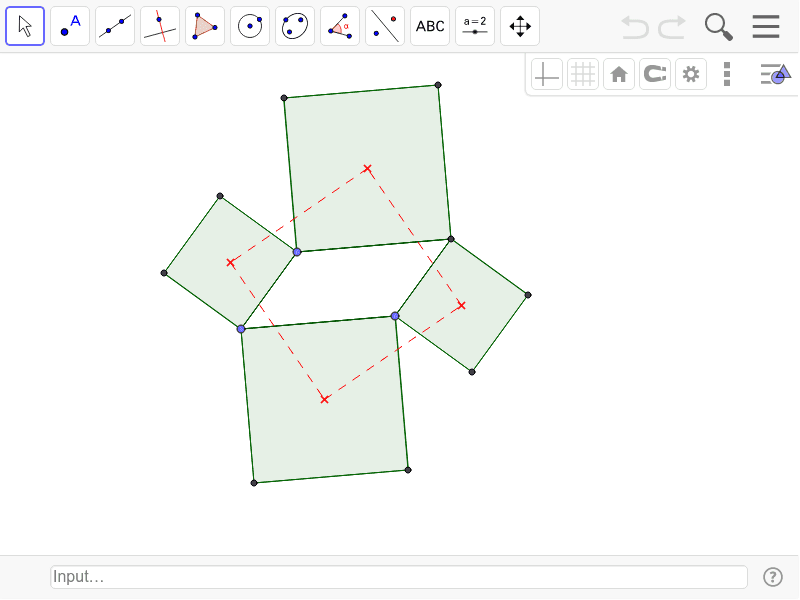
This example demonstrates Thebault's Theorem, involving properties of parallelograms, squares, means, random experiments, incircles, correlation, and linear functions. Key math concepts include parallelogram properties, means inequality, inscribed circles, and linear functions. Construction highlights use of GeoGebra commands/objects like Segment, Line, Intersect, Polygon, and Midpoint. Suitable for high school and above learners exploring complex geometric theorems.
GeoGebra Commands & Parameters
Segment(A, B) → aSegment(A, D) → bLine(D, a) → cLine(B, b) → dIntersect(c, d) → CSegment(D, C) → eSegment(B, C) → fPolygon(B, A, 4) → poly1, g, h, i, j, E, FPolygon(A, D, 4) → poly2, k, l, m, n, G, HPolygon(D, C, 4) → poly3, p, q, r, s, I, JPolygon(C, B, 4) → poly4, t, a_1, b_1, c_1, K, LMidpoint(F, A) → MMidpoint(A, G) → NMidpoint(D, I) → OMidpoint(B, L) → PSegment(M, P) → d_1Segment(P, O) → e_1Segment(O, N) → f_1Segment(N, M) → g_1