
The Distance from a Point on the Perpendicular Bisector to the Endpoints of a Li
Loading the math board and drawing, please wait…
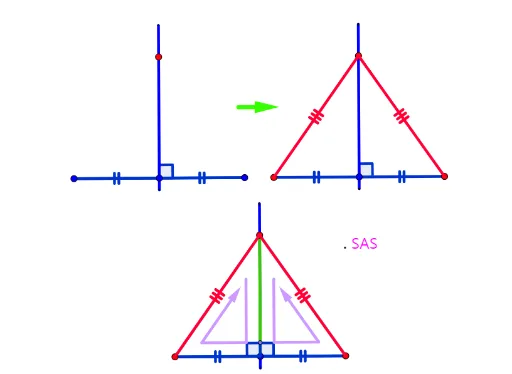
This example demonstrates that the distance from a point on the perpendicular bisector to the endpoints of a line segment is equal. Key mathematical concepts include perpendicular bisector and distance. The construction uses GeoGebra commands such as Segment, Midpoint, OrthogonalLine, etc. Suitable for students at the junior high school level and above for geometric construction.
GeoGebra Commands & Parameters
Segment(B, C) → aMidpoint(a) → C_1OrthogonalLine(C_1, a) → bPoint(b) → A_1Ray(B, C) → cPoint(c) → EVector(B, E) → uTranslate(B, u) → A_2Translate(C, u) → B'Translate(A_1, u) → ASegment(A_2, B') → dRay(A_1, C) → nRay(A, E) → qIntersect(n, q) → JVector(A, J) → wTranslate(A_2, w) → KTranslate(B', w) → B''_1Segment(K, B''_1) → d'Translate(A_2, w) → LTranslate(A, w) → A'_1Translate(A, w) → A'_2Translate(B', w) → B''_2Translate(A, w) → A'_3Translate(E, w) → E'Translate(A, w) → A'Translate(B', w) → B''AngularBisector(E', A'_3, B'') → a_1Intersect(a_1, d') → MOrthogonalLine(B'', d') → q_1Point(q_1) → WOrthogonalLine(A_1, a) → ePoint(e) → DPoint(e) → FPoint(a) → GVector(G, E) → vTranslate(D, v) → D'_1Translate(D, v) → D'_2Translate(F, v) → F'_1Translate(A_1, v) → HVector(A_1, A'_3) → fTranslate(F, f) → F'Translate(D, f) → D'Segment(D, A_1) → gSegment(D'_2, H) → hSegment(D', A'_3) → kPoint(a) → IIntersect(a, g) → NIntersect(d, h) → OSegment(I, N) → lSegment(N, C) → mSegment(E, O) → pSegment(O, B') → rSegment(E', M) → b_{15}Segment(M, B'') → d_1Segment(E, F'_1) → e_1Segment(B', F'_1) → f_1Segment(E', F') → g_1Segment(F', B'') → h_1Angle(C, N, F) → αAngle(B', O, F'_1) → βAngle(B'', M, F') → γMidpoint(A_1, D) → PMidpoint(D'_2, H) → QMidpoint(P, Q) → RSegment(P, Q) → i_1Point(i_1) → SCircle(R, S) → k_1Intersect(k_1, i_1, 2) → TVector(T, S) → u_1Vector(T, S) → v_1Segment(E', F') → j_1Segment(B'', F') → l_1Segment(M, F') → m_1Point(k) → UCircle(U, M) → p_1OrthogonalLine(U, g_1) → r_1Intersect(p_1, r_1, 1) → VVector(U, V) → w_1Intersect(r_1, g_1) → ZTranslate(Z, w_1) → Z'OrthogonalLine(Z', g_1) → s_1Line(Z', g_1) → t_1Line(U, d') → a_2Intersect(p_1, a_2, 1) → B_1Line(B_1, k) → b_{14}Intersect(t_1, b_{14}) → E_1Intersect(t_1, a_2) → F_1Intersect(k, m_1) → G_1Segment(E_1, F_1) → c_2Point(c_2) → D_1Mirror(E_1, k) → H_1Mirror(D_1, k) → I_1Mirror(B_1, k) → J_1Mirror(F_1, k) → K_1Segment(E_1, B_1) → d_2Segment(B_1, F_1) → e_2Segment(H_1, J_1) → g_2Segment(J_1, K_1) → h_2Vector(F_1, D_1) → z_1Vector(K_1, I_1) → u_2Angle(F', M, E') → δ
AI Drawing Prompt Reference
Draw a line segment, find its midpoint, and construct the perpendicular bisector. Take a point on the bisector and show that its distances to the endpoints of the segment are equal. Start by drawing the segment and bisector, then mark a point on the bisector, connect it to the endpoints, and demonstrate triangle congruence. Use rotations and translations to verify the equal distances.
The prompt above was compiled from the original drawing commands and is for reference only.