
Tetrahedron n=4: Polyhedra with Extreme Distribution of Equivalent Vertices
Loading the math board and drawing, please wait…
In collections
₈Polyhedra with extreme distribution of equivalent vertices
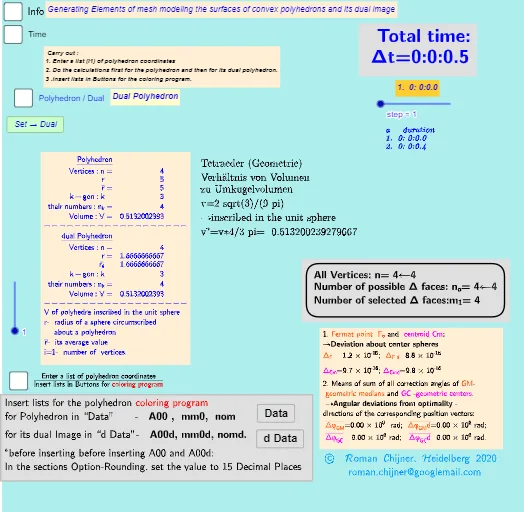
① This example demonstrates how to construct a family of polyhedra based on a regular tetrahedron (n=4) to explore extreme distributions of equivalent vertices, visualizing how volume, circumsphere radius, and other geometric quantities vary with parameters. ② Core mathematical concepts include centroid (barycenter), volume computation, circumscribed and inscribed spheres, geometric mean, linear programming optimization, and uniform distribution of discrete points. ③ Construction highlights: using GeoGebra commands such as Sequence, Sum, If, Length, Div, Element, TableText, Text, IndexOf, First, and Max to generate vertex lists and compute volumes; sliders control parameters (e.g., n, scaling factors) for dynamic exploration; key objects include r_md, Vold, mm7ad, A00d, r_d, Volsphere_d, Vol, etc., for radii, volumes, and surface areas. ④ Suitable for high school to university-level mathematics teaching, especially in solid geometry, optimization problems, and mathematical modeling, as well as for investigating symmetry and extremal distributions of polyhedra.
GeoGebra Commands & Parameters
If(bu0, A00, A00d) → A00_0Length(A00_0) → nLength(l2) → läl2Sequence(sgn(Determinant[{Element[A00_0, i1] - Element[A00_0, j], Element[A00_0, i2] - Element[A00_0, j], Element[A00_0, i3] - Element[A00_0, j]}]), j, 1, n) → l01Length(A00d) → zzzSum(Zip[(T * F), T, SysTimeAkt1, F, {1, 1000, 60000, 3600000, 86400000}]) → TimeAbs1Sum(Zip[(T * F), T, SysTimeAkt2, F, {1, 1000, 60000, 3600000, 86400000}]) → TimeAbs2Div(TimeRelab, 3600) → HDiv(TimeRelab - (H * 3600), 60) → MElement(ZwZeit, step) → text10TableText({{"\underline{Polyhedron}"}, Append["Vertices: n=", {Length[A00]}], Append["r=", {r}], Append["\bar{r}=", {r_m}], Append["k-gon : k=", mm5a], Append["their\; numbers: n_k=", mm7a], Append["Volume: V=", {Vol_r}]}, "hr ") → text7TableText({{"\underline{dual\;Polyhedron}"}, Append["Vertices: n=", {Length[A00d]}], Append["r=", {r_d}], Append[" \bar{r_d}= ", {r_md}], Append["k-gon : k=", mm5ad], Append["their\; numbers: n_k=", mm7ad], Append["Volume: V=", {Vold_r}]}, "hr ") → text20TableText({Append["a duration", Last[ZwZeit, Min[10, Length[ZwZeit]]]]}, "v") → text2cLength(A00) → lm1If(Length[Unique[l01 \ {0}]] ≟ 1, 7, -7) → a7Sum(Zip[(T * F), T, SysTimeAkt0, F, {1, 1000, 60000, 3600000, 86400000}]) → TimeAbs0Div(TimeRelab0, 3600) → H0Div(TimeRelab0 - (H0 * 3600), 60) → M0Text("" + (TimeRelab0 - (H0 * 3600) - (M0 * 60))) → S0aText("" + (TimeRelab - (H * 3600) - (M * 60))) → SIndexOf(".", S) → indexIndexOf(".", S0a) → indexaFirst(S, index + 1) → txtSFirst(S0a, indexa + 1) → txtS0aIf(bu0, " ", "d") → txtbuoMax(Length[A00], Length[A00d]) → maxläElement(A00, 24) → m11
AI Drawing Prompt Reference
Draw a family of polyhedra based on a regular tetrahedron to explore the extreme distribution of equivalent vertices. Start by creating a regular tetrahedron, then generate a series of polyhedra by adjusting parameters n and scaling factors. Calculate the length n of each vertex list, generate volumes, circumradius, inradius, and the number of sides and vertices for each face. Finally, display the volumes and geometric properties of these polyhedra, including the centroid, volume, circumscribed sphere, and inscribed sphere.
The prompt above was compiled from the original drawing commands and is for reference only.