
Tetrahedron (4 vertices) with Sphere-based 3D Geometry Visualization
Loading the math board and drawing, please wait…
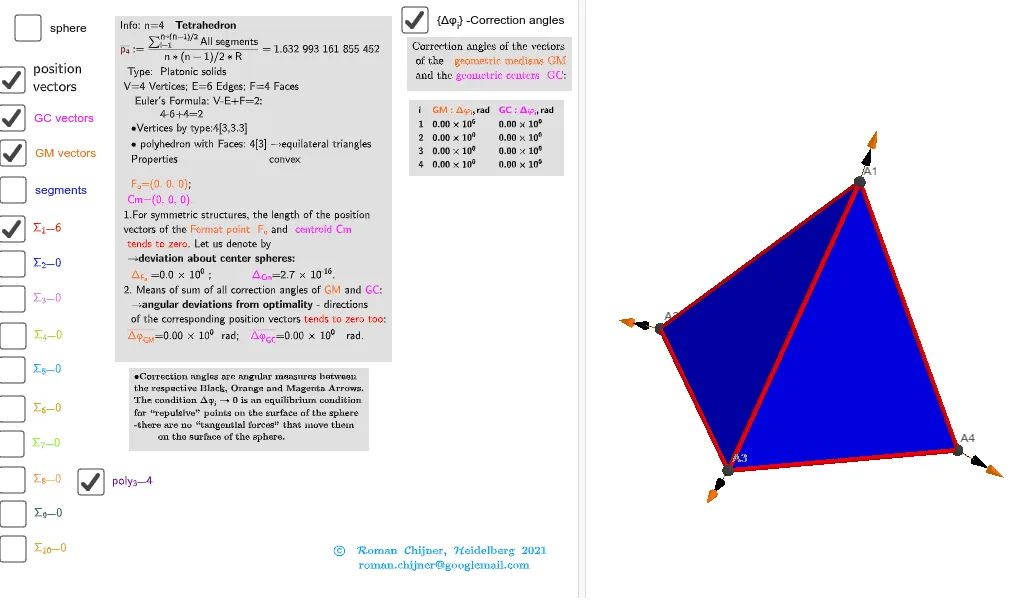
This example demonstrates a 3D tetrahedron defined by four vertices and visualizes how its spatial structure can be studied together with a surrounding sphere (sphere/spherical constraint) for clearer geometric interpretation. Key concepts include solid geometry (tetrahedron), vertices and edges (segments connecting points), spatial point relationships, and representing a geometric condition via a sphere (outer-sphere intuition or sphere-based reference). Construction-wise, it uses UnicodeToLetter and Text for vertex/parameter labeling; creates the four vertices (e.g., Points00 with supporting point objects) and connects them using Segments (including objects like bueseg); builds the sphere using Sphere along with related sphere-control objects; and employs TableText, Sum, and Zip to organize and display computed or indexed information such as vertex labels/values in tables. Suitable for high school through early college students, classroom demonstrations of spatial geometry, and practice with GeoGebra 3D geometric construction.
GeoGebra Commands & Parameters
UnicodeToLetter(34) → u34Text("" + Um1) → txt_pSum(Flatten[Sequence[Append[Sequence[Element[txt_p, i], i, m01(k), m02(k)], " "], k, 1, 5]]) → txtUm1Zip(Vector[a, a + UnitVector[a]], a, Points00) → lVector1Zip(Vector[a, a + (1.5 * UnitVector[b])], a, Points00, b, Wi_Pc) → lVector2Zip(Vector[a, a + (1.5 * UnitVector[b])], a, Points00, b, Wi_P) → lVector3Sphere((0, 0, 0), 5) → sphTableText(Append["i", 1…n], Append[" \fgcolor{orange}{GM :Δφ_i}, rad", l1w], Append["\fgcolor{magenta}{GC :Δφ_i} , rad", l1cw], "v") → text23rZip(Segment[Element[Points00, y(a)], Element[Points00, z(a)]], a, ll1bb(1)) → ll1
AI Drawing Prompt Reference
Draw a 3D tetrahedron defined by four vertices, connected by edges (segments) to form a solid. Add a reference sphere centered at the origin with radius 5 around it to aid spatial interpretation. Label each vertex with a letter or number, and display a table nearby listing vertex indices and corresponding angle values (marked in orange and magenta). From each vertex, draw short vectors indicating directions or unit vectors. The overall composition should clearly show the tetrahedron's relationship to the sphere, suitable for geometry teaching.
The prompt above was compiled from the original drawing commands and is for reference only.