
Taxicab Geometry Demo
Loading the math board and drawing, please wait…
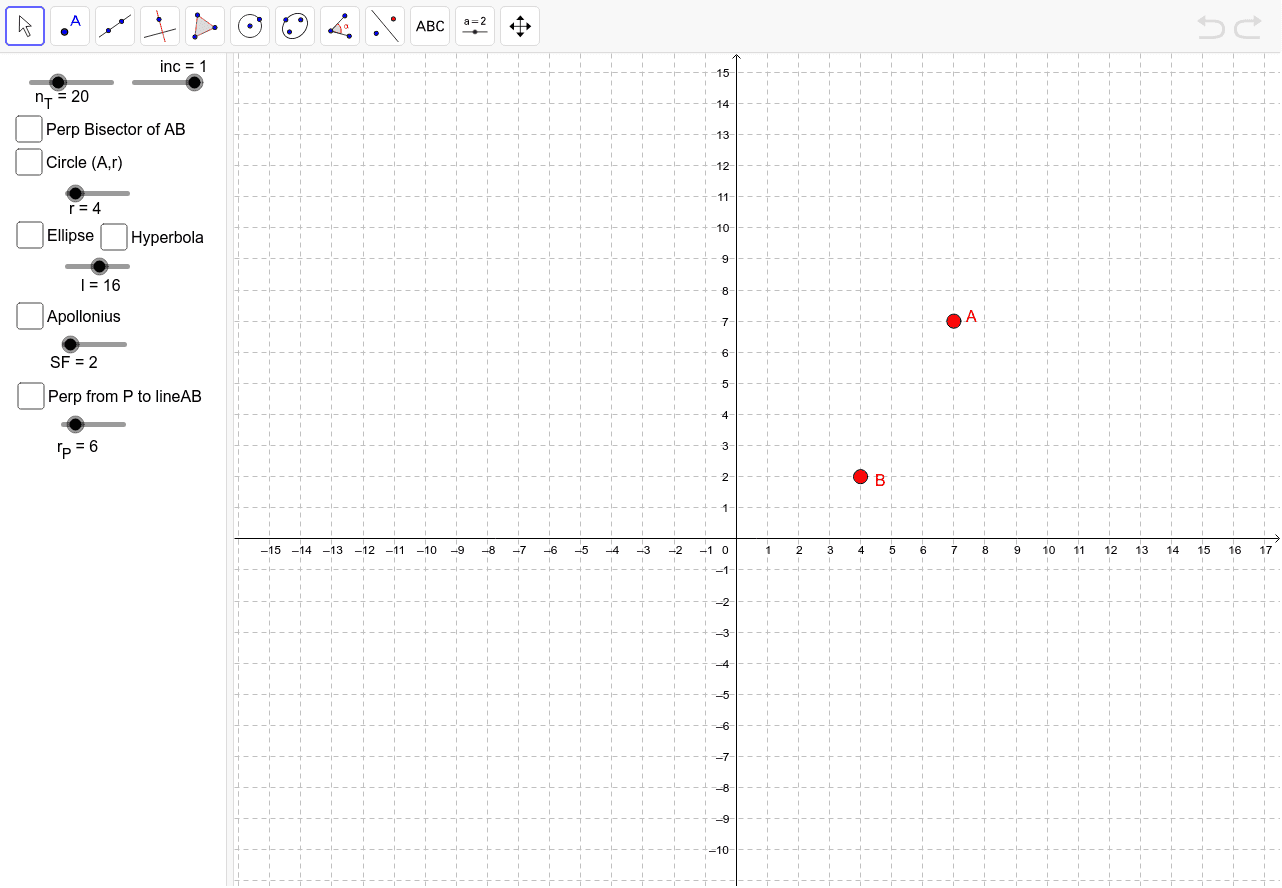
This example demonstrates the construction and properties of figures like circles, ellipses, and hyperbolas in taxicab geometry. It involves core math concepts such as coordinate geometry, derivatives, and vectors. Key GeoGebra commands and objects used include Line, If, points A, B, n_T, parameters a, b, r, objects c, l, d, e, SF, functions f, g, points P, r_P, parameter inc, and specialized objects like Apollonius_T, CircForPerp_T, CircleAr_T, EllipseAB_T, HyperbolaAB_T, PerpPoints_E, and PerpPoints_T. Suitable for high school and above exploring non-Euclidean geometry.
GeoGebra Commands & Parameters
Line(B, A) → gIf(e, Sequence[Sequence[If[abs(x(A) - m) + abs(y(A) - n) ≟ (SF * (abs(x(B) - m) + abs(y(B) - n))), (m, n)], m, (-n_T), n_T, inc], n, (-n_T), n_T, inc], {}) → Apollonius_TIf(f, Sequence[Sequence[If[abs(x(P) - m) + abs(y(P) - n) ≟ r_P, (m, n)], m, (-n_T), n_T, inc], n, (-n_T), n_T, inc], {}) → CircForPerp_TIf(b, Sequence[Sequence[If[abs(x(A) - m) + abs(y(A) - n) ≟ r, (m, n)], m, (-n_T), n_T, inc], n, (-n_T), n_T, inc], {}) → CircleAr_TIf(c, Sequence[Sequence[If[abs(x(A) - m) + abs(y(A) - n) + abs(x(B) - m) + abs(y(B) - n) ≟ l, (m, n)], m, (-n_T), n_T, inc], n, (-n_T), n_T, inc], {}) → EllipseAB_TIf(d, Sequence[Sequence[If[abs(abs(x(A) - m) + abs(y(A) - n) - (abs(x(B) - m) + abs(y(B) - n))) ≟ l, (m, n)], m, (-n_T), n_T, inc], n, (-n_T), n_T, inc], {}) → HyperbolaAB_TIf(a, Sequence[Sequence[If[Distance[A, (m, n)] ≟ Distance[B, (m, n)], (m, n)], m, -10, 10, inc], n, -10, 10, inc], {}) → PerpPoints_EIf(a, Sequence[Sequence[If[abs(x(A) - m) + abs(y(A) - n) ≟ abs(x(B) - m) + abs(y(B) - n), (m, n)], m, (-n_T), n_T, inc], n, (-n_T), n_T, inc], {}) → PerpPoints_T
AI Drawing Prompt Reference
Demonstrate the construction and properties of figures like circles, ellipses, and hyperbolas in taxicab geometry using coordinate geometry, derivatives, and vectors. Start by drawing a line segment, then generate a series of points based on distance conditions to form various geometric shapes, showcasing their characteristics in non-Euclidean geometry.
The prompt above was compiled from the original drawing commands and is for reference only.