
Squares on a Right-Angled Triangle
Loading the math board and drawing, please wait…
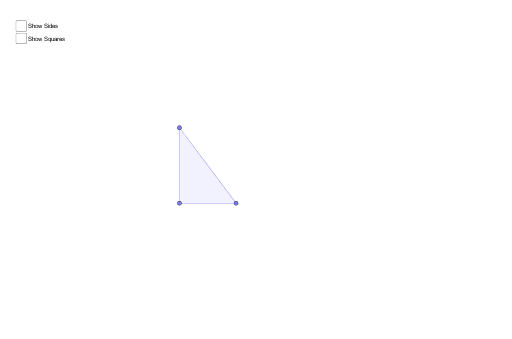
This example demonstrates constructing squares on the sides of a right-angled triangle and exploring the relationships between these squares and the original triangle. Core mathematical concepts include the Pythagorean Theorem, trigonometric functions (sine, cosine), vectors, and coordinate geometry. Construction highlights involve GeoGebra commands like Point, Intersect, Polygon, Midpoint, Length, and Sequence. Suitable for high school mathematics education to understand geometric proofs of the Pythagorean Theorem and applications of trigonometric functions.
GeoGebra Commands & Parameters
Point(yAxis) → AIntersect(xAxis, yAxis) → BPoint(xAxis) → CPolygon(A, B, C) → poly1, c, a, bPolygon(A, C, 4) → poly2, f, g, h, i, D, EPolygon(B, A, 4) → poly3, j, k, l, m, F, GPolygon(C, B, 4) → poly4, n, p, q, r, H, IMidpoint(F, B) → JMidpoint(B, I) → KMidpoint(C, E) → LMidpoint(A, B) → MMidpoint(B, C) → NMidpoint(C, A) → OLength(b) → LHypSequence(A + (t * (C - A)), t, 0, 1, 1 / LHyp) → HypBSequence(E + (t * (D - E)), t, 0, 1, 1 / LHyp) → HypTSequence(A + (t * (E - A)), t, 0, 1, 1 / LHyp) → HypLSequence(C + (t * (D - C)), t, 0, 1, 1 / LHyp) → HypRSequence(Segment[Element[HypL, k], Element[HypR, k]], k, 1, LHyp) → HypLRSequence(Segment[Element[HypT, k], Element[HypB, k]], k, 1, LHyp) → HypTBLength(c) → LS1Length(a) → LS2Sequence(B + (t * (A - B)), t, 0, 1, 1 / LS1) → S1BSequence(G + (t * (F - G)), t, 0, 1, 1 / LS1) → S1TSequence(A + (t * (F - A)), t, 0, 1, 1 / LS1) → S1RSequence(B + (t * (G - B)), t, 0, 1, 1 / LS1) → S1LSequence(B + (t * (C - B)), t, 0, 1, 1 / LS2) → S2BSequence(H + (t * (I - H)), t, 0, 1, 1 / LS2) → S2TSequence(C + (t * (I - C)), t, 0, 1, 1 / LS2) → S2LSequence(B + (t * (H - B)), t, 0, 1, 1 / LS2) → S2RSequence(Segment[Element[S1L, k], Element[S1R, k]], k, 1, LS1) → S1LRSequence(Segment[Element[S2L, k], Element[S2R, k]], k, 1, LHyp) → S2LRSequence(Segment[Element[S1T, k], Element[S1B, k]], k, 1, LS1) → S1TBSequence(Segment[Element[S2T, k], Element[S2B, k]], k, 1, LS2) → S2TB