
Tracing Paper Reflection Transformation
Loading the math board and drawing, please wait…
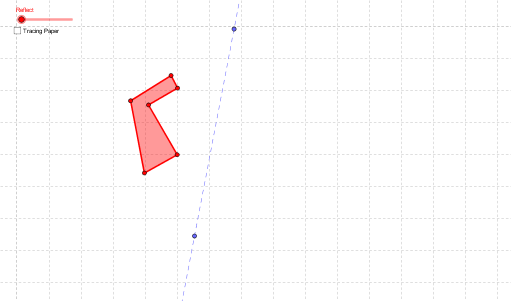
This example demonstrates the geometric transformation process of reflecting shapes using tracing paper; core math concepts include reflection, vectors, 2D coordinate geometry, and geometric construction; constructed using GeoGebra commands/objects like Line, Polygon, OrthogonalLine, Intersect, Mean, Mirror, Circle, Segment, Dilate, Point, Midpoint; suitable for high school mathematics teaching to understand 2D geometric transformations and vector applications.
GeoGebra Commands & Parameters
Line(A, B) → aPolygon(C, D, E, F, G, H) → poly1, c, d, e, f, g, hOrthogonalLine(E, a) → bOrthogonalLine(F, a) → iOrthogonalLine(G, a) → kOrthogonalLine(D, a) → lOrthogonalLine(H, a) → m_1OrthogonalLine(C, a) → nIntersect(a, b) → IIntersect(a, i) → JIntersect(a, l) → KIntersect(a, m_1) → LIntersect(a, n) → MIntersect(a, k) → NMean({x(I), x(J), x(K), x(L), x(M), x(N)}) → xmMean({y(I), y(J), y(K), y(L), y(M), y(N)}) → ymOrthogonalLine(O, a) → jOrthogonalLine(P, a) → pOrthogonalLine(P, p) → qOrthogonalLine(O, j) → rIntersect(q, j) → QIntersect(p, r) → RPolygon(P, Q, O, R) → poly2, p_1, q_1, o_1, r_1Mirror(R, O) → R'Mirror(R', O) → R''Mirror(O, R'') → O'OrthogonalLine(R', r) → a_1OrthogonalLine(O', r) → b_1Intersect(a, a_1) → SIntersect(a, b_1) → TCircle(T, O) → c_1Circle(T, Q) → d_1Circle(S, R'') → e_1Circle(S, P) → f_1Mirror(Q, a) → Q'Mirror(Q', a) → Q''Mirror(Q'', a) → Q'''Mirror(P, a) → P'Mirror(O, a) → O'_1Mirror(R, a) → R'_1Segment(Q'', Q''') → g_1Segment(P, P') → h_1Segment(O, O'_1) → i_1Segment(R, R'_1) → j_1Dilate(Q', m, Q) → Q''_1Dilate(O'_1, m, O) → UDilate(P', m, P) → P''Dilate(R'_1, m, R) → VLine(P'', Q''_1) → k_1Line(V, U) → l_1Intersect(f_1, k_1) → A_1, B_1Intersect(g_1, a) → G_1Intersect(h_1, a) → H_1Mirror(e_1, h_1) → s_1Mirror(c_1, g_1) → t_1Point(k_1) → C_1Line(A_1, H_1) → a_2Intersect(a_2, l_1) → E_1Intersect(d_1, k_1) → W, ZLine(Z, G_1) → n_1Intersect(n_1, l_1) → D_1Polygon(A_1, Z, D_1, E_1) → poly3, a_3, z, d_2, e_2Line(Z, D_1) → b_2Line(A_1, E_1) → c_2Intersect(b_2, c_2) → F_1Line(F_1, a) → f_2OrthogonalLine(MeanP, a) → g_2Intersect(g_2, f_2) → I_1OrthogonalLine(D, g_2) → j_2OrthogonalLine(C, g_2) → k_2OrthogonalLine(G, g_2) → l_2OrthogonalLine(H, g_2) → m_2OrthogonalLine(E, g_2) → n_2OrthogonalLine(F, g_2) → p_2Line(I_1, N) → d_3Line(I_1, J) → e_3Line(I_1, K) → f_3Line(I_1, I) → g_3Line(I_1, L) → h_3Line(I_1, M) → i_3OrthogonalLine(D_1, a) → j_3OrthogonalLine(Z, a) → k_3Intersect(k_3, a) → V_1Intersect(j_3, a) → W_1Line(I_1, W_1) → l_3Line(I_1, V_1) → m_3Intersect(l_3, r) → Z_1Intersect(q, m_3) → A_2Intersect(r, j_3) → J_1Intersect(k_3, q) → K_1Line(K_1, J_1) → h_2Intersect(h_2, j_2) → L_1Intersect(r, n_2) → M_1Intersect(h_2, n_2) → N_1Intersect(h_2, p_2) → O_1Intersect(h_2, l_2) → P_1Intersect(h_2, k_2) → Q_1Intersect(h_2, m_2) → R_1OrthogonalLine(L_1, a) → i_2OrthogonalLine(N_1, a) → q_2OrthogonalLine(O_1, a) → r_2OrthogonalLine(P_1, a) → s_2OrthogonalLine(Q_1, a) → t_2OrthogonalLine(R_1, a) → b_3Intersect(b_3, n_1) → S_1Intersect(t_2, n_1) → T_1Intersect(s_2, n_1) → U_1Intersect(r_2, n_1) → B_2Intersect(q_2, n_1) → C_2Intersect(i_2, n_1) → D_2Line(D_2, l_1) → c_3Line(C_2, l_1) → n_3Line(B_2, l_1) → p_3Line(U_1, l_1) → q_3Line(T_1, l_1) → r_3Line(S_1, l_1) → s_3Intersect(f_3, c_3) → E_2Intersect(g_3, n_3) → F_2Intersect(d_3, q_3) → G_2Intersect(p_3, e_3) → H_2Intersect(h_3, s_3) → I_2Intersect(r_3, i_3) → J_2Polygon(J_2, E_2, F_2, H_2, G_2, I_2) → poly4, j_4, e_4, f_4, h_4, g_4, i_4Mirror(C, a) → C'Mirror(D, a) → D'Mirror(E, a) → E'Mirror(F, a) → F'Mirror(G, a) → G'Mirror(H, a) → H'Polygon(C', D', E', F', G', H') → poly1', c', d', e', f', g', h'Segment(P, R) → t_3Segment(Q, O) → a_4Intersect(a_4, a) → L_2Intersect(t_3, a) → M_2Segment(L_2, M_2) → b_4Midpoint(b_4) → K_2
AI Drawing Prompt Reference
Draw a hexagon and reflect it to its symmetric position using tracing paper. First, draw the hexagon, then draw its opposite sides, find the reflection center through their intersections, and construct a new hexagon using this center and the opposite sides. Finally, complete the reflection process with mirroring and scaling operations.
The prompt above was compiled from the original drawing commands and is for reference only.