
Symmetry Lines of a Square
Loading the math board and drawing, please wait…
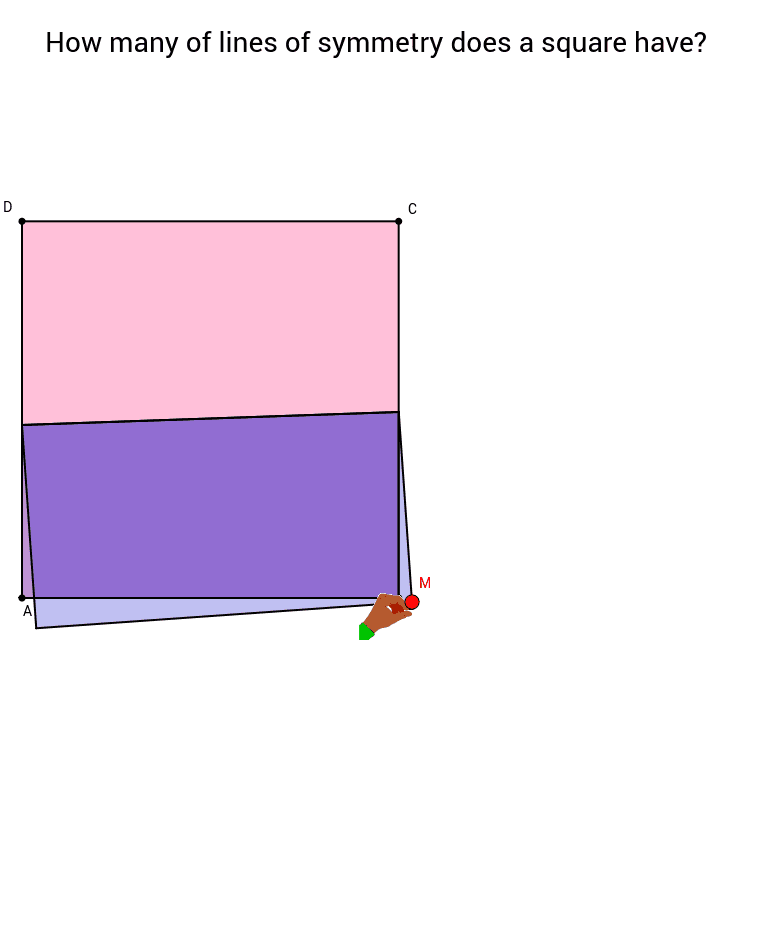
This example demonstrates the four lines of symmetry in a square. It involves core mathematical concepts such as symmetry, geometric transformations, and polygon properties. The construction uses GeoGebra commands/objects like Polygon, Line, LineBisector, Intersect, Mirror, Midpoint, Segment, and If. Suitable for middle school students and teachers learning geometric transformations and symmetry.
GeoGebra Commands & Parameters
Polygon(A, B, C, D) → poly1, a_1, b_1, d_1, c_1Line(C, B) → jLine(D, C) → kLine(A, B) → lLine(D, A) → mLineBisector(M, C) → cIntersect(c, k) → F_1Intersect(c, l) → GIntersect(c, m) → HIntersect(j, c) → IMirror(B, c) → B'Mirror(D, c) → D'Mirror(A, c) → A'Polygon(M, F_1, I) → poly2, i, e, fPolygon(F_1, D, A, B, I) → poly3, f_1, d, a_2, b_2, i_1Polygon(F_1, M, B', G) → poly4, f_2, e_1, b', gPolygon(F_1, D, A, G) → poly5, f_3, d_2, a_3, g_1Polygon(F_1, M, B', A', H) → poly6, f_4, e_2, b'_1, a', hPolygon(F_1, D, H) → poly7, h_1, f_5, d_3Polygon(H, D', M, I) → poly8, h_2, d', e_3, i_2Polygon(H, A, B, I) → poly9, h_3, a_4, b_3, i_3Polygon(H, D', M, B', G) → poly10, h_4, d'_1, e_4, b'_2, g_2Polygon(H, A, G) → poly11, g_3, h_5, a_5Polygon(G, B, I) → poly13, i_4, g_4, b_4Polygon(G, A', D', M, I) → poly12, n, p, q, r, sMidpoint(D, C) → EMidpoint(A, B) → FSegment(E, F) → tIf(Distance[M, D] ≤ 0.05, 1, 0) → okMidpoint(C, M) → JMidpoint(b_1) → KMidpoint(c_1) → LLine(L, K) → a1Line(E, F) → b1Line(D, B) → bLine(D, B) → c1Line(C, A) → d1
AI Drawing Prompt Reference
Draw a square and display its four lines of symmetry. Start by drawing the square, then find the midpoint of each side and draw lines connecting these midpoints to the opposite vertices of the square; these lines are the symmetry axes. Next, reflect parts of the square across each symmetry axis to create multiple smaller shapes. Finally, display the complex pattern formed by the original square and the reflected shapes.
The prompt above was compiled from the original drawing commands and is for reference only.