
Symmetry Artist: Dynamic Mirror Geometry with Tangents and Intersections
Loading the math board and drawing, please wait…
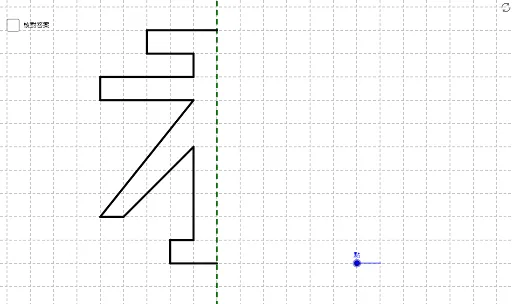
① This interactive GeoGebra example demonstrates how a set of points and segments can be mirrored across an axis (e.g., the y-axis), creating a symmetric pattern while also revealing intersections of tangent lines and special points. ② Core mathematical concepts include axial symmetry, reflection transformation, tangent lines, intersection points, special points (midpoints, feet of perpendiculars), and median lines, blending transformation geometry with coordinate geometry. ③ Construction highlights: using GeoGebra commands Line, Mirror, and Segment, the original points (P_1, A_1…H_1) and their mirrored counterparts (P', A'…H') are generated, along with the symmetry axis axis'. Tangent lines and intersection commands create auxiliary lines (a, b, c, h, i, j) and special points (I_1, J_1…Q_1 and their mirrors), allowing dynamic manipulation. ④ Suitable for high school to early college geometry courses, as well as for artistic symmetric pattern design, helping learners grasp the properties of reflection and the relationships between geometric objects.
GeoGebra Commands & Parameters
Line(X, Y) → axis_yMirror(P_1, axis_y) → P'Mirror(A_1, axis_y) → A'Mirror(B_1, axis_y) → B'Mirror(C_1, axis_y) → C'Mirror(D_1, axis_y) → D'Mirror(E_1, axis_y) → E'Mirror(F_1, axis_y) → F'Mirror(G_1, axis_y) → G'Mirror(H_1, axis_y) → H'Line(X, Y) → axis'Mirror(I_1, axis_y) → I'Mirror(J_1, axis_y) → J'Mirror(K_1, axis_y) → K'Mirror(L_1, axis_y) → L'Mirror(M_1, axis_y) → M'Mirror(Q_1, axis_y) → Q'Segment(P_1, A_1) → aSegment(A_1, B_1) → bSegment(B_1, C_1) → cSegment(G_1, H_1) → hSegment(H_1, I_1) → iSegment(I_1, J_1) → jSegment(J_1, K_1) → kSegment(K_1, L_1) → lSegment(L_1, M_1) → mSegment(M_1, Q_1) → nSegment(P_1, A') → a_1Segment(A', B') → b_1Segment(B', C') → c_1Segment(G', H') → h_1Segment(H', I') → i_1Segment(I', J') → j_1Segment(J', K') → k_1Segment(K', L') → l_1Segment(L', M') → m_1Segment(M', Q') → n_1Segment(C_1, D_1) → dSegment(D_1, E_1) → eSegment(E_1, F_1) → fSegment(F_1, G_1) → gSegment(C', D') → d_1Segment(D', E') → e_1Segment(E', F') → f_1Segment(F', G') → g_1