
Surface of Revolution by Andrew Knauft
Loading the math board and drawing, please wait…
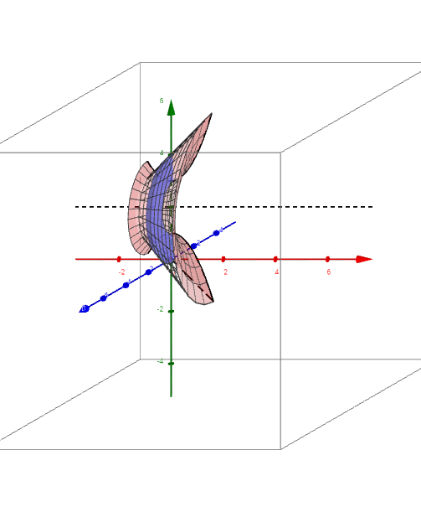
This example demonstrates the generation of a surface of revolution by rotating the region bounded by functions f(x) and g(x) around a horizontal line. Key math concepts include calculus, definite integrals, linear equations, and coordinate transformations. It utilizes GeoGebra commands like Point, Rotate, Locus, Surface, and Textfield to construct the visualization. Suitable for high school students and math enthusiasts exploring the principles of surface generation and integral calculations.
GeoGebra Commands & Parameters
Point(Segment[A, B]) → ERotate(C, α, rot) → C'Rotate(D, α, rot) → D'Locus(D', E) → loc3Locus(C', E) → loc4Surface(t, ((f(t) - R) * cos(u)) + R, ((f(t) - R) * sin(u)), t, a, b, u, (-α), 0) → eSurface(t, ((g(t) - R) * cos(u)) + R, ((g(t) - R) * sin(u)), t, a, b, u, (-α), 0) → iSurface(t, ((f(t) - R) * cos(u)) + R, ((f(t) - R) * sin(u)), t, x(C), x(C) + dx, u, (-α), 0) → lSurface(t, ((g(t) - R) * cos(u)) + R, ((g(t) - R) * sin(u)), t, x(D), x(D) + dx, u, (-α), 0) → dSurface(x(C), R - ((R - ((y(C) * (1 - t)) + (y(D) * t))) * cos(v)), ((R - ((y(C) * (1 - t)) + (y(D) * t))) * sin(v)), t, 0, 1, v, 0, α) → cSurface(x(C) + dx, R - ((R - ((g(x(C) + dx) * (1 - t)) + (f(x(C) + dx) * t))) * cos(v)), ((R - ((g(x(C) + dx) * (1 - t)) + (f(x(C) + dx) * t))) * sin(v)), t, 0, 1, v, 0, α) → kSurface(a, R - ((R - ((g(a) * (1 - t)) + (f(a) * t))) * cos(v)), ((R - ((g(a) * (1 - t)) + (f(a) * t))) * sin(v)), t, 0, 1, v, 0, α) → mSurface(b, R - ((R - ((g(b) * (1 - t)) + (f(b) * t))) * cos(v)), ((R - ((g(b) * (1 - t)) + (f(b) * t))) * sin(v)), t, 0, 1, v, 0, α) → nSurface(t, (g(t) * u) + (f(t) * (1 - u)), 0, t, a, b, u, 0, 1) → pSurface(t, R + (((f(t) * u) + (g(t) * (1 - u)) - R) * cos(α)), ((((R - f(t)) * u) + ((R - g(t)) * (1 - u))) * sin(α)), t, a, b, u, 0, 1) → oSurface(t, R + (((f(t) * u) + (g(t) * (1 - u)) - R) * cos(α)), ((((R - f(t)) * u) + ((R - g(t)) * (1 - u))) * sin(α)), t, x(C), x(C) + dx, u, 0, 1) → qSurface(t, (g(t) * u) + (f(t) * (1 - u)), 0, t, x(C), x(C) + dx, u, 0, 1) → rTextfield(f) → InputBox1Textfield(g) → InputBox2Textfield(R) → InputBox3Textfield(a) → InputBox4Textfield(b) → InputBox5