
Surface Area of a Triangular Prism
Loading the math board and drawing, please wait…
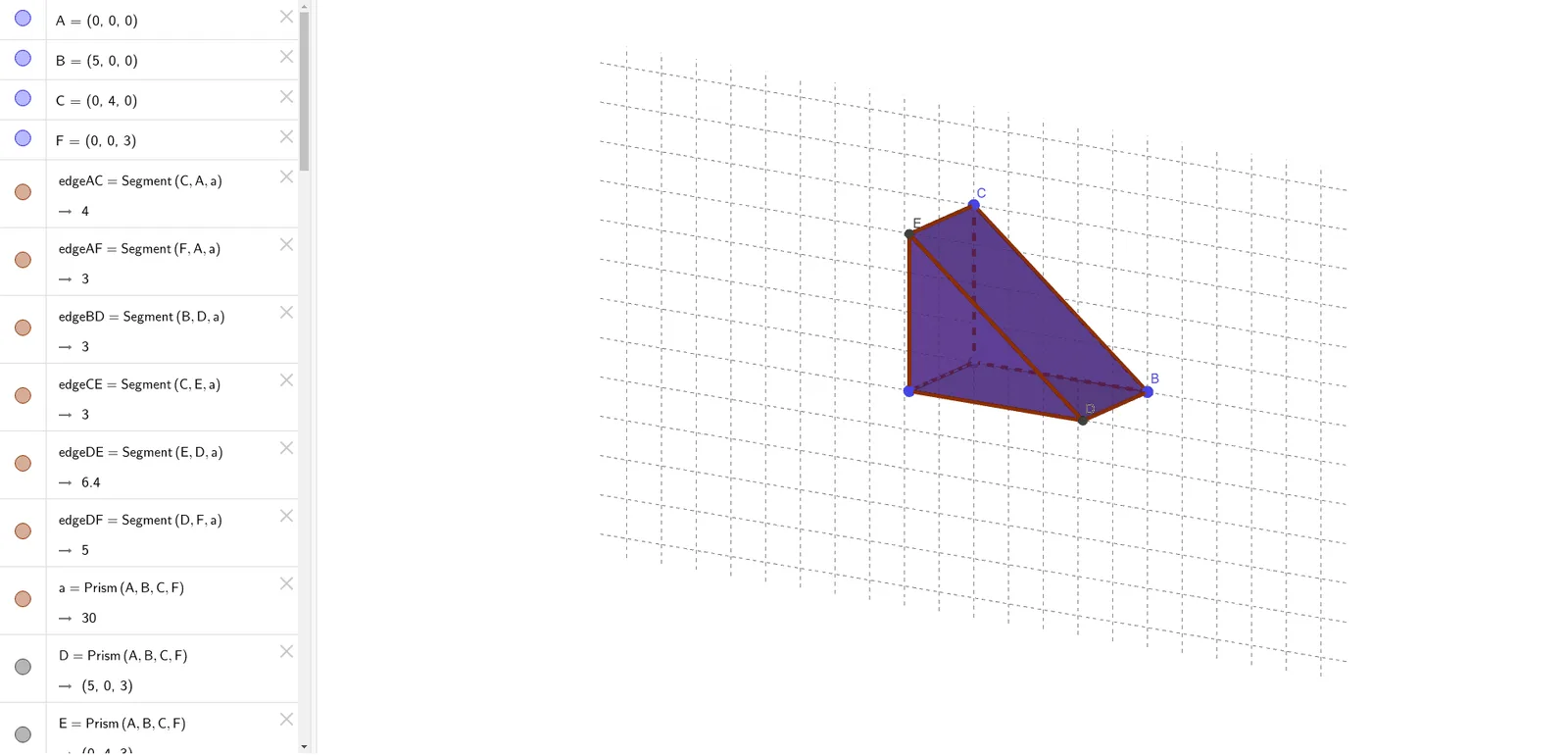
This example demonstrates how to calculate the surface area of a triangular prism. It involves core mathematical concepts such as polygon area, prism structure, surface area formulas, and geometric construction. The construction summary highlights the use of commands like Prism, Net, points A, B, C, F, and objects like faceABC, faceABDF, edgeAB, edgeBC, and more, which are essential for visualizing and computing the surface area. It is suitable for middle school students and above, providing a clear understanding of solid geometry and surface area calculations, as well as for educational demonstrations.
GeoGebra Commands & Parameters
Prism(A, B, C, F) → a, D, edgeAC, edgeAF, edgeBD, edgeCE, edgeDF, edgeDE, edgeEF, E, faceABC, faceABDF, faceBCED, faceACEF, faceDEF, edgeAB, edgeBCNet(a, d) → e, Q, B_1, faceQRS, faceQRUT, faceRSWV, face2, face1, edgeQR, edgeRS, edgeQS, edgeQT, R, edgeTU, edgeRU, edgeRV, edgeVW, edgeSW, edgeSZ, edge4, edge1, edge3, edge2, S, T, U, V, W, Z, A_1
AI Drawing Prompt Reference
Draw a triangular prism to demonstrate the calculation of its surface area. Construct a triangular base and the vertices of the sides, then form the prism, unfold it into a net, and label all faces and edges to understand the surface area calculation.
The prompt above was compiled from the original drawing commands and is for reference only.