
Surface Area and Volume of Rectangular Prisms
Loading the math board and drawing, please wait…
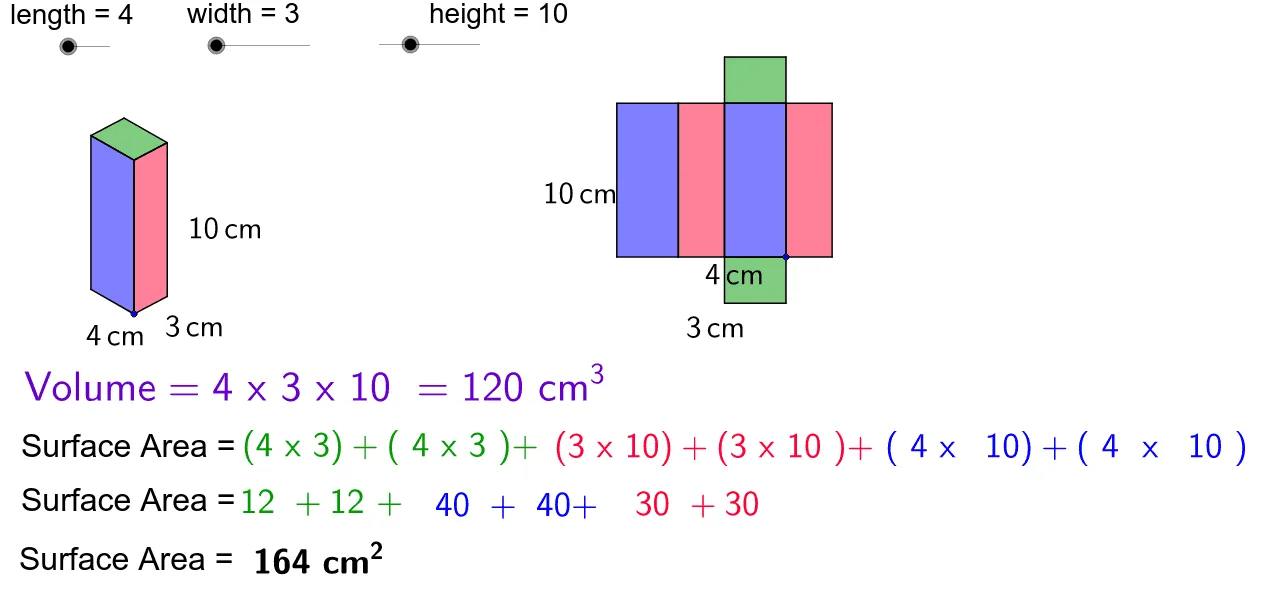
This example demonstrates the 3D shape of rectangular prisms and the calculation of their surface area and volume. Key math concepts include dimensions of geometric figures, surface area formulas, volume formulas, and spatial vector operations. Construction highlights involve using GeoGebra commands like Vector, Translate, Polygon, Line, Intersect, and Midpoint, along with objects such as length, width, height, and various points to build the prism and its faces. Suitable for middle school and above students learning solid geometry, helping them understand the practical application and calculation of surface area and volume.
GeoGebra Commands & Parameters
Vector(A, B) → uVector(A, C) → vVector(A, D) → wTranslate(E, Vector[(height * u)]) → E'Vector(E, E') → zTranslate(E, Vector[(width * w)]) → E'_1Translate(E, Vector[(length * v)]) → E'_2Translate(E'_2, Vector[(height * u)]) → FTranslate(E'_1, Vector[(height * u)]) → GPolygon(F, E'_2, E, E') → poly1, f, e'_2, e, e'Polygon(E, E'_1, G, E') → poly2, e_1, e'_1, g, e'_3Line(F, g) → dLine(G, e') → hIntersect(d, h) → HPolygon(F, E', G, H) → poly3, f_1, e'_4, g_1, h_1Polygon(J, I, K, L) → poly4, j, i, k, lPolygon(N, J, I, M) → poly5, n, j_1, i_1, mPolygon(N, P, O, M) → poly6, n_1, p, o, m_1Polygon(Q, R, N, J) → poly7, q, r, n_2, j_2Polygon(T, S, I, M) → poly8, t, s, i_2, m_2Polygon(V, U, O, P) → poly9, v_1, u_1, o_1, p_1Midpoint(e'_2) → WMidpoint(e_1) → ZMidpoint(e'_1) → A_1Midpoint(v_1) → B_1Midpoint(u_1) → C_1Midpoint(o) → D_1Midpoint(m_2) → E_1Midpoint(t) → F_1
AI Drawing Prompt Reference
Draw a rectangular prism in 3D space. Start with three base vertices and one top vertex, then use vector translations to generate the remaining vertices. Connect vertices with polygons to form six faces, where three faces are constructed via translation and intersection, and the other three are directly defined by vertices. Mark midpoints on each edge for later calculations. The figure should clearly show length, width, and height, and illustrate the geometric meaning of surface area and volume.
The prompt above was compiled from the original drawing commands and is for reference only.