
Surface Area and Volume of Cylinder by Mr. Reilly
Loading the math board and drawing, please wait…
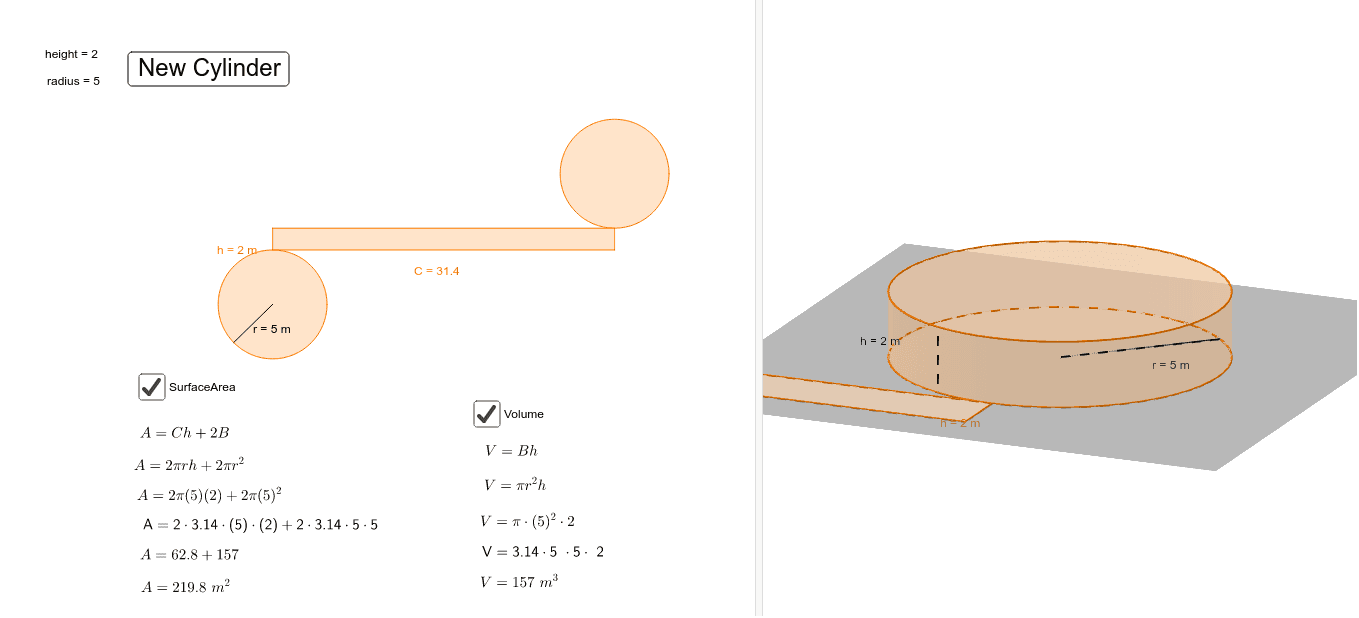
This example demonstrates how to calculate the surface area and volume of a cylinder using geometric construction. Key mathematical concepts include the geometric properties of a cylinder, area, and volume formulas. GeoGebra commands such as Circle, Cylinder, Point, Segment, and Polygon are used in the construction. Suitable for middle school and above students learning solid geometry.
GeoGebra Commands & Parameters
Random(1, 5) → nRandom(1, 9) → iIntersect(xAxis, yAxis) → ACircle(A, n) → cCylinder(c, i) → a, d, bIntersect(xAxis, yAxis) → BPoint(c) → C_1Segment(B, C_1) → rPoint(d) → DOrthogonalLine(D, xOyPlane) → jIntersect(j, c, 1) → ESegment(D, E) → hIntersect(c, yAxis, 2) → FPolygon(F, I, H, G) → poly1, C, i_1, h_1, g_1Circle(J, n) → p
AI Drawing Prompt Reference
Draw a cylinder with a base radius of n and height i. First, draw a circle centered at the origin, then use this circle as the base to draw a cylinder. Next, take a point B on the x-axis and a point C1 on the circle, connect B and C1 to form the height of the cylinder. Then, draw a line j perpendicular to the base from point D on the top of the cylinder, and it intersects the circle at point E. Finally, draw a quadrilateral based on the unfolded side of the cylinder.
The prompt above was compiled from the original drawing commands and is for reference only.