
Sun, Earth, and Moon Model
Loading the math board and drawing, please wait…
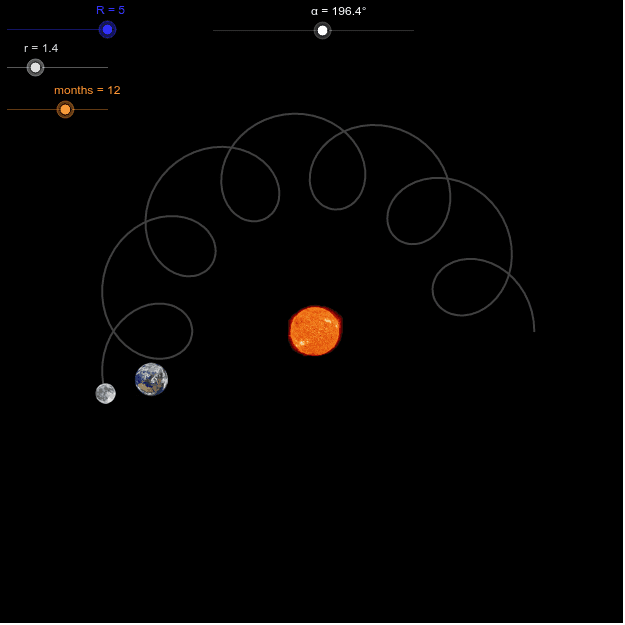
This example demonstrates the relative positions and movements between the Sun, Earth, and Moon, allowing adjustments to radii or the number of months per year. Core math concepts include parametric curves, coordinate geometry, and geometric construction. It utilizes GeoGebra commands like Intersect, Point, Line, and CurveCartesian for construction. Suitable for high school and above students to learn celestial mechanics, parametric equations, and coordinate geometry.
GeoGebra Commands & Parameters
Intersect(xAxis, yAxis) → SunPoint(xAxis) → BLine(A, B) → aLine(Earth, a) → bCurveCartesian((R * cos(t)) + (r * cos((months * t))), (R * sin(t)) + (r * sin((months * t))), t, 0, α) → c1
AI Drawing Prompt Reference
Draw a solar system model showing the relative positions and movements of the Sun, Earth, and Moon. Place the Sun at the origin. The Earth orbits the Sun in a circular path, and the Moon orbits the Earth in an elliptical path. Use parametric equations to define the orbits, allowing adjustments to the sizes of the celestial bodies and the number of months in a year.
The prompt above was compiled from the original drawing commands and is for reference only.