
Sum and Difference of Vectors: Parallelogram and Triangle Rules
Loading the math board and drawing, please wait…
In collections
Multivariable Calculus
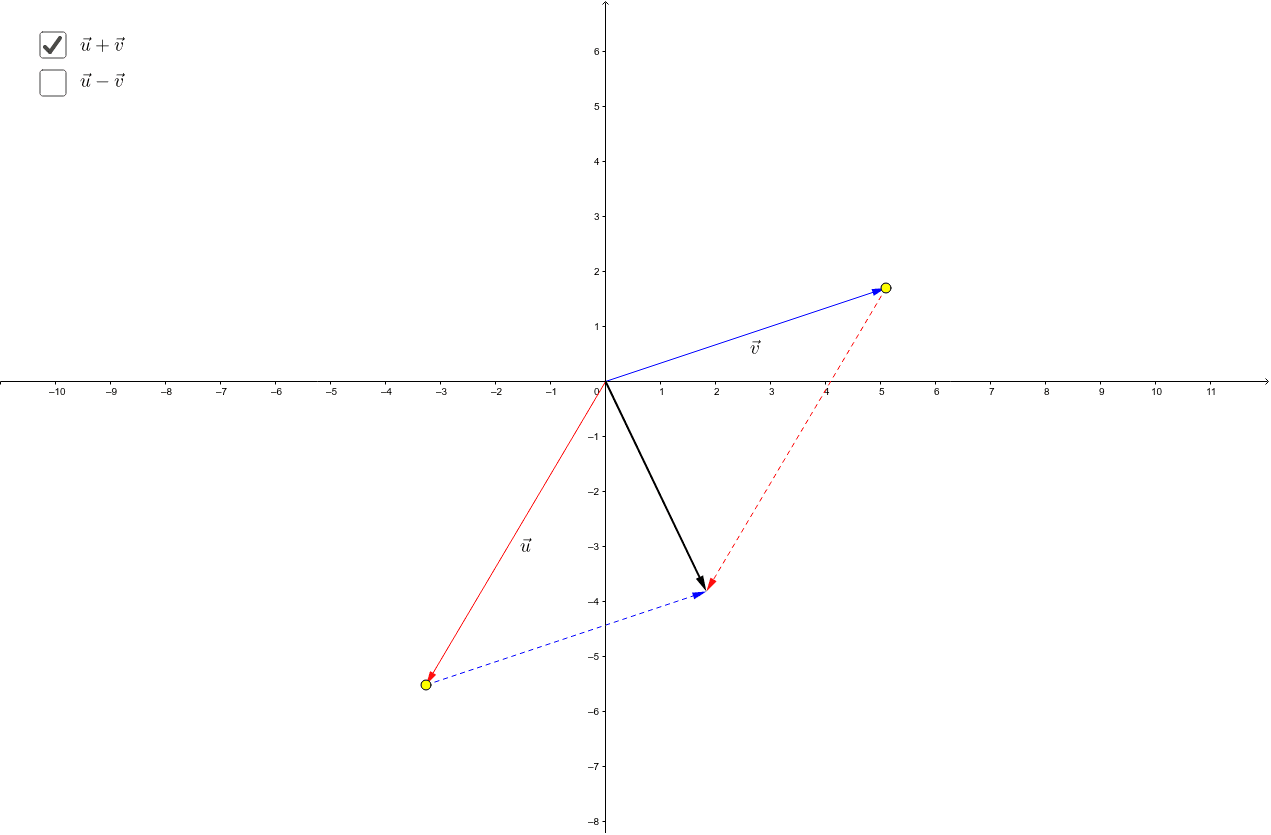
① This GeoGebra example dynamically demonstrates the geometric construction of the sum and difference of two vectors, showing the resulting directed segments. ② The core mathematical concepts are vector addition and subtraction, including the parallelogram law, triangle law, and coordinate-based vector operations. ③ Construction highlights: The Vector command is used to create vectors u and v; points P, Q, U, V, R define the start and end points; objects s, t, r, w represent the sum and difference vectors; text1 to text4 label the relationships; auxiliary objects a, b, c, d, e, f, q support adjustments or annotations. ④ Suitable for high school and early college students learning vector operations, and for teachers as a classroom demonstration tool to bridge geometric intuition and algebraic vector properties.
GeoGebra Commands & Parameters
Vector(P) → uVector(Q) → vVector(P, P + Q) → sVector(Q, P + Q) → tVector(R, R + P) → eVector(P, R + P) → fVector(R + P) → q