
Subtracting Integers on the Number Line
Loading the math board and drawing, please wait…
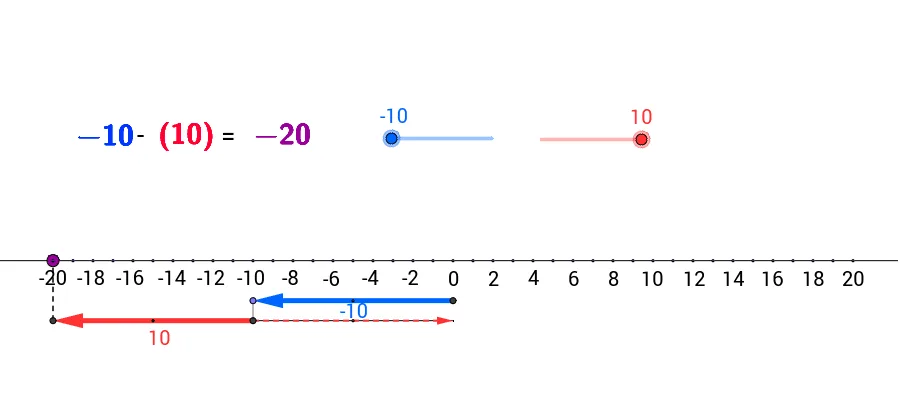
This example demonstrates the geometric representation of subtracting integers on a number line. It involves core math concepts like number line, integer subtraction, and vector operations. Key GeoGebra commands and objects used in the construction include Line, Point, Circle, OrthogonalLine, Intersect, Vector, Translate, Mirror, Segment, and Midpoint. Suitable for middle school mathematics teaching to visually understand the geometric meaning of integer subtraction.
GeoGebra Commands & Parameters
Line(A, B) → aPoint(a) → CCircle(C, 4) → kOrthogonalLine(C, a) → dIntersect(k, d, 2) → R_1Intersect(k, d, 1) → J_1Circle(C, 2) → pIntersect(p, d) → I_1, L_5Circle(L_5, 1) → gIntersect(g, d, 1) → N_1Circle(R_1, N_1) → rIntersect(r, d, 2) → S_1OrthogonalLine(N_1, d) → iCircle(M_1, 1) → qIntersect(q, i) → O_1, P_1Vector(I_1, L_1) → vTranslate(O_1, v) → Q_1Mirror(Q_1, O_1) → Z_1Point(a) → DPoint(a) → EPoint(a) → FPoint(a) → GPoint(a) → HPoint(a) → IPoint(a) → JPoint(a) → KPoint(a) → LPoint(a) → MPoint(a) → NPoint(a) → OPoint(a) → PPoint(a) → QPoint(a) → RPoint(a) → SPoint(a) → TPoint(a) → UPoint(a) → VPoint(a) → WPoint(a) → YPoint(a) → ZPoint(a) → A_1Point(a) → B_1Point(a) → C_1Point(a) → D_1Point(a) → E_1Point(a) → F_1Point(a) → G_1Point(a) → H_1OrthogonalLine(I_1, d) → eOrthogonalLine(L_5, d) → hOrthogonalLine(J_1, d) → fVector(J_1, K_1) → uVector(L_5, M_1) → wVector(O_1, Q_1) → zOrthogonalLine(S_1, d) → jVector(S_1, T_1) → lSegment(J_1, S_1) → mSegment(M_1, O_1) → tOrthogonalLine(K_1, a) → nIntersect(n, a) → U_1OrthogonalLine(L_1, a) → sOrthogonalLine(T_1, a) → a_1Intersect(s, a) → W_1Intersect(a_1, a) → Y_1Segment(K_1, U_1) → b_1Segment(T_1, Y_1) → c_1Segment(L_1, W_1) → d_1Segment(I_1, L_1) → b_2Segment(J_1, K_1) → e_1Segment(L_5, M_1) → f_1Segment(Q_1, O_1) → g_1Segment(T_1, S_1) → h_1Midpoint(J_1, K_1) → Z_2Midpoint(I_1, L_1) → A_2Midpoint(L_5, M_1) → B_2Midpoint(Q_1, O_1) → C_2Mirror(O_1, O_1) → O_1'Segment(Z_1, O_1') → i_1Vector(O_1, Z_1) → u_1Segment(O_1, Z_1) → j_1Midpoint(O_1, Z_1) → V_1Segment(Z_1, Y_1) → k_1Point(a) → D_2Point(a) → E_2Point(a) → F_2Point(a) → G_2Point(a) → H_2Point(a) → I_2Point(a) → J_2Point(a) → K_2Point(a) → L_2Point(a) → M_2
AI Drawing Prompt Reference
Draw a number line starting from point C and a line segment a. Draw a circle k with radius 4 centered at point C, and a line d perpendicular to line segment a, intersecting circle k at points R1 and J1. Draw a circle p with radius 2 centered at point C, intersecting line d at points I1 and L5. Draw a circle g with radius 1 centered at point L5, intersecting line d at points N1. Draw a circle r with centers at points R1 and N1, intersecting line d at point S1. Draw a line i perpendicular to point N1, and a circle q with radius 1 centered at point M1, intersecting line i at points O1 and P1. Draw a vector v from point I1 to point L1, translate point O1 along vector v to get point Q1, and reflect point Q1 over point O1 to get point Z1. Place points D to Z1 sequentially on line segment a.
The prompt above was compiled from the original drawing commands and is for reference only.