
Steiner Points (4 Points)
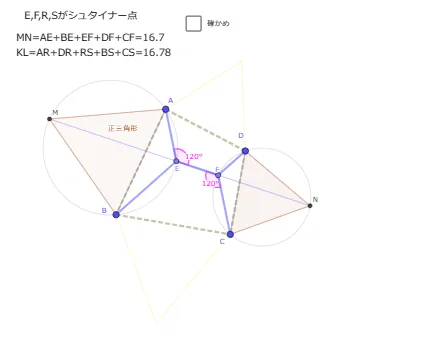
Loading the math board and drawing, please wait…
In collections
Besondere Punkte/Special Points
This example demonstrates the geometric construction and properties of Steiner points through four given points. It involves core mathematical concepts such as quadratic equations, similarity transformations, exponential functions, conic sections, and statistical characteristics. GeoGebra commands and objects like Polygon, Segment, Rotate, Angle, Distance, Circle, and Intersect are used in the construction process. Suitable for high school and above mathematics learners to understand the application of Steiner points in geometric optimization.
GeoGebra Commands & Parameters
Polygon(B, A, 3) → poly1, n, q, r, MPolygon(D, C, 3) → poly2, s, t, a, NSegment(M, N) → bSegment(B, C) → m_1Segment(A, B) → n_1Segment(D, C) → p_1Segment(A, D) → cRotate(I, 60°, B) → I'Angle(I, B, I') → νRotate(J, -60°, C) → J'Angle(J', C, J) → ξSegment(I, J) → dSegment(I', I) → q_1Segment(M, I') → r_1Segment(B, I) → s_1Segment(A, I) → t_1Segment(J, C) → a_1Segment(J, J') → b_1Segment(J, D) → c_1Segment(J', N) → d_1Distance(M, N) → uSegment(I', B) → e_1Segment(J', C) → f_2Polygon(A, D, 3) → poly3, g_2, h_2, i_2, KPolygon(C, B, 3) → poly4, j_2, k_2, l_2, LSegment(K, L) → m_2Circle(K, A, D) → c_2Circle(B, L, C) → d_2Intersect(c_2, m_2, 2) → RIntersect(d_2, m_2, 2) → SSegment(A, R) → fSegment(R, D) → gSegment(R, S) → hSegment(B, S) → iSegment(S, C) → jCircle(M, B, A) → eCircle(D, C, N) → kIntersect(e, b, 2) → EIntersect(k, b, 2) → FSegment(A, E) → lSegment(B, E) → mSegment(E, F) → pSegment(F, D) → f_1Segment(F, C) → g_1Angle(F, E, A) → αAngle(E, F, C) → βDistance(K, L) → KL