
Steiner Point Construction for Six Points
Loading the math board and drawing, please wait…
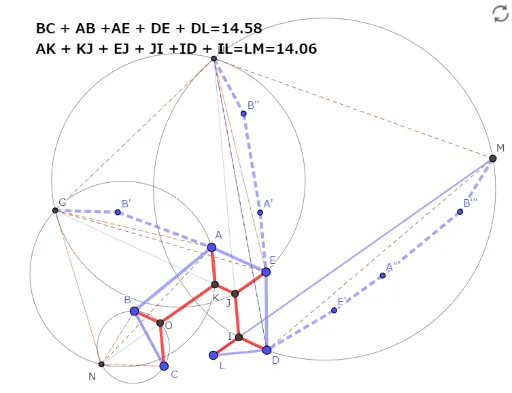
This example demonstrates the geometric construction of the Steiner point for six given points. It involves core concepts like rotation, trapezoid, statistics, polygons, and coordinate geometry. Key GeoGebra commands used include Polygon, Circle, Segment, Distance, Rotate, Angle, and Intersect to form the basis of the construction and calculate intersection points. Suitable for high school and advanced learners exploring geometric constructions and transformations.
GeoGebra Commands & Parameters
Polygon(C, B, 3) → poly1, f, g, h, FCircle(B, C, F) → cPolygon(F, A, 3) → poly2, i, j, k, GCircle(G, F, A) → dPolygon(G, E, 3) → poly3, l, m, n, HCircle(G, E, H) → eSegment(H, D) → pDistance(A, B) → ABDistance(B, C) → BCDistance(C, D) → CDDistance(D, E) → DESegment(A, B) → j_1Segment(B, C) → k_1Segment(D, E) → m_1Segment(A, E) → i_1Rotate(B, (-(60°)), A) → B'Angle(B', A, B) → αRotate(A, (-(60°)), E) → A'Angle(A', E, A) → εRotate(B', (-(60°)), E) → B''Angle(B'', E, B') → ζSegment(D, L) → t_1Polygon(H, D, 3) → poly4, q_1, r_1, s_1, MCircle(H, D, M) → c_1Segment(L, M) → a_1Intersect(c_1, a_1, 2) → ISegment(H, I) → qIntersect(e, q, 2) → JSegment(G, J) → rIntersect(d, r, 2) → KSegment(F, K) → sIntersect(c, s) → N, OSegment(C, O) → tSegment(B, O) → aSegment(O, K) → bSegment(K, A) → f_1Segment(K, J) → g_1Segment(J, E) → h_1Segment(J, I) → b_1Segment(I, L) → d_1Segment(D, I) → e_1Distance(L, M) → vDistance(C, O) → CODistance(B, O) → BODistance(O, K) → OKDistance(A, K) → AKDistance(K, J) → KJDistance(E, J) → EJRotate(A', (-(60°)), D) → A''Angle(A'', D, A') → βRotate(B'', (-(60°)), D) → B'''Angle(B''', D, B'') → γRotate(E, (-(60°)), D) → E'Angle(E', D, E) → δSegment(M, B''') → l_1Segment(B''', A'') → n_1Segment(A'', E') → p_1Segment(E', D) → f_2Segment(G, B') → g_2Segment(B', A) → h_2Segment(H, B'') → i_2Segment(B'', A') → j_2Segment(A', E) → k_2
AI Drawing Prompt Reference
Draw a geometric construction of the Steiner point for six points. Start by forming triangles from three points, then draw circles centered at these points and connect their intersections to create new triangles. Use rotations and line segments to form intersecting shapes, ultimately locating the Steiner point. Highlight the application of rotation, trapezoids, polygons, and coordinate geometry.
The prompt above was compiled from the original drawing commands and is for reference only.