
Star-Octagonal Surface
Loading the math board and drawing, please wait…
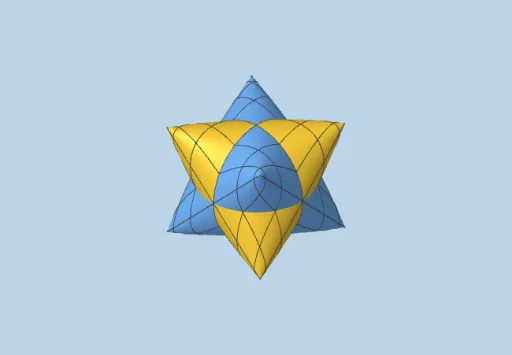
This example demonstrates a complex 3D surface generated from a star-octagon (eight-pointed star) outline, forming a symmetric and aesthetically pleasing solid through rotation and spatial transformations. Core mathematical concepts include parametric surface definition, polygon rotation, vector operations, and differential geometry in surface construction. Construction highlights: The Surface command is used to generate the surface based on polygons and circles, combined with Cube, Rotate, and Tetrahedron commands to build base solids; the star outline is defined via Circle and Polygon; sliders (botón1, botón2, etc.) control rotation angles and parameters, while vectors (rotasi, rotano) and axes (ejessi, ejesno) enable dynamic transformations; objects include multiple points (A-L), faces (caraEFHG, etc.), and colors (red, green, blue) plus text (texto1) for visualization. Suitable for high school to university-level mathematics teaching, this example aids in intuitive understanding of 3D surfaces, solids of revolution, and parametric geometry, and can also be used for geometric modeling in art and design.
GeoGebra Commands & Parameters
Surface((a * cos(u)), (a * cos(v)), (a * cos(u + v)), u, 0, α, v, 0, α) → cosenoPolygon(A, B, C, D) → c1, a_1, b_1, c_1, d_1Cube(G, E, F) → c, H, caraFHLK, caraIJKL, aristaGH, aristaEG, aristaEF, aristaFH, aristaGI, aristaHL, aristaIL, aristaIJ, I, aristaEJ, aristaJK, aristaFK, aristaKL, J, K, L, caraEFHG, caraGHLI, caraEGIJ, caraEFKJRotate(coseno, β, zAxis) → coseno'Circle((0, 0, 0), a, xAxis) → hCircle((0, 0, 0), a, yAxis) → pCircle((0, 0, 0), a, zAxis) → qTetrahedron(O, E, I) → f, P, aristaIP, aristaEP, caraEIO, caraIOP, caraEOP, caraEIP, aristaIO, aristaEO, aristaEI, aristaOPRotate(f, β, zAxis) → f'