
SSS Triangle Congruence Theorem: Dynamic Proof by Aaron Dankman
Loading the math board and drawing, please wait…
In collections
Triangle Congruence Book 1
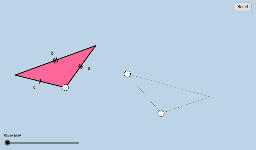
①This GeoGebra example dynamically demonstrates the proof of the SSS (Side-Side-Side) triangle congruence theorem, showing that if three sides of one triangle are equal to the corresponding sides of another, the triangles are congruent. ②Core mathematical concept: the SSS congruence criterion in Euclidean geometry, emphasizing the logical sufficiency of side lengths to determine triangle shape. ③Construction highlights: uses Circle and Intersect to create points, Segment and Polygon to form triangles, applies transformations such as Dilate, Translate, Rotate, and Mirror, and employs Angle, Vector, Ray, and dynamic sliders to visualize correspondence and enable interactive manipulation. ④Suitable for middle school geometry (grades 8-9) to teach triangle congruence, ideal for classroom demonstrations or student-led exploration of geometric proofs.
GeoGebra Commands & Parameters
Circle(A, a) → d_1Intersect(d_1, e) → B, CCircle(C, b) → fSegment(A, C) → gCircle(A, c) → kIntersect(k, f) → F, G, ,Segment(C, F) → hSegment(F, A) → iPolygon(A, C, F) → poly1, f_1, a_1, c_1Circle(D, i) → pPoint(p) → ESegment(D, E) → nCircle(D, g) → qCircle(E, h) → rIntersect(q, r, 2) → HSegment(D, H) → sSegment(H, E) → tLine(A, n) → g_1Point(g_1) → IAngle(I, A, F) → αDilate(A, If[0 < o ≤ 1, 1 - o, 0], D) → A'Vector(A, A') → uTranslate(F, u) → F'Translate(A, u) → A'_1Segment(F', A'_1) → i'Rotate(F', If[1 < o ≤ 2, ((-(o - 1)) * α), (-α)], D) → F''Rotate(A'_1, If[1 < o ≤ 2, ((-(o - 1)) * α), (-α)], D) → JSegment(F'', J) → i''Dilate(A, If[2 < o ≤ 3, 3 - o, 0], D) → A'_2Vector(A, A'_2) → vTranslate(A, v) → A'_3Translate(C, v) → C'Segment(A'_3, C') → g'Line(D, g) → h_1Point(h_1) → KAngle(H, D, K) → βRotate(A'_3, If[3 < o ≤ 4, ((-(o - 3)) * β), (-β)], D) → LRotate(C', If[3 < o ≤ 4, ((-(o - 3)) * β), (-β)], D) → C''Segment(L, C'') → g''Line(C, t) → i_1Point(i_1) → MAngle(M, C, F) → γDilate(C, If[4 < o ≤ 5, 5 - o, 0], C'') → C'_1Vector(C, C'_1) → wTranslate(C, w) → C'_2Translate(F, w) → F'_1Segment(C'_2, F'_1) → h'Rotate(C'_2, If[5 < o ≤ 6, ((-(o - 5)) * γ), (-γ)], C'') → NRotate(F'_1, If[5 < o ≤ 6, ((-(o - 5)) * γ), (-γ)], C'') → OSegment(N, O) → h''Line(F, C) → j_1Mirror(A, j_1) → A'_6Mirror(C, j_1) → C'_4Mirror(F, j_1) → F'_3Polygon(A'_6, C'_4, F'_3) → poly1'_1, f'_3, a'_6, c'_4Point(j_1) → SPoint(j_1) → TRay(C'_4, T) → k_1Ray(F'_3, S) → l_1Segment(A'_6, F'_3) → m_1Segment(A'_6, C'_4) → n_1Dilate(F, If[0 < d ≤ 1, 1 - d, 0], E) → F'_2Vector(F, F'_2) → u_1Translate(A'_6, u_1) → PTranslate(C'_4, u_1) → QTranslate(F'_3, u_1) → RPolygon(P, Q, R) → poly2, r_1, p_1, q_1Translate(A'_6, u_1) → UTranslate(C'_4, u_1) → VSegment(U, V) → s_1Translate(A'_6, u_1) → WTranslate(F'_3, u_1) → ZSegment(W, Z) → t_1Translate(C, u_1) → C'_3Translate(F, u_1) → F'_4Segment(C'_3, F'_4) → h'_1Translate(A'_6, u_1) → A_1Translate(F'_3, u_1) → B_1Segment(A_1, B_1) → e_1Line(E, k_1) → f_2Point(f_2) → C_1Angle(C'', E, C_1) → δRotate(P, If[1 < d ≤ 2, ((-(d - 1)) * δ), (-δ)], E) → P'Rotate(Q, If[1 < d ≤ 2, ((-(d - 1)) * δ), (-δ)], E) → Q'Rotate(R, If[1 < d ≤ 2, ((-(d - 1)) * δ), (-δ)], E) → R'Polygon(P', Q', R') → poly2', r', p', q'Rotate(A_1, If[1 < d ≤ 2, ((-(d - 1)) * δ), (-δ)], E) → D_1Rotate(B_1, If[1 < d ≤ 2, ((-(d - 1)) * δ), (-δ)], E) → E_1Segment(D_1, E_1) → g_2Rotate(U, If[1 < d ≤ 2, ((-(d - 1)) * δ), (-δ)], E) → U'Rotate(V, If[1 < d ≤ 2, ((-(d - 1)) * δ), (-δ)], E) → V'Segment(U', V') → h_2Rotate(C'_3, If[1 < d ≤ 2, ((-(d - 1)) * δ), (-δ)], E) → F_1Rotate(F'_4, If[1 < d ≤ 2, ((-(d - 1)) * δ), (-δ)], E) → G_1Segment(F_1, G_1) → i_2Polygon(D, C'', E) → poly3, e_2, d_2, c''Dilate(D, If[2.5 < d ≤ 3.5, 3.5 - d, 0], D_1) → D'Segment(D, D') → j_2Segment(E, C'') → k_2Min(c, k_2 / 2) → o_1Circle(D, (0.3 * o_1)) → c_2Intersect(c_2, i'') → H_1,Intersect(c_2, j_2) → I_1,CircleSector(D, I_1, H_1) → p_2Intersect(j_2, k_2) → J_1Polygon(D, D_1, E) → poly4, e_3, d_3, d_4Dilate(D, If[3.5 < d ≤ 4.5, 4.5 - d, 0], D_1) → D'_1Vector(D, D'_1) → v_1Translate(p_2, v_1) → q_2Angle(E, D_1, D) → εRotate(q_2, If[4.5 < d ≤ 5.5, ((d - 4.5) * (π - ε)), π - ε], D_1) → r_2Intersect(c_2, g'') → K_1, L_1CircleSector(D, K_1, I_1) → s_2Polygon(D, C'', D_1) → poly5, d_5, d_6, c''_1Dilate(D, If[6 < d ≤ 7, 7 - d, 0], D_1) → D'_2Vector(D, D'_2) → w_1Translate(s_2, w_1) → t_2Angle(D, D_1, C'') → ζRotate(t_2, If[7 < d ≤ 8, ((-(d - 7)) * (π - ζ)), (-(π - ζ))], D_1) → c_3Dilate(E, If[8.5 < d ≤ 9.5, 9.5 - d, 0], C'') → E'Segment(E, E') → l_2Segment(E, C'') → m_2Polygon(A, C, F) → poly6, f_3, a_2, c_4Polygon(D, C'', E) → poly7, e_4, d_7, c''_2
AI Drawing Prompt Reference
Draw a dynamic illustration of the SSS triangle congruence theorem, showing that two triangles with equal corresponding sides are congruent. Start by creating triangle vertices using circles and intersection points, then connect them with line segments to form two triangles. Apply transformations like dilation, translation, rotation, and reflection to superimpose one triangle onto the other, and use angles and vectors to visualize the correspondences. Incorporate sliders to control transformation parameters for interactive manipulation.
The prompt above was compiled from the original drawing commands and is for reference only.