
SSS Similarity Theorem Exploration
Loading the math board and drawing, please wait…
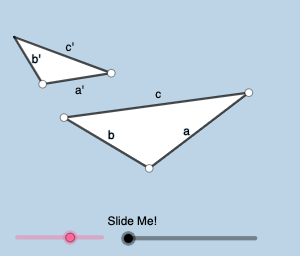
This example illustrates the SSS Similarity Theorem, which states that if the corresponding sides of two triangles are proportional, then the triangles are similar. Key mathematical concepts include similar triangles and proportions. Using GeoGebra commands such as Segment, Rotate, Ray, and Point, dynamic exploration of triangle similarity is facilitated. Suitable for middle school and above students to learn about similar triangles.
GeoGebra Commands & Parameters
Segment(A, B) → aRotate(B, (a_{2} * pi / 180), A) → B'Ray(A, B') → fPoint(f) → CSegment(A, C) → bOrthogonalLine(C, b) → rCircle(C, 1) → tIntersect(t, r, 2) → KOrthogonalLine(K, r) → i_1Point(i_1) → WRotate(E, (a_{2} * pi / 180), D) → E'Ray(D, E') → jSegment(D, E) → a'Circle(D, (a' / a * b)) → dIntersect(d, j, 1) → FSegment(D, F) → b'Line(K, b') → k_1Point(k_1) → ULine(K, a') → j_1Point(j_1) → VCircle(B, 1) → sOrthogonalLine(B, a) → qPoint(q) → MIntersect(s, q, 1) → JOrthogonalLine(J, q) → h_1Point(h_1) → PPolygon(A, B, C) → t1, c_{2}, a_1, b_{1}Polygon(D, F, E) → t2, e, d_1, f_1Min({a, a', b, b'}) → gCircle(A, (0.35 * g)) → hIntersect(h, a, 1) → GIntersect(h, b, 1) → HCircleSector(A, G, H) → kLine(A, a') → iDilate(A, If[6 < l ≤ 7, 7 - l, 0], D) → A'Vector(A, A') → uTranslate(k, u) → k'Point(i) → IAngle(I, A, B) → αCircleArc(A, G, H) → pDilate(D, If[1 < l ≤ 2, 2 - l, 0], J) → D'Vector(D, D') → vTranslate(D, v) → D'_{1}Translate(E, v) → E'_{1}Segment(D'_{1}, E'_{1}) → a''Line(J, a') → g_1Point(g_1) → LAngle(P, J, L) → βRotate(D'_{1}, If[1 < l ≤ 2, ((l - 1) * β), β], D'_{1}) → NRotate(E'_{1}, If[1 < l ≤ 2, ((-(l - 1)) * β), (-β)], D'_{1}) → OSegment(N, O) → a'''Dilate(D, If[2 < l ≤ 3, 3 - l, 0], K) → D'_{2}Vector(D, D'_{2}) → wTranslate(D, w) → D'_{3}Translate(E, w) → E'_{2}Point(j_1) → QPoint(i_1) → RAngle(W, K, U) → γRotate(D'_{3}, If[2 < l ≤ 3, ((l - 2) * γ), γ], D'_{3}) → SRotate(E'_{2}, If[2 < l ≤ 3, ((l - 2) * γ), γ], D'_{3}) → TTranslate(D, w) → D'_{4}Translate(F, w) → F'Segment(D'_{4}, F') → b''Rotate(D'_{4}, If[2 < l ≤ 3, ((-(l - 2)) * γ), (-γ)], K) → ZRotate(F', If[2 < l ≤ 3, ((-(l - 2)) * γ), (-γ)], K) → F''Segment(Z, F'') → b'''If(o, 7, 4) → c_1Angle(A, C, B) → δIntersect(t, b, 1) → A_1Rotate(A_1, If[4 < l ≤ 5, ((l - 4) * δ), δ], C) → B_1CircleSector(C, A_1, B_1) → e_1Dilate(C, If[6 < l ≤ 7, 7 - l, 0], F) → C'Vector(C, C') → u_1Translate(e_1, u_1) → p_1Line(C, b') → l_1Point(l_1) → C_1Angle(C_1, C, A) → εSegment(F, E) → m_1Segment(B, C) → cOrthogonalLine(B, c) → r_1Circle(B, 1) → s_1Intersect(s_1, r_1, 1) → D_1Dilate(E, If[3 < l ≤ 4, 4 - l, 0], D_1) → E'_{3}Vector(E, E'_{3}) → v_1Translate(F, v_1) → F'_{1}Translate(E, v_1) → E'_{4}Segment(F'_{1}, E'_{4}) → t_1Line(E, c) → f_2Point(f_2) → E_1Angle(F, E, E_1) → ζRotate(F'_{1}, If[3 < l ≤ 4, ((l - 3) * ζ), ζ], E'_{3}) → F_1Rotate(E'_{4}, If[3 < l ≤ 4, ((l - 3) * ζ), ζ], E'_{3}) → G_1Segment(F_1, G_1) → g_2Rotate(p_1, If[6 < l ≤ 7, ((-(l - 6)) * ε), (-ε)], C') → q_1Angle(B, A, C) → ηRotate(G, If[4 < l ≤ 5, ((l - 4) * η), η], A) → G'CircleSector(A, G, G') → d_2CircleArc(C, A_1, B_1) → e_2Rotate(k', If[6 < l ≤ 7, ((-(l - 6)) * α), (-α)], A') → k''
AI Drawing Prompt Reference
Draw two similar triangles to illustrate the SSS Similarity Theorem. The first triangle is formed by points A, B, and C, while the second triangle is formed by points D, F, and E. The triangles are generated through rotations and reflections to ensure proportional corresponding sides. Use rays, circles, and intersection points to help locate key points. The figure should clearly show the relationship between the two triangles and how they are connected through similarity.
The prompt above was compiled from the original drawing commands and is for reference only.