
Squaring the Circle: Constructing an Equal-Area Square via Scaling
Loading the math board and drawing, please wait…
In collections
Complex Math
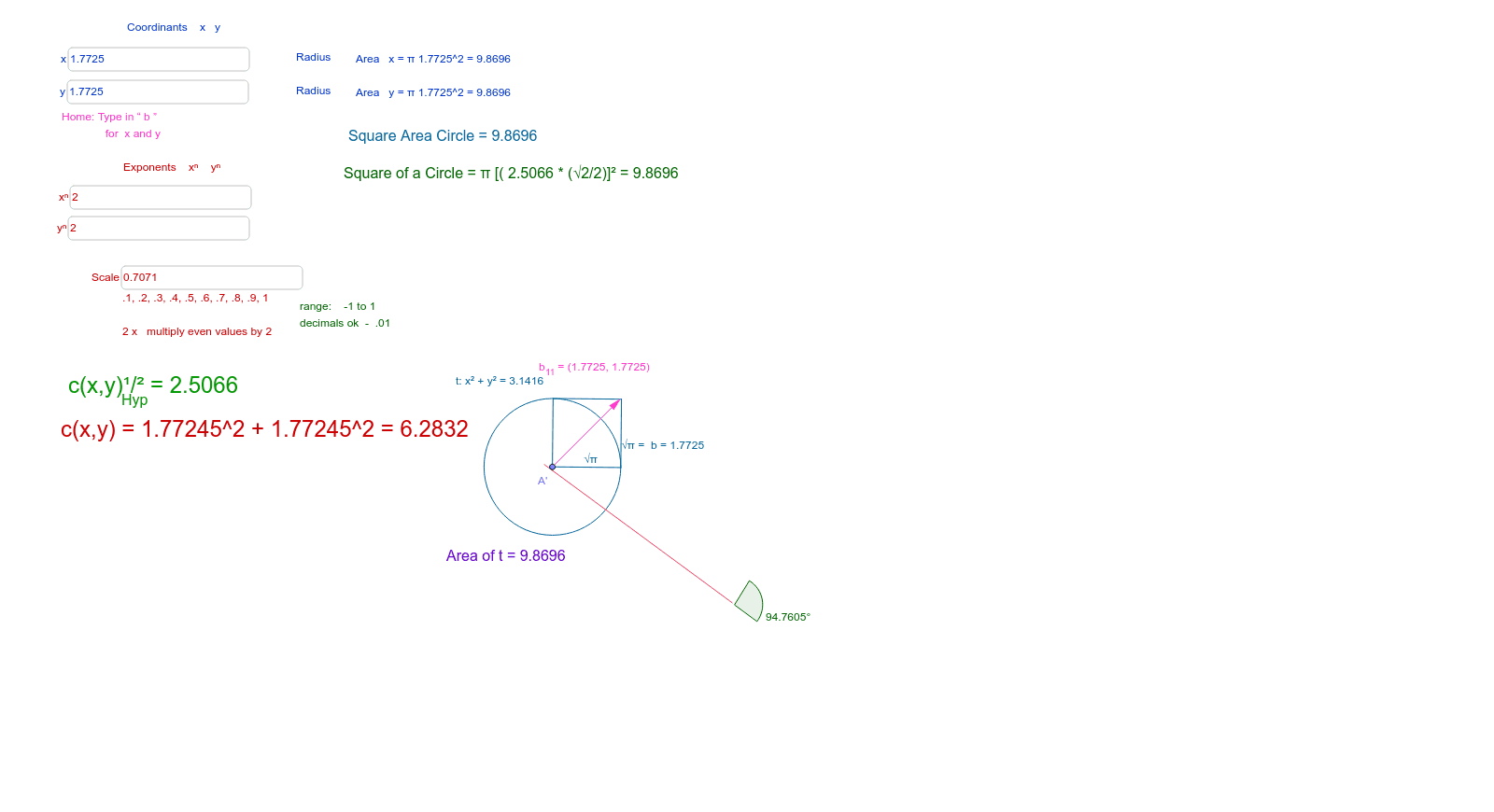
①This example demonstrates how to construct a square whose area equals that of a given circle, addressing the classic problem of 'squaring the circle' through geometric scaling. ②Core mathematical concepts include the area formula of a circle, area of a square, proportional scaling, geometric construction, and area conservation. ③Construction highlights: Based on the construction summary, the example uses GeoGebra text input boxes (inputBox1-5) for user parameters, and employs commands such as Point, Distance, Polygon, Rotate, Vector, Translate, Segment, Line, OrthogonalLine, Intersect, Angle, Area, and PointIn to build dynamic geometry. The 'Scale' transformation adjusts dimensions, and area calculations verify equality. ④Suitable for high school and above, or math enthusiasts, for exploring geometric constructions, area relationships, and dynamic math experiments, also useful for visualizing the historical 'squaring the circle' problem.
GeoGebra Commands & Parameters
Textfield(a) → inputBox1Textfield(b_9) → inputBox2Textfield(m) → inputBox3Textfield(v) → inputBox4Point(Hyp_1) → APoint(Hyp_1) → BDistance(A, B) → distanceABTextfield(ε) → inputBox5Polygon(C_1, D_1, B_1, A_1) → poly1_1, c_1, d_1, b_1, a_1Rotate(C_1, 5*°, A_1) → C'_1Rotate(D_1, 5*°, A_1) → D'_1Rotate(B_1, 5*°, A_1) → B'_1Rotate(A_1, 5*°, A_1) → A'_1Polygon(C'_1, D'_1, B'_1, A'_1) → poly1'_1, c'_1, d'_1, b'_1, a'_1Vector(E_1, F_1) → u_1Translate(C'_1, u_1) → C''_1Translate(D'_1, u_1) → D''_1Translate(B'_1, u_1) → B''_1Translate(A'_1, u_1) → A''_1Polygon(C''_1, D''_1, B''_1, A''_1) → poly1''_1, Z_1, d''_1, b''_1, a''_1Distance(E_1, F_1) → distanceEF_1Distance(B'_1, B''_1) → distanceB'B''_1Segment(C'_1, C''_1) → e_1Segment(A'_1, A''_1) → f_1Segment(B'_1, B''_1) → g_8Segment(D'_1, D''_1) → h_7Segment(D''_1, G_1) → Y_1Segment(G_1, C''_1) → X_1Segment(H_1, I_1) → i_8Line(J_1, i_8) → j_1Point(j_1) → K_1Segment(I_1, K_1) → k_1Line(L_1, Y_1) → l_1Distance(G_1, I_1) → distanceGI_1Distance(D''_1, K_1) → distanceD''K_1Point(l_1) → M_1Segment(G_1, M_1) → m_1Line(N_1, m_1) → n_1Segment(M_1, N_1) → p_1Distance(N_1, C''_1) → distanceNC''_1Distance(G_1, M_1) → distanceGM_1Segment(G_1, I_1) → q_1Segment(D''_1, K_1) → r_1OrthogonalLine(P_1, q_1) → s_1OrthogonalLine(Q_1, q_1) → t_1OrthogonalLine(R_1, r_1) → a_2OrthogonalLine(S_1, r_1) → b_2Line(T_1, k_1) → c_2Line(P_1, q_1) → d_2OrthogonalLine(U_1, a_2) → e_2Segment(K_1, R_1) → f_2Segment(R_1, P_1) → g_2Segment(P_1, I_1) → h_2Segment(I_1, K_1) → i_2Intersect(t_1, d_2) → V_1Segment(P_1, V_1) → j_2Segment(G_1, V_1) → k_2Segment(G_1, I_1) → l_2Segment(I_1, K_1) → m_2Segment(K_1, D''_1) → n_2Segment(D''_1, G_1) → p_2Intersect(b_2, e_2) → W_1Segment(D''_1, W_1) → q_2Segment(W_1, V_1) → r_2Segment(W_1, R_1) → s_2Segment(V_1, P_1) → t_2Segment(R_1, P_1) → a_3Segment(G_1, V_1) → b_3Segment(I_1, P_1) → c_3Line(A_2, q_1) → d_3Point(d_3) → B_2Segment(G_1, B_2) → e_3Line(C_2, e_3) → f_3Line(D_2, f_3) → g_3Line(E_2, g_3) → h_3Line(F_2, p_1) → i_3Line(G_2, p_1) → j_3Point(f_3) → H_2Segment(B_2, H_2) → k_3Segment(M_1, H_2) → l_3Segment(H_2, B_2) → m_3Segment(B_2, G_1) → n_3Segment(G_1, M_1) → p_3Intersect(h_3, i_3) → I_2Segment(B_2, I_2) → r_3Segment(I_2, C''_1) → s_3Segment(C''_1, G_1) → t_3Segment(G_1, B_2) → a_4Segment(I_2, L_2) → b_4Segment(L_2, H_2) → c_4Segment(L_2, I_2) → d_4Segment(H_2, B_2) → e_4Segment(C''_1, N_1) → f_4Segment(L_2, N_1) → q_3Segment(J_2, K_2) → g_4Intersect(Z_1, a''_1) → M_2Intersect(Y_1, X_1) → N_2Intersect(e_3, k_3) → O_2Intersect(r_3, s_3) → P_2Polygon(M_2, N_2, O_2, P_2) → poly2_1, m_4, n_4, o_1, p_4Intersect(Y_1, X_1) → Q_2Intersect(k_1, q_1) → R_2Intersect(k_1, r_1) → S_2Intersect(Z_1, d''_1) → T_2Polygon(Q_2, R_2, S_2, T_2) → poly3_1, q_4, r_4, s_4, t_4Intersect(Y_1, X_1) → U_2Intersect(j_2, r_2) → V_2Intersect(h_2, j_2) → W_2Intersect(k_1, q_1) → Z_2Polygon(U_2, V_2, W_2, Z_2) → poly4_1, u_2, v_1, w_1, z_1Intersect(k_1, q_1) → A_3Intersect(h_2, j_2) → B_3Intersect(f_2, s_2) → C_3Intersect(k_1, r_1) → D_3Polygon(A_3, B_3, C_3, D_3) → poly5_1, a_5, b_5, c_5, d_5Rotate(M_2, 15*°, M_2) → E_3Rotate(N_2, 15*°, M_2) → F_3Rotate(O_2, 15*°, M_2) → G_3Rotate(P_2, 15*°, M_2) → H_3Polygon(E_3, F_3, G_3, H_3) → poly2'_1, e_5, f_5, g_5, h_4Rotate(G_1, 15*°, M_2) → G'_1Rotate(C''_1, 15*°, M_2) → C'''_1Segment(G'_1, C'''_1) → X'_1Rotate(C''_1, 15*°, M_2) → C'''_2Rotate(D''_1, 15*°, M_2) → D'''_1Segment(C'''_2, D'''_1) → Z'_1Rotate(D''_1, 15*°, M_2) → D'''_2Rotate(G_1, 15*°, M_2) → G'_2Segment(D'''_2, G'_2) → Y'_1Rotate(E_3, 15*°, M_2) → J_3Rotate(F_3, 15*°, M_2) → K_3Rotate(G_3, 15*°, M_2) → L_3Rotate(H_3, 15*°, M_2) → M_3Polygon(J_3, K_3, L_3, M_3) → poly2''_1, j_4, k_4, l_4, m_5Rotate(J_3, 15*°, M_2) → N_3Rotate(K_3, 15*°, M_2) → O_3Rotate(L_3, 15*°, M_2) → P_3Rotate(M_3, 15*°, M_2) → Q_3Polygon(N_3, O_3, P_3, Q_3) → poly2'''_1, n_5, o_2, p_5, q_5Rotate(N_3, 15*°, M_2) → R_3Rotate(O_3, 15*°, M_2) → S_3Rotate(P_3, 15*°, M_2) → T_3Rotate(Q_3, 15*°, M_2) → U_3Polygon(R_3, S_3, T_3, U_3) → poly6_1, r_5, s_5, t_5, u_3Rotate(R_3, 15*°, M_2) → V_3Rotate(S_3, 15*°, M_2) → W_3Rotate(T_3, 15*°, M_2) → Z_3Rotate(U_3, 15*°, M_2) → A_4Polygon(V_3, W_3, Z_3, A_4) → poly6'_1, v_2, w_2, z_2, a_6Rotate(V_3, 15*°, M_2) → B_4Rotate(W_3, 15*°, M_2) → C_4Rotate(Z_3, 15*°, M_2) → D_4Rotate(A_4, 15*°, M_2) → E_4Polygon(B_4, C_4, D_4, E_4) → poly6''_1, b_6, c_6, d_6, e_6Rotate(B_4, 15*°, M_2) → F_4Rotate(C_4, 15*°, M_2) → G_4Rotate(D_4, 15*°, M_2) → H_4Rotate(E_4, 15*°, M_2) → I_4Polygon(F_4, G_4, H_4, I_4) → poly6'''_1, f_6, g_6, h_5, i_4Rotate(F_4, 15*°, M_2) → J_4Rotate(G_4, 15*°, M_2) → K_4Rotate(H_4, 15*°, M_2) → L_4Rotate(I_4, 15*°, M_2) → M_4Polygon(J_4, K_4, L_4, M_4) → poly7_1, j_5, k_5, l_5, m_6Rotate(J_4, 15*°, M_2) → N_4Rotate(K_4, 15*°, M_2) → O_4Rotate(L_4, 15*°, M_2) → P_4Rotate(M_4, 15*°, M_2) → Q_4Polygon(N_4, O_4, P_4, Q_4) → poly7'_1, n_6, o_3, p_6, q_6Rotate(N_4, 15*°, M_2) → R_4Rotate(O_4, 15*°, M_2) → S_4Rotate(P_4, 15*°, M_2) → T_4Rotate(Q_4, 15*°, M_2) → U_4Polygon(R_4, S_4, T_4, U_4) → poly7''_1, r_6, s_6, t_6, u_4Rotate(R_4, 15*°, M_2) → V_4Rotate(S_4, 15*°, M_2) → W_4Rotate(T_4, 15*°, M_2) → Z_4Rotate(U_4, 15*°, M_2) → A_5Polygon(V_4, W_4, Z_4, A_5) → poly7'''_1, v_3, w_3, z_3, a_7Rotate(V_4, 15*°, M_2) → B_5Rotate(W_4, 15*°, M_2) → C_5Rotate(Z_4, 15*°, M_2) → D_5Rotate(A_5, 15*°, M_2) → E_5Polygon(B_5, C_5, D_5, E_5) → poly8_1, b_7, c_7, d_7, e_7Rotate(B_5, 15*°, M_2) → F_5Rotate(C_5, 15*°, M_2) → G_5Rotate(D_5, 15*°, M_2) → H_5Rotate(E_5, 15*°, M_2) → I_5Polygon(F_5, G_5, H_5, I_5) → poly8'_1, f_7, g_7, h_6, i_5Rotate(F_5, 15*°, M_2) → J_5Rotate(G_5, 15*°, M_2) → K_5Rotate(H_5, 15*°, M_2) → L_5Rotate(I_5, 15*°, M_2) → M_5Polygon(J_5, K_5, L_5, M_5) → poly8''_1, j_6, k_6, l_6, m_7Rotate(J_5, 15*°, M_2) → N_5Rotate(K_5, 15*°, M_2) → O_5Rotate(L_5, 15*°, M_2) → P_5Rotate(M_5, 15*°, M_2) → Q_5Polygon(N_5, O_5, P_5, Q_5) → poly8'''_1, n_7, o_4, p_7, q_7Rotate(N_5, 15*°, M_2) → R_5Rotate(O_5, 15*°, M_2) → S_5Rotate(P_5, 15*°, M_2) → T_5Rotate(Q_5, 15*°, M_2) → U_5Polygon(R_5, S_5, T_5, U_5) → poly9_1, r_7, s_7, t_7, u_5Rotate(R_5, 15*°, M_2) → V_5Rotate(S_5, 15*°, M_2) → W_5Rotate(T_5, 15*°, M_2) → Z_5Rotate(U_5, 15*°, M_2) → A_6Polygon(V_5, W_5, Z_5, A_6) → poly9'_1, v_4, w_4, z_4, a_8Rotate(V_5, 15*°, M_2) → B_6Rotate(W_5, 15*°, M_2) → C_6Rotate(Z_5, 15*°, M_2) → D_6Rotate(A_6, 15*°, M_2) → E_6Polygon(B_6, C_6, D_6, E_6) → poly9''_1, b_8, c_8, d_8, e_8Rotate(B_6, 15*°, M_2) → F_6Rotate(C_6, 15*°, M_2) → G_6Rotate(D_6, 15*°, M_2) → H_6Rotate(E_6, 15*°, M_2) → I_6Rotate(F_6, 15*°, M_2) → J_6Rotate(G_6, 15*°, M_2) → K_6Rotate(H_6, 15*°, M_2) → L_6Rotate(I_6, 15*°, M_2) → M_6Polygon(J_6, K_6, L_6, M_6) → poly10_1, j_7, k_7, l_7, m_8Rotate(B_6, 15*°, M_2) → N_6Rotate(C_6, 15*°, M_2) → O_6Rotate(D_6, 15*°, M_2) → P_6Rotate(E_6, 15*°, M_2) → Q_6Polygon(N_6, O_6, P_6, Q_6) → poly9'''_1, n_8, o_5, p_8, q_8Intersect(Z_1, h_7) → R_6Intersect(Z'_1, Y'_1) → S_6Segment(R_6, S_6) → i_1Intersect(e_5, f_5) → T_6Point(Z'_1) → U_6Segment(T_6, U_6) → ρ_1Intersect(Z_1, h_7) → V_6Segment(V_6, U_6) → i_7Intersect(Z'_1, ρ_1) → W_6Segment(M_2, W_6) → f_8Intersect(Z'_1, Y'_1) → Z_6Segment(M_2, Z_6) → z'_1Angle(Z_1, f_8) → α_1Angle(Y_1, i_7) → β_1Intersect(ρ_1, i_7) → A_7Segment(M_2, A_7) → g_1Intersect(Y'_1, i_1) → B_7Segment(A_7, B_7) → i_6Segment(M_2, B_7) → h_1Intersect(X'_1, Y'_1) → C_7Intersect(ρ_1, i_7) → D_7Point(Z_1) → E_7Intersect(Y'_1, i_1) → F_7Polygon(C_7, D_7, E_7, F_7) → poly11_1, c_9, d_9, e_9, f_9Angle(i_1, Y_1) → γ_1Angle(C''_1, G_1, D''_1) → δ_1Angle(X'_1, ρ_1) → ζ_1Point(Y_1) → CPoint(k_3) → DSegment(C, D) → jIntersect(Z_1, X_1) → EPoint(b_4) → FSegment(E, F) → kSegment(F, D) → lIntersect(Z_1, X_1) → GIntersect(p_1, q_3) → HSegment(G, H) → nIntersect(c'_1, a'_1) → IIntersect(Z_1, X_1) → JSegment(I, J) → pAngle(w_3, f_1) → αPoint(w_3) → KPoint(b_{11}) → LSegment(K, L) → qAngle(w_3, q) → βArea(t) → uPointIn(t) → Pointt_1Point(t) → PSegment(A, P) → bRotate(A, 90*°, A) → A'Rotate(P, 90*°, A) → P'Segment(A', P') → j_8Rotate(A', 90*°, P') → A''Rotate(P', 90*°, P') → P''Segment(A'', P'') → k_8Rotate(A, -90*°, P) → A'_2Rotate(P, -90*°, P) → P'_1Segment(A'_2, P'_1) → l_8Textfield(δ) → inputBox7Area(t) → v_6PointIn(t) → Pointt
AI Drawing Prompt Reference
Draw a circle and a square with equal areas. First, input the radius of the circle and calculate the side length of the square based on the circle's area formula. Then, construct a square and adjust its position through rotation and translation to match the circle's area. Finally, ensure the square's area equals the circle's area through adjustments and rotations.
The prompt above was compiled from the original drawing commands and is for reference only.