
Squares within Square v.3: Similarity Transformations and Vector Construction
Loading the math board and drawing, please wait…
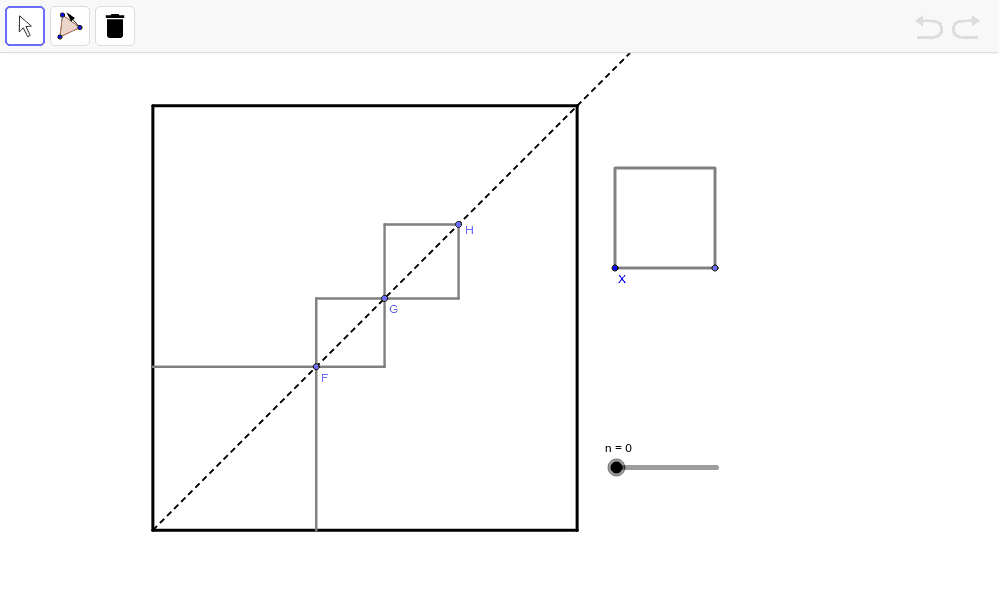
This example demonstrates the recursive nesting of smaller squares inside a larger square through similarity transformations and vector translations, creating a fractal-like visual pattern. It explores core mathematical concepts including perimeter and area relationships of squares, incircles and inscribed circles, similarity transformations, 3D vectors projected onto a plane, exponential growth patterns, and definite integrals as a way to sum accumulated areas. The construction uses GeoGebra commands such as Circle, Point, Ray, Intersect, Segment, OrthogonalLine, Line, Vector, Translate, and Polygon. Starting with a base square and its incircle, key points are determined via orthogonal lines and intersections, then vector translations and similarity transformations generate successive nested squares, involving auxiliary objects like l_1 and n_3. This is suitable for high school and university students exploring geometric transformations, vector operations, and area accumulation, as well as for mathematical modeling or artistic pattern design.
GeoGebra Commands & Parameters
Circle(A, 6) → cPoint(c) → BRay(B, A) → aIntersect(c, a, 2) → DSegment(B, D) → qPoint(q) → FSegment(F, D) → jOrthogonalLine(A, a) → bIntersect(c, b, 2) → ESegment(E, B) → gIntersect(c, b, 1) → CSegment(C, D) → eLine(B, e) → l_1Point(j) → GRay(G, D) → mPoint(m) → HOrthogonalLine(H, g) → n_3Segment(B, C) → dSegment(D, E) → fOrthogonalLine(F, g) → hOrthogonalLine(F, d) → iOrthogonalLine(G, g) → kOrthogonalLine(G, d) → lOrthogonalLine(H, d) → pIntersect(i, k) → IIntersect(h, l) → JIntersect(l, n_3) → KIntersect(k, p) → LIntersect(h, g) → MIntersect(i, d) → NSegment(M, J) → rSegment(N, I) → sSegment(I, L) → tSegment(J, K) → a_1Segment(K, H) → b_1Segment(L, H) → c_1Segment(B, M) → d_1Segment(F, M) → f_1Point(f_1) → OIntersect(k, g) → PSegment(G, P) → g_1Point(g_1) → QLine(O, g) → e_1Intersect(e_1, g_1) → RSegment(O, R) → h_1Intersect(n_3, l_1) → SSegment(K, S) → i_1Line(Q, g) → j_1Intersect(j_1, i_1) → TSegment(Q, T) → k_1Segment(B, N) → m_1Segment(F, N) → n_1Point(n_1) → UOrthogonalLine(J, f) → p_1OrthogonalLine(U, e) → q_1Intersect(p_1, q_1) → VSegment(U, V) → r_1Intersect(p_1, d) → WSegment(G, W) → s_1Point(s_1) → ZOrthogonalLine(H, f) → t_1Line(Z, f) → a_2Intersect(t_1, a_2) → A_1Segment(Z, A_1) → b_2Vector(B, C) → uTranslate(X, u) → X'Vector(X, X') → vPoint(v) → YPolygon(X, Y, 4) → poly1, c_2, d_2, e_2, f_2, C_1, D_1Vector(X, Y) → wTranslate(X, z) → X'_1Vector(X, X'_1) → u_1Point(u_1) → E_1OrthogonalLine(E_1, e_2) → g_2OrthogonalLine(D_1, f_2) → h_2Intersect(h_2, g_2) → F_1Segment(E_1, F_1) → i_2Circle(X, Length[u_1]) → k_2Line(D_1, X) → j_2Intersect(k_2, j_2, 2) → G_1Segment(X, G_1) → l_2Point(l_2) → H_1OrthogonalLine(H_1, f_2) → m_2OrthogonalLine(Y, c_2) → n_2Intersect(m_2, n_2) → I_1Segment(H_1, I_1) → p_2
AI Drawing Prompt Reference
Draw a large square and recursively draw smaller squares inside it using similarity transformations and vector translations. Start by defining the incircle of the large square, then use orthogonal lines and intersections to find key points, and finally apply vector translations and similarity transformations to generate successive nested squares, forming a fractal-like pattern.
The prompt above was compiled from the original drawing commands and is for reference only.