
Square, Tangent Circles, and External Tangent
Loading the math board and drawing, please wait…
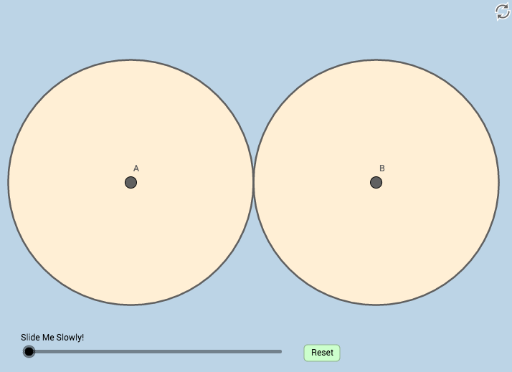
This example demonstrates the geometric relationship between a square, two tangent circles, and their common external tangent. It involves core math concepts like circles, polygons, angles, vectors, functions, coordinate geometry, and geometric constructions. The construction utilizes GeoGebra commands and objects such as Circle, Segment, Intersect, Angle, Dilate, Rotate, Line, Midpoint, Polygon, Vector, and Translate. It is suitable for high school students learning geometric constructions and properties, particularly in the context of coordinate geometry and geometric constructions.
GeoGebra Commands & Parameters
Circle(A, D) → cCircle(B, F_2) → dSegment(H_1, G_1) → fCircle(G_1, f) → eCircle(H_1, f) → gIntersect(c, g, 1) → MIntersect(d, e, 2) → HAngle(M, H, G_1) → αAngle(H, G_1, E_2) → βAngle(G_1, H_1, M) → γAngle(H_1, M, H) → δSegment(M, H) → hSegment(H, G_1) → iSegment(M, H_1) → jDilate(A, If[0 < b ≤ 1, 1 - b, 0], D) → A'Segment(A, A') → lRotate(A, If[1 < b ≤ 2, ((b - 1) * π / 2), π / 2], A) → A'_1Rotate(A', If[1 < b ≤ 2, ((b - 1) * π / 2), π / 2], A) → A''Segment(A'_1, A'') → l'Rotate(A'_1, If[2 < b ≤ 3, ((b - 2) * π), π], C) → KRotate(A'', If[2 < b ≤ 3, ((b - 2) * π), π], C) → A'''Segment(K, A''') → l''Line(B, F_2) → mCircle(F_2, l / 5) → pIntersect(p, m) → L, M_1Circle(L, l / 5) → qIntersect(q, m) → N, OCircle(N, l / 5) → rIntersect(r, m) → P, QMidpoint(P, B) → RMidpoint(M, H) → SDilate(M, If[4 < b ≤ 5, 5 - b, 0], S) → I'Segment(M, I') → nDilate(S, If[5 < b ≤ 6, 6 - b, 0], H) → S'Segment(S, S') → sRotate(M, If[7 < b ≤ 8, ((b - 7) * π), π], S) → I'_1Rotate(I', If[7 < b ≤ 8, ((b - 7) * π), π], S) → I''Rotate(M, If[6 < b ≤ 7, ((b - 6) * π), π], S) → I'_2Rotate(I', If[6 < b ≤ 7, ((b - 6) * π), π], S) → I''_1Segment(I'_2, I''_1) → n'Rotate(M, If[7 < b ≤ 8, ((b - 7) * π / 2), π / 2], H) → GRotate(I', If[7 < b ≤ 8, ((b - 7) * π / 2), π / 2], H) → I''_2Segment(G, I''_2) → n'_1Rotate(I'_2, If[7 < b ≤ 8, ((b - 7) * π / 2), π / 2], H) → TRotate(I''_1, If[7 < b ≤ 8, ((b - 7) * π / 2), π / 2], H) → USegment(T, U) → n''Rotate(S, If[7 < b ≤ 8, ((b - 7) * π / 2), π / 2], H) → S'_1Angle(M, H, G_1) → εRotate(T, If[8 < b ≤ 9, ((b - 8) * π / 2), π / 2], G_1) → FRotate(U, If[8 < b ≤ 9, ((b - 8) * π / 2), π / 2], G_1) → U'Segment(F, U') → n'''Rotate(G, If[8 < b ≤ 9, ((b - 8) * π / 2), π / 2], G_1) → VRotate(I''_2, If[8 < b ≤ 9, ((b - 8) * π / 2), π / 2], G_1) → WSegment(V, W) → tRotate(S'_1, If[8 < b ≤ 9, ((b - 8) * π / 2), π / 2], G_1) → ZAngle(H, G_1, H_1) → ζRotate(F, If[9 < b ≤ 10, ((b - 9) * π / 2), π / 2], H_1) → T''Rotate(U', If[9 < b ≤ 10, ((b - 9) * π / 2), π / 2], H_1) → U''Segment(T'', U'') → f_1Rotate(Z, If[9 < b ≤ 10, ((b - 9) * π / 2), π / 2], H_1) → Z'Rotate(V, If[9 < b ≤ 10, ((b - 9) * π / 2), π / 2], H_1) → V'Rotate(W, If[9 < b ≤ 10, ((b - 9) * π / 2), π / 2], H_1) → W'Segment(V', W') → t'Polygon(H_1, G_1, H, M) → poly1, h_1, g_1, j_1, i_1Angle(G_1, H_1, M) → ηDilate(H_1, If[10 < b ≤ 11, 11 - b, 0], D) → H'Dilate(G_1, If[10 < b ≤ 11, 11 - b, 0], F_2) → ESegment(G_1, E) → k_1Segment(H_1, H') → l_1Angle(H_1, D, A) → θDilate(F_2, If[11 < b ≤ 12, 12 - b, 0], N) → F'Segment(F_2, F') → m_1Dilate(N, If[12 < b ≤ 13, 13 - b, 0], R) → N'Segment(N, N') → n_1Dilate(R, If[13 < b ≤ 14, 14 - b, 0], B) → R'Segment(R, R') → p_1Dilate(H, If[14 < b ≤ 15, 15 - b, 0], N) → J'Vector(H, J') → uTranslate(T, u) → T'_1Translate(U, u) → U'_1Segment(T'_1, U'_1) → n'''_1Translate(S'_1, u) → A_1Translate(G, u) → B_1Translate(I''_2, u) → C_1Segment(B_1, C_1) → q_1Dilate(H, If[15 < b ≤ 16, 16 - b, 0], R) → J'_1Vector(H, J'_1) → vTranslate(S'_1, v) → D_1Translate(T, v) → T'_2Translate(U, v) → U'_2Segment(T'_2, U'_2) → n'''_2Translate(G, v) → E_1Translate(I''_2, v) → F_1Segment(E_1, F_1) → r_1Dilate(H, If[16 < b ≤ 17, 17 - b, 0], B) → J'_2Vector(H, J'_2) → wTranslate(T, w) → T'_3Translate(U, w) → U'_3Segment(T'_3, U'_3) → n'''_3Angle(B, F_2, G) → ι