
Square Root Spiral
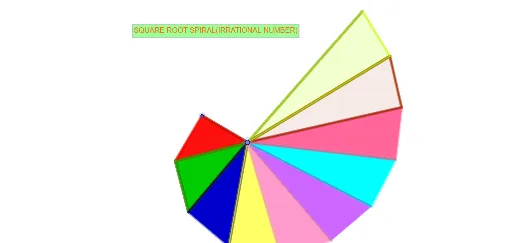
Loading the math board and drawing, please wait…
This example demonstrates the creation of a square root spiral by continuously constructing isosceles triangles and squares, visually representing the concept of square roots. It involves core mathematical concepts such as square roots, isosceles triangles, geometric constructions, and sequences. The construction utilizes GeoGebra commands like Circle, Point, Segment, OrthogonalLine, Intersect, and Polygon. It is suitable for middle school and above, serving as a visual aid for understanding geometric constructions, square roots, and sequence generation.
GeoGebra Commands & Parameters
Circle(A, 1) → cPoint(c) → BSegment(A, B) → fOrthogonalLine(A, f) → gIntersect(c, g, 1) → CSegment(C, B) → hCircle(C, 1) → dOrthogonalLine(C, h) → iPolygon(C, B, A) → t1, a, c_1, bIntersect(d, i, 1) → DSegment(D, B) → jSegment(C, D) → kPolygon(B, C, D) → t2, d_1, b_1, c_2Polygon(B, A, C) → t3, c_3, b_2, a_1Polygon(B, C, D) → t4, d_2, b_3, c_4Circle(D, 1) → eOrthogonalLine(D, j) → lIntersect(e, l) → E, FSegment(E, B) → mPolygon(D, E, B) → t5, b_4, d_3, e_1Circle(E, 1) → pOrthogonalLine(E, m) → nIntersect(p, n) → G, HSegment(G, B) → qSegment(B, D) → rSegment(E, B) → sSegment(B, E) → tPolygon(B, E, G) → t6, g_1, b_5, e_2Circle(G, 1) → f_1Circle(G, 1) → h_1OrthogonalLine(G, q) → i_1Intersect(h_1, i_1) → I, JSegment(B, I) → j_1Polygon(B, G, I) → t7, i_2, b_6, g_2Circle(I, 1) → k_1OrthogonalLine(I, j_1) → l_1Intersect(k_1, l_1) → K, LSegment(B, L) → m_1Polygon(B, I, L) → t8, l_2, b_7, i_3Circle(L, 1) → p_1OrthogonalLine(L, m_1) → n_1Intersect(m_1, i_3) → MIntersect(p_1, n_1) → N, OSegment(B, O) → q_1Polygon(B, L, O) → t9, o, b_8, l_3Circle(O, 1) → r_1OrthogonalLine(O, q_1) → s_1Intersect(r_1, s_1) → P, QSegment(B, Q) → t_1Polygon(B, O, Q) → t10, q_2, b_9, o_1Circle(Q, 1) → f_2OrthogonalLine(Q, t_1) → h_2Intersect(f_2, h_2) → R, SSegment(B, S) → j_2Polygon(B, Q, S) → t11, s_2, b_{10}, q_3Polygon(B, Q, S) → t12, s_3, b_{11}, q_4Circle(S, 1) → k_2OrthogonalLine(S, j_2) → m_2Intersect(k_2, m_2) → T, USegment(B, U) → n_2Polygon(B, S, U) → t13, u, b_{12}, s_4