
Square Cross Section: Step 2 - Constructing the Top Edges
Loading the math board and drawing, please wait…
In collections
Square Cross Sections
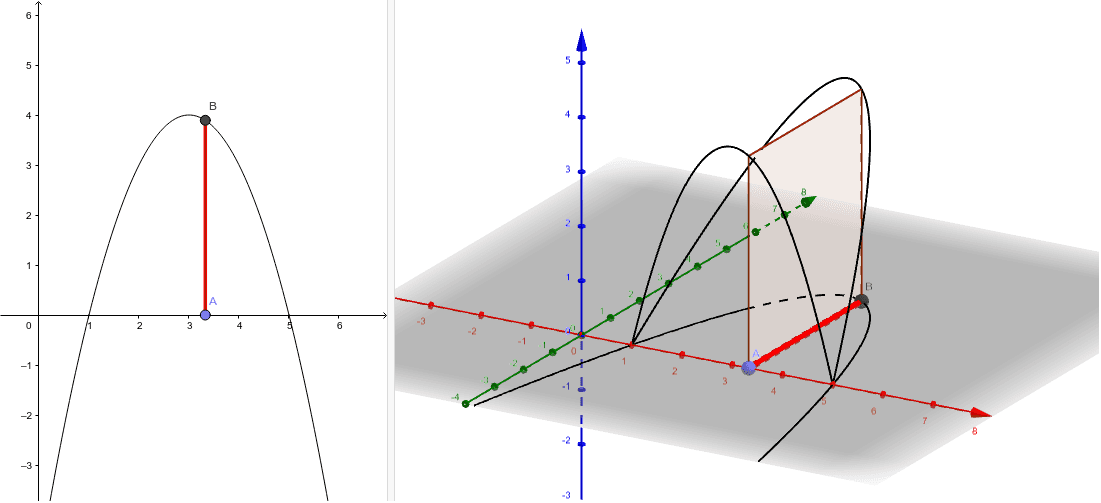
① This example demonstrates the second step in constructing a solid with square cross sections, where the top two edges are built after the bottom two edges have been established in the xy-plane, gradually forming the 3D framework. ② The core mathematical concepts involve the method of cross-sections for volume, square cross-sections bounded by function curves, and spatial relationships of edges and faces in solid geometry. ③ Construction highlights: based on the construction summary, GeoGebra commands such as Root, Segment, Point, Polygon, and CurveCartesian are used, with objects including function f, regions R1 and R2, points A and B, and segments a, b, c, d, e, g, to precisely define the top edges. ④ This is suitable for high school or college calculus courses when teaching volume by integration, helping students visualize the step-by-step construction of solids, and can be used for classroom demonstrations or independent student exploration.
GeoGebra Commands & Parameters
Root(f) → R1, R2Segment(R1, R2) → aPoint(a) → ASegment(A, B) → bPolygon(A, B, (x(B), y(B), y(B)), (x(A), y(A), y(B))) → poly1, a_1, b_1, c, dCurveCartesian(t, 0, f(t), t, 1, 5) → eCurveCartesian(t, f(t), f(t), t, 1, 5) → g
AI Drawing Prompt Reference
In a 3D coordinate system, first draw a horizontal curve that intersects the horizontal axis at two points, and connect these two points with a line segment as the base edge. Pick a point on this base segment and connect it to another given point to form a slanted edge. Then, using these four points as vertices, construct a vertical rectangular cross-section, with two vertices on the horizontal plane and the other two extending vertically upward to the curve's height. Finally, draw two spatial curves along the horizontal direction: one rising from the base start point along the curve to the end point, and another rising vertically from the base start point to the curve height then extending horizontally, together outlining the two top edges of the solid. The overall result is a 3D framework of rectangular cross-sections and curved boundaries, illustrating the cross-section method for volume.
The prompt above was compiled from the original drawing commands and is for reference only.