
Sphere Touching Three Cones
Loading the math board and drawing, please wait…
In collections
intersection: surface-surface, curve-curve
intersection: surface-surface, curve-curve
intersection: surface-surface, curve-curve
intersection: surface-surface, curve-curve
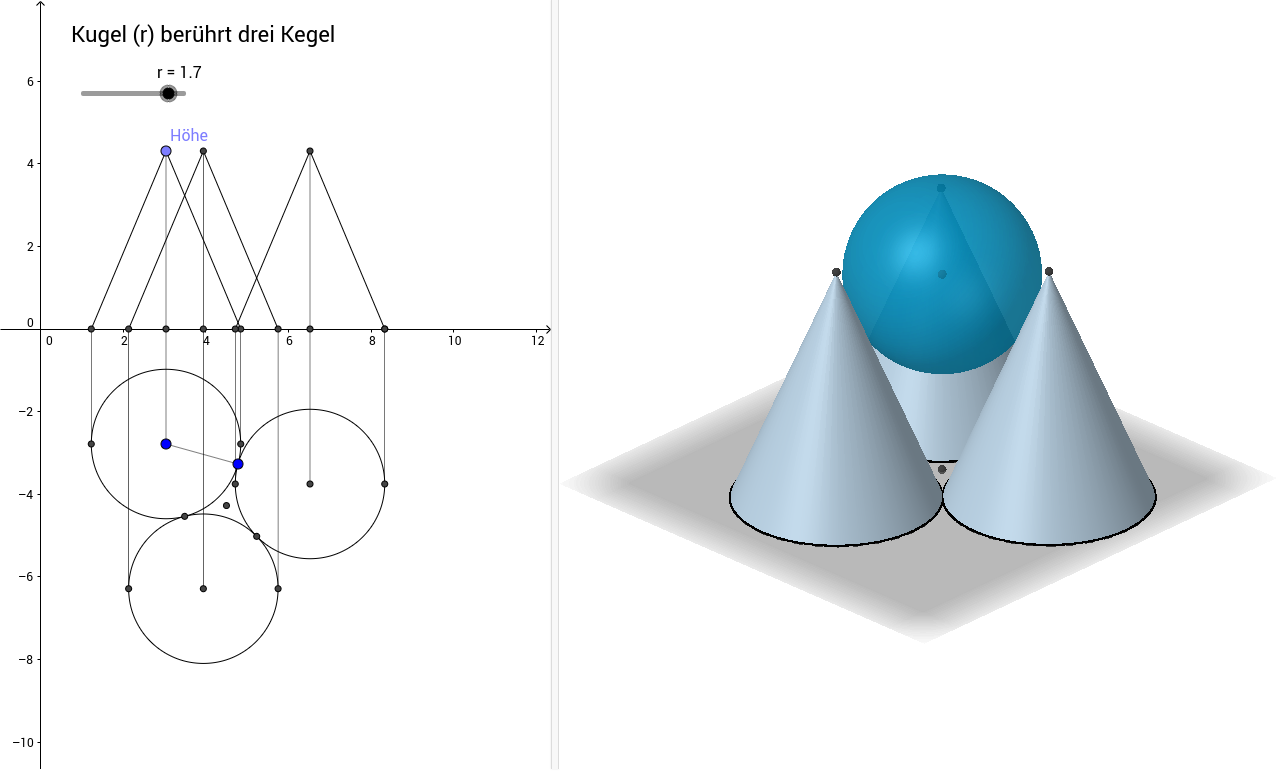
This example demonstrates the geometric relationship formed by a sphere touching three cones. It involves core mathematical concepts such as sphere, cone, tangent, midpoint, perpendicular line, intersection point, etc. The construction uses commands and objects like Circle, Line, Intersect, Midpoint, OrthogonalLine, Point, Segment, Center, Cone, Sphere as per the summary. Suitable for high school solid geometry teaching and geometric construction practice.
GeoGebra Commands & Parameters
Circle(A, B) → cCircle(B, A) → dLine(A, B) → fIntersect(d, f, 2) → DCircle(D, B) → eCircle(D, A) → gCircle(A, D) → hIntersect(g, h, 1) → CMidpoint(C, A) → ECircle(C, E) → kOrthogonalLine(A, xAxis) → iOrthogonalLine(D, xAxis) → jOrthogonalLine(C, xAxis) → lIntersect(e, k, 1) → FPoint(i) → GOrthogonalLine(G, i) → mIntersect(l, m) → HIntersect(j, m) → IIntersect(i, xAxis) → JIntersect(l, xAxis) → KIntersect(j, xAxis) → LCircle(J, Segment[B, A]) → pCircle(K, Segment[B, A]) → qCircle(L, Segment[B, A]) → r_2Intersect(r_2, xAxis, 2) → MIntersect(q, xAxis, 2) → NIntersect(p, xAxis, 1) → OIntersect(q, xAxis, 1) → PIntersect(p, xAxis, 2) → QIntersect(r_2, xAxis) → R, SSegment(O, G) → nSegment(G, Q) → sSegment(P, H) → tSegment(H, N) → aSegment(R, I) → bSegment(I, M) → f_1Segment(G, A) → g_1Segment(H, C) → h_1Segment(I, D) → i_1OrthogonalLine(M, xAxis) → j_1OrthogonalLine(R, xAxis) → k_1Intersect(e, k_1, 1) → TIntersect(e, j_1, 1) → USegment(M, U) → l_1Segment(R, T) → m_1OrthogonalLine(N, xAxis) → n_1OrthogonalLine(P, xAxis) → p_1Intersect(k, p_1, 1) → VIntersect(k, n_1, 1) → WSegment(N, W) → q_1Segment(P, V) → r_1OrthogonalLine(O, xAxis) → s_1OrthogonalLine(Q, xAxis) → t_1Intersect(c, s_1, 1) → ZIntersect(c, t_1, 1) → A_1Segment(O, Z) → a_1Segment(Q, A_1) → b_1Circle(A, C, D) → c_1Center(c_1) → B_1Segment(F_1, C_1) → d_1Circle(d_1, G_1) → e_1Segment(A, B) → f_2Cone(C_1, F_1, f_2) → o, c_2, uSegment(H_1, E_1) → g_2Cone(E_1, H_1, f_2) → v, d_2, wSegment(I_1, D_1) → h_2Cone(D_1, I_1, f_2) → o_1, e_2, u_1OrthogonalLine(J_1, xOyPlane) → i_2Segment(B_1, D) → j_2Line(D, xAxis) → k_2Circle(D, B_1) → p_2Intersect(p_2, k_2, 2) → K_1OrthogonalLine(K_1, k_2) → l_2Intersect(l_2, xAxis) → L_1OrthogonalLine(M, f_1) → m_2Circle(M, r) → q_2Intersect(q_2, m_2, 2) → M_1OrthogonalLine(M_1, m_2) → n_2Intersect(l_2, n_2) → N_1Sphere(O_1, r) → v_1
AI Drawing Prompt Reference
Draw a sphere touching three cones to demonstrate their geometric relationship. Start by drawing two intersecting circles and find their intersection points. Use these points to construct additional circles and lines. Identify the intersection points of the circles with lines to determine the contact points of the sphere. Draw perpendicular lines to the x-axis to locate key points and connect them to form the tangent lines between the sphere and cones. Finally, connect the points with line segments to complete the geometric figure of the sphere touching three cones.
The prompt above was compiled from the original drawing commands and is for reference only.