
Sphere - Tetrahedron - Sphere: Combination of Solid Figures
Loading the math board and drawing, please wait…
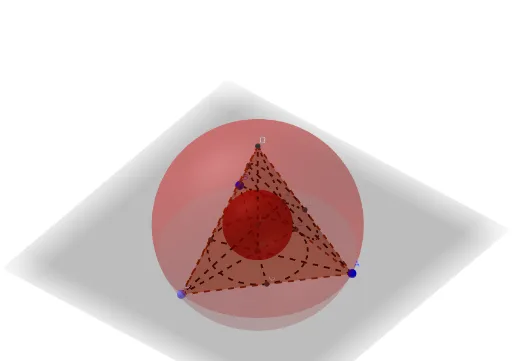
① This example demonstrates a geometric construction combining a sphere, a regular tetrahedron, and another sphere, showing how polyhedra and curved surfaces can be nested or related in 3D space. ② Core mathematical concepts include vertices, edges, and faces of a tetrahedron, sphere centers and surfaces, midpoints, and centroids (barycenters); it illustrates relationships such as inscribed or circumscribed spheres relative to the tetrahedron. ③ Construction details: using GeoGebra commands Point (creating A, B, C), Tetrahedron (generating the solid), Midpoint (for edge midpoints), Segment (for edges), Intersect (for intersection points), Circle and Sphere (for circles and spheres); objects include the four faces (граньABC, etc.), six edges (реброAC, etc.), midpoints E, F, G, auxiliary points H, I, J, K, L, circles c, i, j, k, d, and spheres b, e. ④ Suitable for high school or college solid geometry lessons, to explore combinations of tetrahedra and spheres, inscribed/circumscribed sphere concepts, and as a GeoGebra 3D construction exercise.
GeoGebra Commands & Parameters
Point(Circle[Midpoint[A, B], (Distance[A, B] * sqrt(3) / 2), Segment[A, B]]) → CTetrahedron(A, B, C) → a, D, реброCD, реброBD, граньABC, граньACD, граньABD, граньBCD, реброAC, реброAB, реброBC, реброADMidpoint(A, B) → EMidpoint(B, C) → FMidpoint(C, A) → GSegment(B, G) → fSegment(C, E) → gSegment(A, F) → hIntersect(h, f) → HCircle(G, F, E) → cSegment(H, D) → iMidpoint(D, B) → ISegment(A, I) → jSegment(D, E) → kMidpoint(D, A) → JSegment(B, J) → lIntersect(l, k) → KCircle(E, I, J) → dSegment(K, C) → mIntersect(m, i) → LSphere(L, H) → bSphere(L, C) → e