
Solving Quadratic Equations with Mapping Diagrams (Real and Complex)
Loading the math board and drawing, please wait…
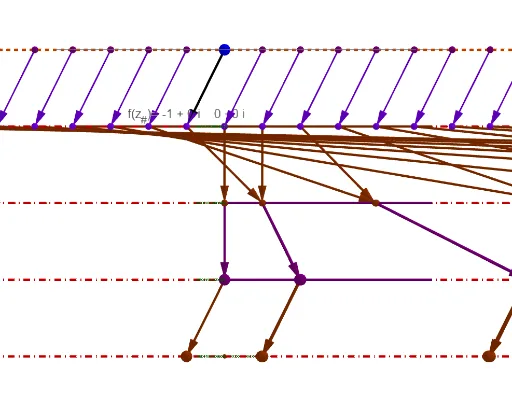
This example uses mapping diagrams to solve quadratic equations, including both real and complex solutions. Key mathematical concepts include the roots of quadratic equations and their correspondence in mapping diagrams. Using GeoGebra commands like If, Sequence, and Zip, the example dynamically illustrates the properties of the solutions. Suitable for high school mathematics education and learning quadratic equation solutions.
GeoGebra Commands & Parameters
If(RorC ≟ 2, w_C, w_R) → wIf(RorC ≟ 2, k_C, k_R) → kIf(RorC ≟ 2, h_C, h_R) → hIf(RorC ≟ 2, A_C, A_R) → ASequence(0, n) → M_1Zip(((2 * π) * k / n), k, M_1) → t_*Zip((δ * ℯ^((t * ί))) + z_#, t, t_*) → z_cZip(z_# + ((t - π) * (P_l - z_#)), t, t_*) → z_lLine(z_#, P_l) → lCircle(z_#, δ) → cPoint(c) → PcIf(m ≟ 1, z_c, z_l) → z_*Zip(s1(z), z, z_*) → fz_*Line(O, ZY1) → Im_{axis}Line(O, ZX1) → Real_{axis}Vector(z_#, fz1_#) → vecf_#Textfield(F) → InputBox1Zip((x(z), y(z), ht), z, fz_*) → fpt_*Zip(Vector[z, w], z, z_*, w, fpt_*) → fvec_*Locus(Pts1Pc, Pc) → loc_cPoint(l) → PlLocus(Pts1Pl, Pl) → loc_lLine((x(O2), y(O2), z(O2)), Vector[(1, 0, 0)]) → Real_{axis2}Line((x(O2), y(O2), z(O2)), Vector[(0, 1, 0)]) → Im_{axis2}Zip(g(s1(z)), z, z_*) → gfz_*Zip((x(z), y(z), (2 * ht)), z, gfz_*) → gfpt_*Zip(Vector[z, w], z, fpt_*, w, gfpt_*) → gfvec_*Locus(Ptgs1Pc, Pc) → loc2_cTextfield(G) → InputBox2Sequence(n_p) → NpZip(z = (ht * k), k, Np) → PlanesZip(mf(g(s1(z))), z, z_*) → Agfz_*Zip((x(z), y(z), (3 * ht)), z, Agfz_*) → Agfpt_*Zip(Vector[z, w], z, gfpt_*, w, Agfpt_*) → Agfvec_*Zip(s2(mf(SQ(s1(z)))), z, z_*) → kAgfz_*Zip((x(z), y(z), (4 * ht)), z, kAgfz_*) → kAgfpt_*Zip(Vector[z, w], z, Agfpt_*, w, kAgfpt_*) → kAgfvec_*Locus(PtAgs1Pc, Pc) → Loc3_cLocus(Pts2Ags1Pc, Pc) → Loc4_cLocus(Ptgs1Pl, Pl) → loc2_lLocus(PtAgs1Pl, Pl) → Loc3_lLocus(Pts2Ags1Pl, Pl) → Loc4_lVector(B3, Is2B3) → uVector(Is2B3, IAIs2B3) → vVector(IAIs2B3, SQRNIAIs2B3) → bVector(SQRPIAIs2B3, Is1SQRPIAIs2B) → eVector(SQRNIAIs2B3, Is1SQRNIAIs2B) → dPoint(Planes) → BVector(IAIs2B3, SQRPIAIs2B3) → aZip((0, 0, (ht * k)), k, Np) → OsZip(Line[p, Vector[(1, 0, 0)]], p, Os) → AxesxZip(Line[p, Vector[(0, 1, 0)]], p, Os) → Axesy