
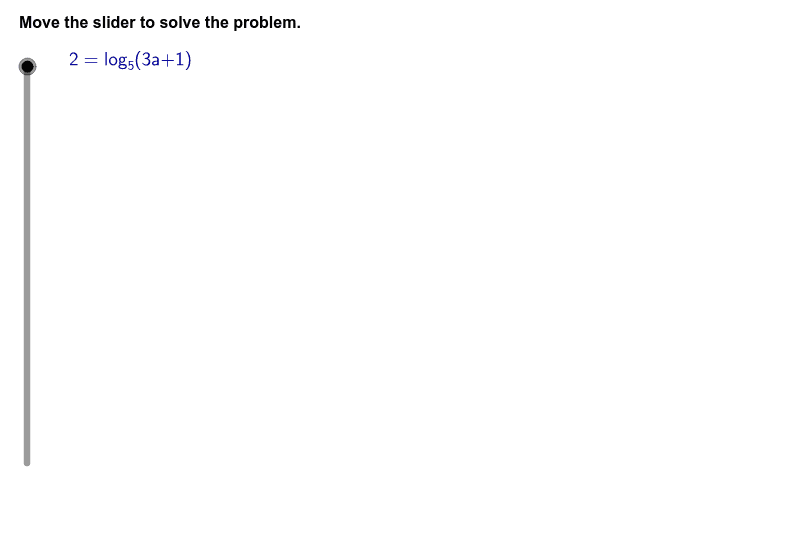
Solving Logarithmic Equation 2 = log₅(3a+1) for a
Loading the math board and drawing, please wait…
In collections
CCGPS AA Unit 4 Lesson 2
① This example demonstrates solving the logarithmic equation 2 = log₅(3a+1) for a by applying the definition of logarithms to rewrite it in exponential form. ② Core mathematical concepts include logarithmic functions, conversion between logarithmic and exponential forms, and solving a linear equation in one variable. ③ Construction highlights: LaTeX for formula rendering, Sequence to generate step‑by‑step sequences, Text and TableText for dynamic annotations, If for conditional logic, and objects such as const1, const2, problem, exponent, expression, base, stepmax, stepper, steps, align, power, logeqn, a, geneqn, powereqn, answer to build an interactive solution workflow. ④ Suitable for high‑school algebra or pre‑calculus courses as a teaching demo and self‑practice tool.
GeoGebra Commands & Parameters
LaTeX((((("{" * Element[const1, problem]) * "}\text{a+}{") * Element[const2, problem]) * "}")) → expressionSequence(x = a, a, -7, -4, 0.5) → alignText("Move the slider to solve the problem.") → text0LaTeX((((((("{" * Element[exponent, problem]) * "}=\log_{") * Element[base, problem]) * "}\left( {") * expression) * "}\right)")) → logeqnLaTeX("y=\log_{b} {x}") → geneqnLaTeX("\text{Determine values for }\textcolor{#000099}\text{b}\text{, }\textcolor{#000099}\text{x}\text{, and }\textcolor{#000099}\text{y}\text{ from the logarithmic equation.}") → text1LaTeX((("\text{The general form of a logarithmic equation is }\textcolor{#000099}{" * geneqn) * "}\text{, where }\textcolor{#000099}\text{b}\text{ is the}\cr \text{base, }\textcolor{#000099}\text{x}\text{ is the argument, and }\textcolor{#000099}\text{y}\text{ is the logarithm of }\textcolor{#000099}\text{x}\text{ to the base }\textcolor{#000099}\text{b}\text{.}")) → text2LaTeX("b^y=x") → genexpeqnLaTeX((("\text{Write the exponential equation in the form of }\textcolor{#000099}{" * genexpeqn) * "}\text{ from the values in}\cr \text{the original problem.}")) → text4LaTeX("\text{Solve the exponential equation for }\textcolor{#000099}\text{a}\text{.}") → text7LaTeX((((("\text{The logarithmic equation }\textcolor{#000099}{" * geneqn) * "}\text{ is equivalent to the exponential}\cr\text{equation }\textcolor{#000099}{") * genexpeqn) * "}\text{. Therefore, substitute the determined values for }\textcolor{#000099}\text{b}\text{, }\textcolor{#000099} \text{x}\text{,}\cr\text{and }\textcolor{#000099}\text{y}\text{ into the exponential form.}")) → text5LaTeX("\text{Use the buttons below to return to the original problem or}\cr \text{randomly generate a similar practice problem.}") → text11LaTeX((((((("{" * Element[base, problem]) * "}^{") * Element[exponent, problem]) * "}={") * expression) * "}")) → powereqnLaTeX((((("\text{The logarithmic function }\textcolor{#000099}{" * logeqn) * "}\text{ is equivalent to the}\cr\text{exponential equation }\textcolor{#000099}{") * powereqn) * "}.")) → text6LaTeX((("\text{The exponential equation }\textcolor{#000099}{{" * powereqn) * "}}\text{ can be solved for }\textcolor{#000099}\text{a}\text{ using}\cr \text{algebraic techniques.}")) → text8LaTeX((((("{" * Element[power, problem]) * "}={") * expression) * "}")) → sqrdpowereqnLaTeX((((("{" * Element[minusconst2, problem]) * "}={") * Element[const1, problem]) * "}\text{a}")) → minuspowereqnIf(Element[exponent, problem] ≟ 2, LaTeX[(("\text{Square }\textcolor{#000099}{" * Element[base, problem]) * "}.")], If[Element[exponent, problem] ≟ 3, LaTeX[(("\text{Cube }\textcolor{#000099}{" * Element[base, problem]) * "}.")], If[Element[exponent, problem] ≟ 4, LaTeX[(("\text{Raise }\textcolor{#000099}{" * Element[base, problem]) * "}\text{ to the fourth power.}")], LaTeX[(("\text{Raise }\textcolor{#000099}{" * Element[base, problem]) * "}\text{ to the fifth power.}")]]]) → powerwordLaTeX((((("\text{In the logarithmic equation }\textcolor{#000099}{" * logeqn) * "}\text{, }\textcolor{#000099}{\text{a = }{") * Element[answer, problem]) * "}}\text{.}")) → text10LaTeX((("\textcolor{#000099}{" * logeqn) * "}")) → problemtextLaTeX((((((((("\text{In the function }\textcolor{#000099}{" * logeqn) * "}\text{, }\textcolor{#000099}\text{b = }\textcolor{#000099}{") * Element[base, problem]) * "}\text{, }\textcolor{#000099}\text{x = }\textcolor{#000099}{") * expression) * "}\text{, and }\textcolor{#000099}\text{y = }\textcolor{#000099}{") * Element[exponent, problem]) * "}.")) → text3TableText({{LaTeX[(("\textcolor{#000099}{ {" * powereqn) * "} }")], LaTeX["Exponential \, equation"]}, {LaTeX[(("\textcolor{#000099} {" * sqrdpowereqn) * "}")], LaTeX[(("{" * powerword) * "}")]}, {LaTeX[(("\textcolor{#000099}{" * minuspowereqn) * "}")], LaTeX[(("\text{Subtract }\textcolor{#000099}{" * Element[const2, problem]) * "}\text{ from both sides.}")]}, {LaTeX[(("\textcolor{#000099}{{" * Element[answer, problem]) * "}\text{ = a}}")], LaTeX[(("\text{Divide both sides by }\textcolor{#000099}{" * Element[const1, problem]) * "}.")]}}) → text9
AI Drawing Prompt Reference
Create a graphic demonstrating the solution of a logarithmic equation, featuring a logarithmic function graph and dynamic annotations. Start with the equation 2 = log₅(3a+1), then convert it to the exponential form b^y = x using the definition of logarithms, and explain the conversion and solving steps sequentially. Include a slider to dynamically adjust parameter a, with step-by-step textual explanations showing the process of converting from logarithmic to exponential form, solving the linear equation, and arriving at the final answer. The graphic should incorporate the function graph, textual annotations, and a step-by-step table to clearly illustrate the problem-solving workflow.
The prompt above was compiled from the original drawing commands and is for reference only.