
Solving First Degree Equations
Loading the math board and drawing, please wait…
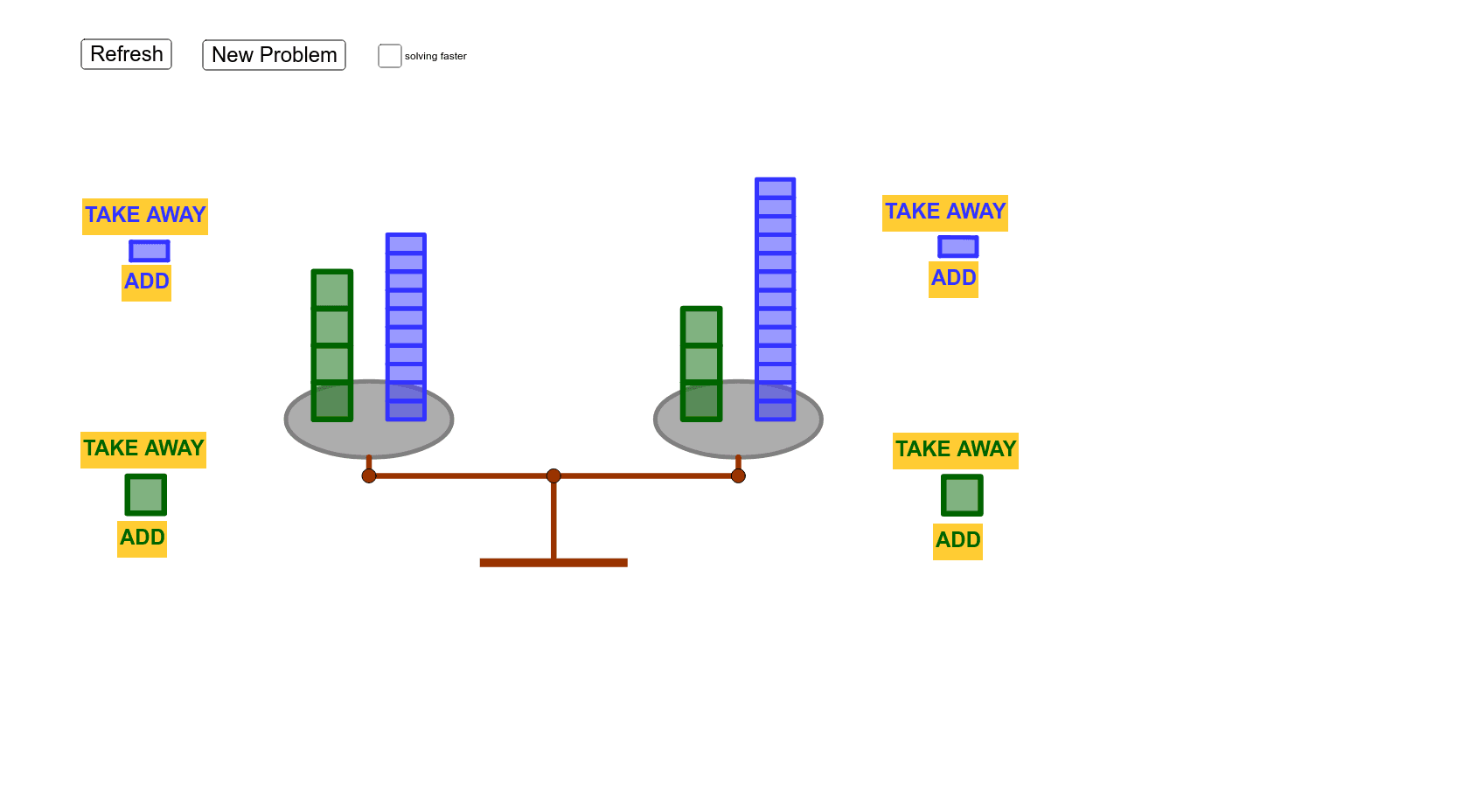
This example demonstrates solving first degree equations through subtraction. Key mathematical concepts include the solution methods for first degree equations. It uses commands like If, Ellipse, Segment, Intersect, Point, Polygon, Midpoint, Sequence, and Textfield in GeoGebra. Suitable for middle school mathematics education.
GeoGebra Commands & Parameters
If((u * UL) + L ≟ (u * UR) + R, 0, If[(u * UL) + L ≥ (u * UR) + R, -1, 1]) → BEllipse((-3, B), (-7, B), 2.25) → cEllipse((3, (-B)), (7, (-B)), 2.25) → dSegment((-5, B), (-5, -3)) → aIntersect(c, a) → A,Segment((5, (-B)), (5, -3)) → bIntersect(d, b) → C,Segment(A, A') → eSegment(C, C') → fSegment(A', C') → gIntersect(yAxis, g) → DPoint(yAxis) → EPolygon((10.455803599971945, 4.428079038697364), (11.45154195318282, 4.426628459182624), (11.45154195318282, 4.926628459182623), (10.455803599971945, 4.928079038697364)) → poly2, i, j, k, mSegment(D, E) → hPolygon(F, G, H, I) → poly3, f_1, g_1, h_1, i_1Midpoint(J, M) → OSequence(Polygon[(-4.5, B - 0.5 + t / 2), (-3.5, B - 0.5 + t / 2), (-3.5, B + t / 2), (-4.5, B + t / 2)], t, 1, L, 1) → list1Polygon((-11.445852088028492, 4.308916490437969), (-10.445852088028493, 4.308916490437969), (-10.445852088028493, 4.8089164904379675), (-11.445852088028492, 4.8089164904379675)) → poly4, n, p, q, sPolygon((-10.543680266275816, -2.544527077316755), (-10.543680266275816, -1.5445270773167552), 4) → poly1Polygon((11.557939744940192, -2.5558711836942214), (11.557939744940192, -1.5558711836942218), 4) → poly1_3Polygon((-10.806626137271166, 7.362992675821548), (-9.806626137271168, 7.362992675821548), (-9.806626137271168, 7.8629926758215465), (-10.806626137271166, 7.8629926758215465)) → poly4_1, n_1, p_1, q_1, s_1Polygon((-10.806626137271166, 7.362992675821548), (-9.806626137271168, 7.362992675821548), (-9.806626137271168, 7.8629926758215465), (-10.806626137271166, 7.8629926758215465)) → poly4_2, n_2, p_2, q_2, s_2Sequence(Polygon[(-6.5, B - 1 + t), (-5.5, B - 1 + t), 4], t, 1, UL, 1) → list3Sequence(Polygon[(3.5, (-B) - 1 + t), (4.5, (-B) - 1 + t), 4], t, 1, UR, 1) → list4Sequence(Polygon[(5.5, (-B) - 0.5 + t / 2), (6.5, (-B) - 0.5 + t / 2), (6.5, (-B) + t / 2), (5.5, (-B) + t / 2)], t, 1, R, 1) → list2Textfield(fml) → input_fmlTextfield(fmr) → InputBox1Textfield(fmul) → InputBox2Textfield(fmur) → InputBox3