
First Degree Equation with Geometric Integration (Level 4)
Loading the math board and drawing, please wait…
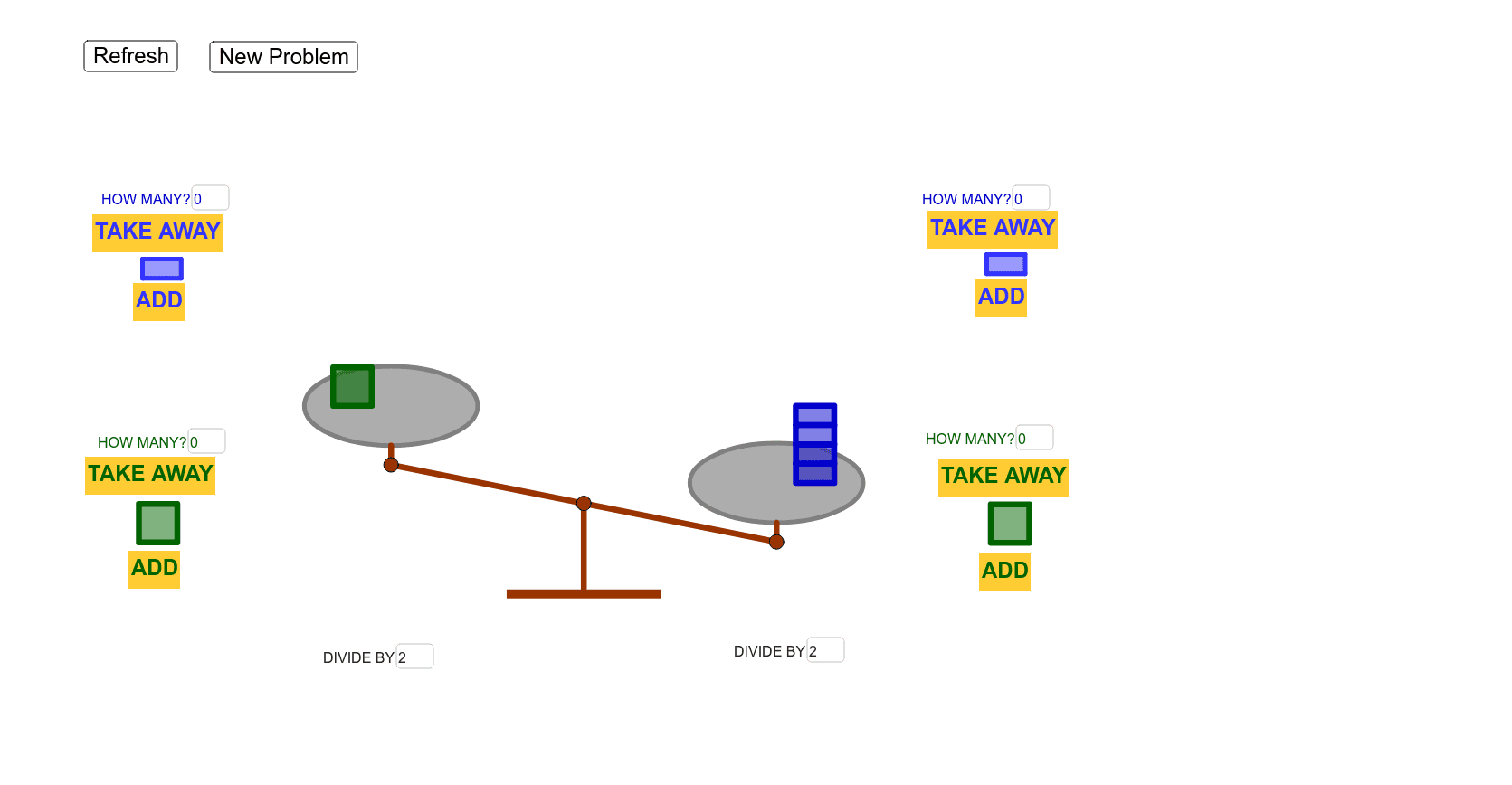
This GeoGebra example demonstrates solving first-degree equations (linear equations) in a dynamic geometry environment, integrating algebraic concepts with geometric figures. It involves core mathematical ideas such as linear equations, polygons, ellipses, conic sections, and perimeter calculations. The construction uses commands like Point, Polygon, Random, Textfield, If, Ellipse, Segment, Intersect, and Sequence to create multiple polygons (poly1, poly2, poly3, poly4), ellipses (f_1, etc.), text labels, and interactive buttons (Refresh, NewProblem) that generate random problems and link equations to visual shapes. Suitable for middle school to high school students for practicing equation solving and geometry, and useful for teachers in classroom demonstrations or for self-paced learning.
GeoGebra Commands & Parameters
Point(yAxis) → EPolygon((10.455803599971945, 4.428079038697364), (11.45154195318282, 4.426628459182624), (11.45154195318282, 4.926628459182623), (10.455803599971945, 4.928079038697364)) → poly2, i, j, k, mPolygon(F, G, H, I) → poly3, f_1, g_1, h_1, i_1Polygon((-11.445852088028492, 4.308916490437969), (-10.445852088028493, 4.308916490437969), (-10.445852088028493, 4.8089164904379675), (-11.445852088028492, 4.8089164904379675)) → poly4, n, p, q, sPolygon((-10.543680266275816, -2.544527077316755), (-10.543680266275816, -1.5445270773167552), 4) → poly1Polygon((11.557939744940192, -2.5558711836942214), (11.557939744940192, -1.5558711836942218), 4) → poly1_3Random(1, 5) → uRandom(2, 5) → ul1Random(1, 5) → lRandom(1, 5) → urTextfield(fml) → InputBox1Textfield(fmr) → InputFMRTextfield(fmul) → InputFMULTextfield(fmur) → InputFMURTextfield(dl) → InputBoxdlTextfield(dr) → InputdrIf((u * UL) + L ≟ (u * UR) + R, 0, If[(u * UL) + L ≥ (u * UR) + R, -1, 1]) → BIf((u_2 * UL_2) ≟ R_2, 0, If[(u_2 * UL_2) ≥ R_2, -1, 1]) → B_2If((u_3 * UL_3) ≟ R_3, 0, If[(u_3 * UL_3) ≥ R_3, -1, 1]) → B_3If((u_1 * UL_1) ≟ R_1, 0, If[(u_1 * UL_1) ≥ R_1, -1, 1]) → B_1If((u_4 * UL_4) ≟ R_4, 0, If[(u_4 * UL_4) ≥ R_4, -1, 1]) → B_4Ellipse((-3, B), (-7, B), 2.25) → c_1Ellipse((3, (-B)), (7, (-B)), 2.25) → d_1Segment((-5, B_4), (-5, -3)) → a_1Intersect(c_1, a_1) → A_1,Segment((5, (-B_4)), (5, -3)) → b_1Intersect(d_1, b_1) → C_1,Segment(A_1, A'_1) → e_1Segment(C_1, C'_1) → f_2Segment(A'_1, C'_1) → g_2Intersect(g_2, yAxis) → ASegment(A, C) → bSequence(Polygon[(-6.5, B - 1 + t), (-5.5, B - 1 + t), 4], t, 1, UL, 1) → list1Sequence(Polygon[(5.5, (-B) - 0.5 + t / 2), (6.5, (-B) - 0.5 + t / 2), (6.5, (-B) + t / 2), (5.5, (-B) + t / 2)], t, 1, R, 1) → list2Sequence(Polygon[(-4.5, B - 0.5 + t / 2), (-3.5, B - 0.5 + t / 2), (-3.5, B + t / 2), (-4.5, B + t / 2)], t, 1, L, 1) → list3Sequence(Polygon[(3.5, (-B) - 1 + t), (4.5, (-B) - 1 + t), 4], t, 1, UR, 1) → list4