
Solve Quadratic Equations Using the Quadratic Formula (Interactive GeoGebra)
Loading the math board and drawing, please wait…
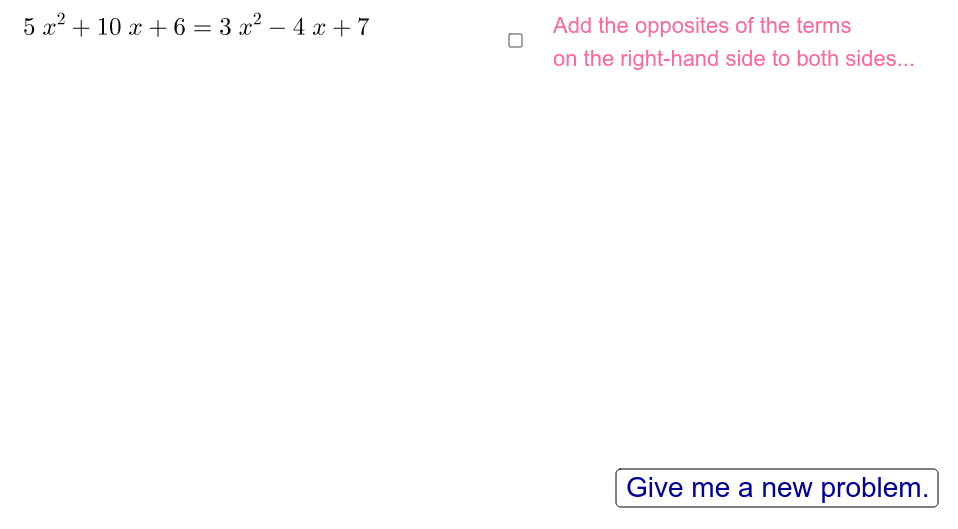
① This GeoGebra example demonstrates how to solve quadratic equations using the quadratic formula, with interactive controls that show how changing coefficients affects the roots. ② The core mathematical concepts include the standard form ax²+bx+c=0, the discriminant Δ=b²-4ac, and the quadratic formula x=(-b±√Δ)/(2a), covering both real and complex roots. ③ Construction highlights: the Random command generates random coefficients a, b, c; the If command checks the sign of the discriminant to compute real or complex roots; multiple text objects (text1 to text21) display the equation, discriminant, roots, and solution steps; a button (button1) regenerates a random equation; sliders or input fields (s1, s2, etc.) allow manual coefficient adjustment; objects l, l1, l2, l3 store roots or intermediate results, while nr, nr1 etc. hold numeric outputs. ④ Suitable for upper middle school to high school students and math teachers for classroom demonstrations or self-study, reinforcing the quadratic formula, discriminant analysis, and the geometric interpretation of roots.
GeoGebra Commands & Parameters
Random(1, 10) → l2Random(4, 6) → l3Random(5, 7) → l1Random(-10, -1) → r2Random(2, 3) → r1Random(7, 10) → r3If((abs(s1 - s3) < 0.005) ∨ (abs(s1 - s4) < 0.005) ∧ ((di > 0.005) ∨ (dj > 0.005)), true, false) → trIf((abs(s1 - s3) < 0.005) ∨ (abs(s1 - s4) < 0.005), true, false) → tr1If((abs(s1 - s3) > 0.005) ∨ (abs(s1 - s4) > 0.005), true, false) → tr2If(tr1 ∧ tr2, true, false) → tr3If((abs(s2 - s3) < 0.005) ∨ (abs(s2 - s4) < 0.005), true, false) → tr4If((abs(s2 - s4) > 0.005) ∨ (abs(s2 - s3) > 0.005), true, false) → tr5If(tr4 ∧ tr5, true, false) → tr6If(tr3 ∧ tr6, true, false) → tr7
AI Drawing Prompt Reference
Draw a quadratic equation graph ax²+bx+c=0, where a, b, and c are randomly generated integers in the ranges 1-10, 4-6, and 5-7 respectively. Use the quadratic formula x=(-b±√(b²-4ac))/(2a) to calculate the roots, and display real or complex roots based on the discriminant Δ=b²-4ac. Add sliders to adjust the values of a, b, and c and observe the changes in the roots.
The prompt above was compiled from the original drawing commands and is for reference only.