
Solutions to Linear Equations in Two Variables
Loading the math board and drawing, please wait…
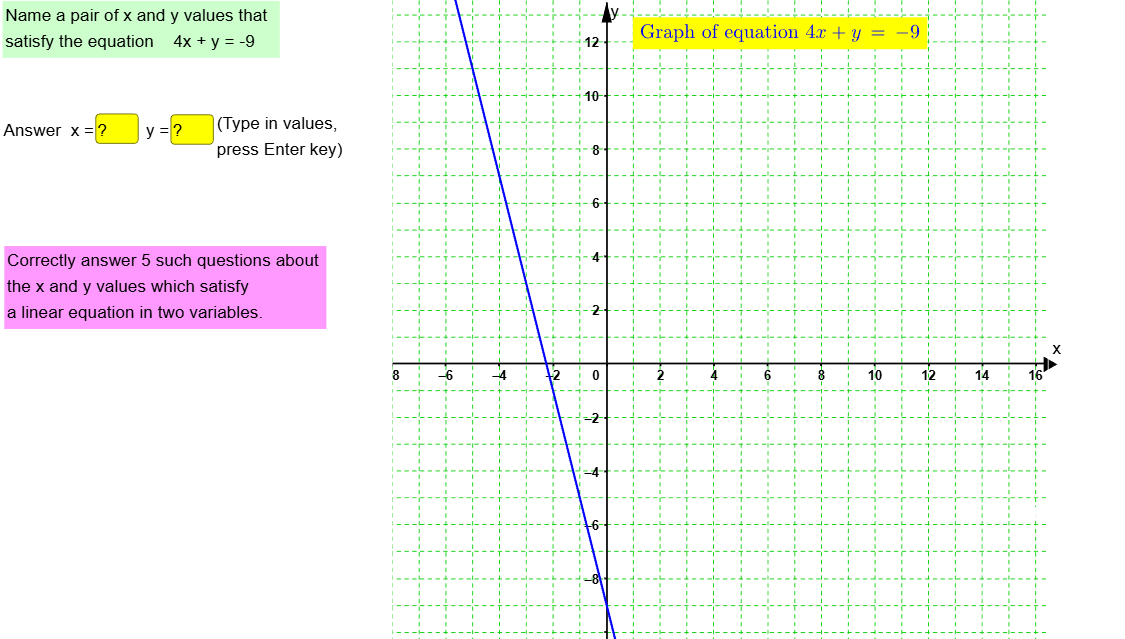
This example demonstrates finding the x and y values that satisfy a given linear equation in two variables. Key mathematical concepts include linear equations and their solutions. GeoGebra commands such as TextToUnicode, If, and IndexOf are used for numerical processing and equation solving. Suitable for middle school and above students.
GeoGebra Commands & Parameters
TextToUnicode(usertxtanswery) → listdigitsyIndexOf(46, listdigitsy) → yindexofdecimalpointIndexOf(47, listdigitsy) → yindexofdivisorIf(Element[listdigitsy, 1] ≟ 45, 2, 1) → ystartindexIf(Defined[IndexOf[32, listdigitsy]], IndexOf[32, listdigitsy], ystartindex - 1) → yindexofspaceIf(Defined[yindexofdivisor], Sum[(If[Element[listdigitsy, 1] ≟ 45, -1, 1] * Sequence[((Element[listdigitsy, i] - 48) * 10^(yindexofspace - 1 - i)), i, ystartindex, yindexofspace - 1])], If[Defined[yindexofdecimalpoint], (If[Element[listdigitsy, 1] ≟ 45, -1, 1] * Sum[Sequence[((Element[listdigitsy, i] - 48) * 10^(yindexofdecimalpoint - 1 - i)), i, ystartindex, yindexofdecimalpoint - 1]]), 0]) → ywholepartLength(listdigitsy) → ylengthlistdigitsSum(Sequence[((Element[listdigitsy, i] - 48) * 10^(ylengthlistdigits - i)), i, ydenomstartindex, ylengthlistdigits]) → ydenomIf(Defined[yindexofdivisor], ynumer / ydenom, If[Defined[yindexofdecimalpoint], (If[Element[listdigitsy, 1] ≟ 45, -1, 1] * Sum[Sequence[((Element[listdigitsy, i] - 48) * 10^(ylengthlistdigits - i)), i, yindexofdecimalpoint + 1, ylengthlistdigits]] / 10^(ylengthlistdigits - yindexofdecimalpoint)), 0]) → ydecimalpartTextToUnicode(usertxtanswerx) → listdigitsxIndexOf(46, listdigitsx) → xindexofdecimalpointIf(Element[listdigitsx, 1] ≟ 45, 2, 1) → xstartindexIf(Defined[IndexOf[32, listdigitsx]], IndexOf[32, listdigitsx], xstartindex - 1) → xindexofspaceLength(listdigitsx) → xlengthlistdigitsIndexOf(47, listdigitsx) → xindexofdivisorSum(Sequence[((Element[listdigitsx, i] - 48) * 10^(xlengthlistdigits - i)), i, xdenomstartindex, xlengthlistdigits]) → xdenomIf(Defined[xindexofdivisor], xnumer / xdenom, If[Defined[xindexofdecimalpoint], (If[Element[listdigitsx, 1] ≟ 45, -1, 1] * Sum[Sequence[((Element[listdigitsx, i] - 48) * 10^(xlengthlistdigits - i)), i, xindexofdecimalpoint + 1, xlengthlistdigits]] / 10^(xlengthlistdigits - xindexofdecimalpoint)), 0]) → xdecimalpartIf(Defined[xindexofdivisor], Sum[(If[Element[listdigitsx, 1] ≟ 45, -1, 1] * Sequence[((Element[listdigitsx, i] - 48) * 10^(xindexofspace - 1 - i)), i, xstartindex, xindexofspace - 1])], If[Defined[xindexofdecimalpoint], (If[Element[listdigitsx, 1] ≟ 45, -1, 1] * Sum[Sequence[((Element[listdigitsx, i] - 48) * 10^(xindexofdecimalpoint - 1 - i)), i, xstartindex, xindexofdecimalpoint - 1]]), 0]) → xwholepartRandomElement({-1, 1, 2, -2, -3, 3, 4, -4, -1, 1, -2, 2, 5, -5, -1, 1}) → a_1RandomElement({0, -1, 1, 2, -2, -3, 3, 0, -1, 1, -2, 2, 4, -4, 0, -1, 1, -2, 2, 5, -5, 0, -1, 1, -2, 2}) → n_3RandomElement({-1, 0, 1, 2, -2, 0, -3, 3}) → x_gRandomElement({-1, 1, 2, -2, -3, 3, 4, -4, -1, 1, -2, 2, 5, -5, -1, 1}) → b_1If(Defined[xindexofdivisor], xdecimalpart + xwholepart, If[Defined[xindexofdecimalpoint], xdecimalpart + xwholepart, Sum[(If[Element[listdigitsx, 1] ≟ 45, -1, 1] * Sequence[((Element[listdigitsx, i] - 48) * 10^(xlengthlistdigits - i)), i, xstartindex, xlengthlistdigits])]]) → xuseranswerIf(Defined[yindexofdivisor], ydecimalpart + ywholepart, If[Defined[yindexofdecimalpoint], ydecimalpart + ywholepart, Sum[(If[Element[listdigitsy, 1] ≟ 45, -1, 1] * Sequence[((Element[listdigitsy, i] - 48) * 10^(ylengthlistdigits - i)), i, ystartindex, ylengthlistdigits])]]) → yuseranswerSimplify(If[-8 ≤ x ≤ 16, ((-(x(e_n) / y(e_n))) * x) - z(e_n) / y(e_n)]) → fSequence(abs(f(0) - (a_1 / b_1 * i) - round(f(0) - (a_1 / b_1 * i), 0)), i, 0, abs(b_1 - 1)) → listsearch1stinteger, {0}Sort(Sequence[xInty + (b_1 * i), i, -2, 2, 1]) → listxnoRandomElement({1, 2, 3, 4}) → shiftpostyJoin({{x}, listxno}) → listxRandomElement(Remove[{1, 2, 3, 4}, {shiftposty}]) → shiftpostxRemove(listx, {Element[listx, shiftpostx + 1]}) → listprexJoin({{y}, (m * listx) + d}) → listyRemove(listy, {Element[listy, shiftposty + 1]}) → listpreyInsert("p", listprey, shiftposty + 1) → listypostElement(listy, shiftposty + 1) → answerpElement(listx, shiftposty + 1) → x_pGCD({a_1, b_1, c_1}) → c_gInsert("q", listprex, shiftpostx + 1) → listxpostTableText({listxpost, listypost}, "c_|h") → txtTableValuesElement(listy, shiftpostx + 1) → y_qTextfield(usertxtanswerx) → InputBox1Textfield(usertxtanswery) → InputBox2Element(listx, shiftpostx + 1) → answerqMin(Min[listyno] - ((Max[listyno] - Min[listyno]) * 0.1), -2) → yMinMax(Max[listyno] + ((Max[listyno] - Min[listyno]) * 0.1), 2) → yMaxMin(Min[listxno] - ((Max[listxno] - Min[listxno]) * 0.2), -2) → xMinMax(Max[listxno] + ((Max[listxno] - Min[listxno]) * 0.2), 2) → xMaxPoint(e_n) → EPolygon((x(P_{xaxisarrow}), y(Corner[2])), Corner[2], (x(Corner[2]), y(Corner[4]) + 4), (x(P_{xaxisarrow}), y(Corner[4]) + 4)) → Whiteboxright, g, j, k, lPolygon(Corner[1], (-8, y(Corner[1])), (-8, y(Corner[4]) + 4), Corner[4] + 4) → Whiteboxleft, c, e, h, iVector(P_{feedbackanchor1}, P_{useranswer}) → pIf(abs(yuseranswer - f(xuseranswer)) < 0.0001, true, false) → answersbothcorrectCoordPointertoAxes7(E) → u, v, text3, text4, text5, text6, text7, A, BDefined(xindexofspace) → isMixedNumberIf(abs(yuseranswer - f(xuseranswer)) < 0.001, true, false) → yanswerapproxtrueforxSequence(Translate[badge, Vector[(0, 0), ((2 * j), 0)]], j, 1, score) → listbadgepicsIndexOf(Min[listynoabs], listynoabs) → listynominindexIf(Defined[Element[listyno, listynominindex + 1]], listynominindex + 1, listynominindex - 1) → listynochosenindexPathParameter(E) → a
AI Drawing Prompt Reference
Draw a coordinate system with multiple lines and their intersection points. Randomly generate coefficients for a set of linear equations, calculate and label the x and y values that satisfy these equations. Mark the intersection points on the coordinate system and include a table listing the corresponding x and y values. Adjust the axis range to clearly display all intersection points, ensuring the graph is suitable for middle school students to understand the solutions to linear equations.
The prompt above was compiled from the original drawing commands and is for reference only.