
Solution to Parallel Lines & Angles Problem by Tim Brzezinski
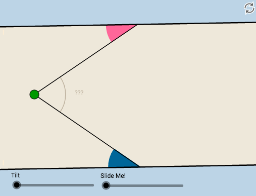
Loading the math board and drawing, please wait…
This example demonstrates the relationship between parallel lines and related angles, enhancing understanding of parallel line properties and angle bisector theorems through dynamic visualization. Core mathematical concepts include parallel line properties, angle bisector theorem, angle calculation, and coordinate geometry. GeoGebra commands and objects used in construction are Rotate, Angle, Line, OrthogonalLine, Intersect, PointIn, Segment, Min, Circle, CircleSector, Dilate, Vector, Translate, and CircleArc. Suitable for high school mathematics teaching and geometric construction learning.
GeoGebra Commands & Parameters
Rotate(B, α, A) → B'Angle(B, A, B') → βLine(A, B') → fLine(C, f) → gOrthogonalLine(C, f) → hIntersect(f, h) → DPointIn(d) → ESegment(C, E) → iSegment(E, D) → jMin(i, j) → kCircle(C, (0.25 * k)) → pCircle(D, (0.25 * k)) → qIntersect(q, f) → F, GIntersect(q, j) → H,Intersect(p, g) → I, JIntersect(p, i) → K,CircleSector(C, I, K) → rCircleSector(D, H, F) → sDilate(C, If[0 < m ≤ 1, 1 - m, 0], E) → C'Vector(C, C') → uTranslate(r, u) → r'Rotate(r', If[1 < m ≤ 2, ((m - 1) * π), π], E) → r''Dilate(D, If[2 < m ≤ 3, 3 - m, 0], E) → D'Vector(D, D') → vTranslate(s, v) → s'Rotate(s', If[3 < m ≤ 4, ((m - 3) * π), π], E) → s''Circle(E, (0.25 * k)) → tIntersect(t, j) → M,Intersect(t, i) → N,CircleArc(E, M, N) → c_1
AI Drawing Prompt Reference
Draw two parallel lines AB and CD with their angle relationships. First, rotate point B around point A by angle α to get B'. Then, calculate the angle ∠BAB' as β. Next, draw line f through points C and B', and draw line g through points C and f, then draw the perpendicular line h to f, intersecting at point D. Draw line segment DE through points D and E, calculate the minimum value k of DE, and draw circle p with center C and radius 0.25k, and draw circle q with center D and radius 0.25k, intersecting at points F and G, H and I, J and K. Then, draw circular arc C-I-K, D-H-F, perform a scaling transformation on C to get C', draw vector u, translate circular arc C' to get r', rotate r' to get r'', perform a scaling transformation on D to get D', draw vector v, translate circular arc D' to get s', rotate s' to get s'', and draw circular arc E-M-N with center E and radius 0.25k.
The prompt above was compiled from the original drawing commands and is for reference only.