
Parallel Line and Transversal Angle Exploration
Loading the math board and drawing, please wait…
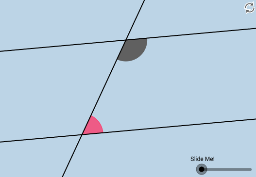
This example demonstrates the angle relationships formed by parallel lines and transversals, including properties of isosceles triangles. It involves core math concepts like angles, straight lines, derivatives, isosceles triangles, spheres, exponential functions, and medians. Construction highlights the use of GeoGebra commands such as Point, Rotate, Angle, Line, Circle, Intersect, CircleSector, Dilate, Vector, Translate, and CircleArc. Ideal for high school mathematics instruction and geometric construction exploration.
GeoGebra Commands & Parameters
Point(a) → BRotate(B, α, A) → B'Angle(B, A, B') → βLine(A, B') → bCircle(A, 1) → eIntersect(b, d) → CCircle(C, 1) → fIntersect(e, a) → D, EIntersect(e, b) → F, GIntersect(f, b) → H, IIntersect(f, d) → J, KCircleSector(C, K, I) → gCircleSector(C, I, J) → hCircleSector(C, J, H) → kCircleSector(C, H, K) → pCircleSector(A, E, G) → qCircleSector(A, G, D) → rDilate(A, If[0 < i < 1, 1 - i], C) → A'Vector(A, A') → uTranslate(q, u) → q'Translate(r, u) → r'CircleArc(A, E, G) → c_1CircleArc(A, G, D) → f_1